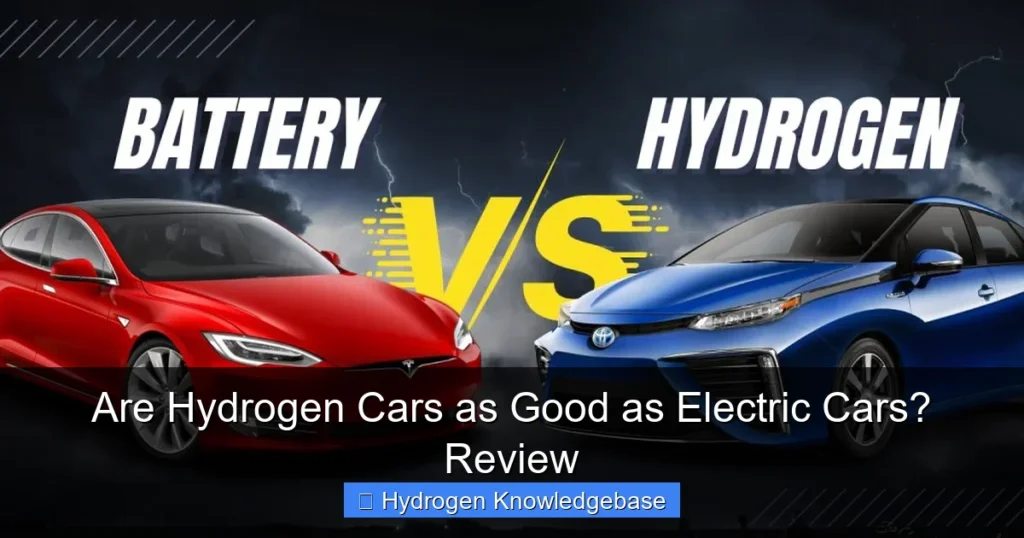
Hydrogen cars offer fast refueling and long range, but face infrastructure and cost challenges. While electric cars dominate today’s market with better efficiency and charging networks, hydrogen vehicles could shine in specific use cases like long-haul transport.
Key Takeaways
- Refueling Speed: Hydrogen cars refuel in 3–5 minutes, similar to gasoline, while EVs take 30+ minutes for fast charging.
- Range Comparison: Most hydrogen vehicles offer 300–400 miles per tank, rivaling many long-range EVs.
- Energy Efficiency: EVs convert 77–82% of grid energy to power; hydrogen cars only achieve 25–35% due to production and conversion losses.
- Infrastructure Gap: There are over 60,000 public EV chargers in the U.S., but fewer than 100 hydrogen refueling stations—mostly in California.
- Environmental Impact: Hydrogen is only “green” if made with renewable energy; most current production relies on natural gas.
- Cost and Availability: Hydrogen vehicles are expensive ($60,000+) and limited to models like the Toyota Mirai and Hyundai NEXO.
- Future Potential: Hydrogen may excel in heavy transport (trucks, buses) where batteries are too heavy or slow to charge.
Quick Answers to Common Questions
Can hydrogen cars charge at home?
No, hydrogen cars cannot be refueled at home. You must visit a public hydrogen station, which are rare outside California.
Do hydrogen cars produce emissions?
Hydrogen cars emit only water vapor while driving. However, most hydrogen is produced from natural gas, which creates CO₂ emissions upstream.
How long does it take to refuel a hydrogen car?
Refueling a hydrogen car takes 3–5 minutes, similar to gasoline, making it much faster than most EV fast charging.
Are hydrogen cars safe?
Yes, hydrogen cars are designed with multiple safety features, including leak detection and reinforced tanks. They undergo rigorous testing.
Can I drive a hydrogen car across the country?
Not easily. With fewer than 100 stations in the U.S.—mostly in California—long-distance travel is currently impractical.
📑 Table of Contents
Are Hydrogen Cars as Good as Electric Cars? A Head-to-Head Review
Imagine pulling up to a fuel station, filling your car in under five minutes, and driving 350 miles—all without a single drop of gasoline or a plug-in charge. That’s the promise of hydrogen fuel cell vehicles (FCEVs). But with electric vehicles (EVs) dominating headlines, charging networks expanding rapidly, and Tesla leading the charge, you might wonder: Are hydrogen cars really as good as electric cars?
The short answer? Not quite—yet. But it’s not because hydrogen technology is flawed. It’s because the ecosystem around it isn’t ready. Electric cars have had a decade-long head start in infrastructure, affordability, and public awareness. Hydrogen cars, while promising, are still in their infancy. That said, they’re not just a science experiment. Real-world models like the Toyota Mirai and Hyundai NEXO are on the road today, offering smooth, quiet, zero-emission driving.
So, which is better? It depends on what “better” means to you. If you value convenience, cost, and environmental impact, EVs currently win. But if you’re a long-haul driver, live in a region with hydrogen stations, or need quick refueling, hydrogen might surprise you. Let’s dive into the details and see how these two clean transportation technologies stack up.
How Hydrogen and Electric Cars Work
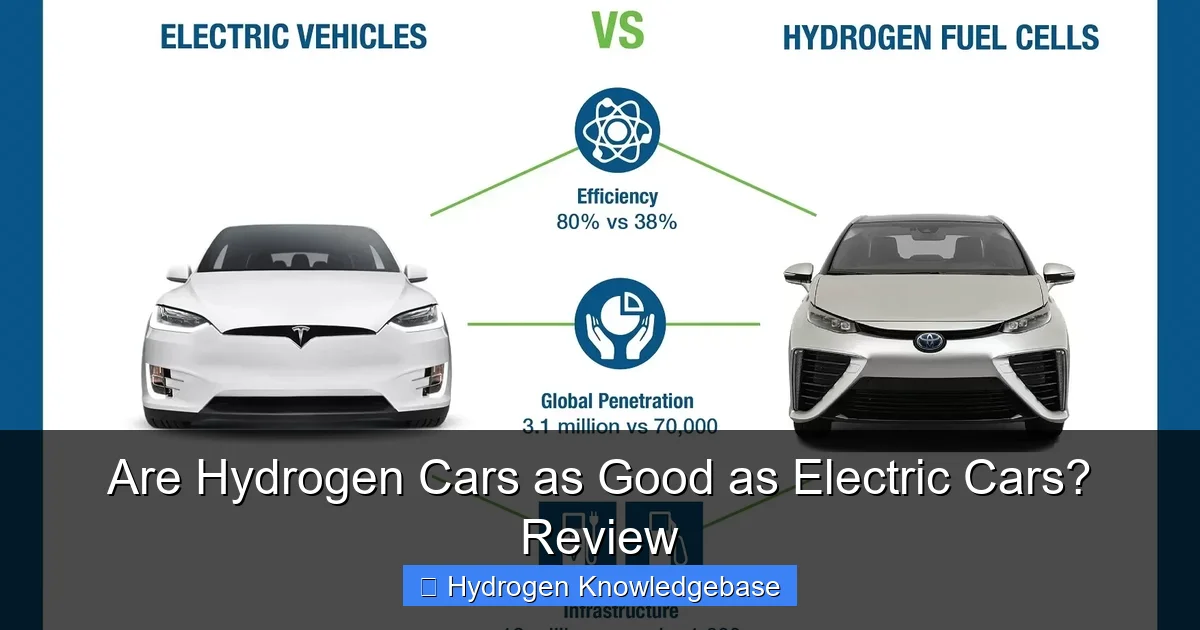
Visual guide about Are Hydrogen Cars as Good as Electric Cars? Review
Image source: static.wixstatic.com
Before comparing performance, it helps to understand how each vehicle type operates. Both are electric—meaning they use electric motors to drive the wheels—but they generate and store energy very differently.
Electric Vehicles: Battery-Powered Simplicity
Electric cars store energy in large lithium-ion batteries, much like your phone or laptop—just much bigger. When you plug in, electricity from the grid charges the battery. When you drive, the battery powers an electric motor. It’s a straightforward, efficient system.
For example, a Tesla Model 3 can store about 75 kWh of energy. Charging at home overnight is cheap and convenient. Fast chargers (like Tesla Superchargers) can add 200+ miles in 15–30 minutes. The simplicity of EVs is one reason they’ve become so popular—fewer moving parts, less maintenance, and instant torque.
Hydrogen Fuel Cell Vehicles: Chemistry on Wheels
Hydrogen cars, on the other hand, don’t store electricity—they generate it onboard. They use a fuel cell stack that combines hydrogen gas (stored in high-pressure tanks) with oxygen from the air. This chemical reaction produces electricity, which powers the motor. The only byproduct? Water vapor.
Think of it like a mini power plant under the hood. The Toyota Mirai, for instance, carries about 5.6 kg of hydrogen in two carbon-fiber tanks. When you refuel, you’re essentially “filling up” with gas—but it’s hydrogen, not gasoline. The fuel cell then converts that hydrogen into electricity as you drive.
Key Differences in Energy Flow
Here’s where things get interesting:
– EVs take electricity from the grid → store it in a battery → use it to drive.
– Hydrogen cars take hydrogen (often made from natural gas) → convert it to electricity in the car → use it to drive.
This extra step—converting hydrogen to electricity—means energy loss. But it also means faster refueling and potentially longer range, especially for larger vehicles.
Performance and Driving Experience
So, how do hydrogen and electric cars actually feel on the road? Let’s look at acceleration, range, refueling, and overall driving dynamics.
Acceleration and Power
Both hydrogen and electric cars deliver instant torque—meaning they accelerate quickly from a stop. The Hyundai NEXO, for example, goes from 0 to 60 mph in about 9 seconds. That’s not sports-car fast, but it’s smooth and responsive.
Compare that to a Tesla Model 3 Performance, which hits 60 mph in under 4 seconds. But for everyday driving, both feel peppy and quiet. The real difference isn’t in speed—it’s in consistency. EVs maintain strong performance even as the battery depletes. Hydrogen cars do the same, since the fuel cell generates power continuously as long as there’s hydrogen.
Range: How Far Can You Go?
Range anxiety is a real concern for EV drivers, but hydrogen cars aim to solve that. Most modern FCEVs offer 300–400 miles per tank. The Toyota Mirai, for instance, gets an EPA-estimated 402 miles—more than many EVs.
But here’s the catch: real-world range depends on driving conditions, climate, and terrain. Cold weather reduces EV range by 20–40%. Hydrogen cars are less affected by temperature, but their range can still drop in extreme conditions.
Still, for long-distance travelers, hydrogen’s consistent range is a big plus. No need to plan charging stops every 200 miles—just fill up and go.
Refueling: Minutes vs. Minutes (But Different Kinds)
This is where hydrogen cars shine. Refueling a hydrogen car takes 3–5 minutes—just like gasoline. You pull up, connect the nozzle, and walk away. No waiting.
EVs, even with fast charging, take 20–40 minutes to reach 80% charge. And that’s only if you’re at a high-speed charger. At home, overnight charging is fine—but on a road trip? It’s a different story.
Imagine driving from Los Angeles to San Francisco (about 380 miles). In a hydrogen car, you might stop once for 5 minutes. In an EV, you’d need two 30-minute charging stops. That’s an extra hour of travel time.
Of course, EV charging is improving. Tesla’s V4 Superchargers can add 100+ miles in 5 minutes. But hydrogen still wins on speed—for now.
Environmental Impact: Which Is Greener?
Both hydrogen and electric cars produce zero emissions while driving. But what about the full lifecycle—from energy source to manufacturing?
Electric Cars: Cleaner, But Not Perfect
EVs are only as green as the electricity that charges them. In regions with lots of coal power, EVs still have a carbon footprint. But in places like California or Norway, where renewables dominate, EVs are very clean.
Over their lifetime, EVs produce about 50–70% fewer emissions than gasoline cars—even when accounting for battery production. And as grids get greener, that number will only improve.
Hydrogen Cars: The “Green” Problem
Here’s the big issue: most hydrogen today is “gray” hydrogen—made from natural gas through steam reforming. This process releases CO₂. Only about 1% of hydrogen is “green,” made using renewable energy to split water (electrolysis).
So, unless your hydrogen comes from wind or solar, it’s not truly clean. Even then, the energy loss in production, compression, transport, and conversion means hydrogen cars are far less efficient than EVs.
Studies show that EVs use about 3–4 times less energy per mile than hydrogen cars. That’s a massive difference.
Manufacturing and Materials
Both vehicle types require rare materials. EV batteries need lithium, cobalt, and nickel. Hydrogen fuel cells use platinum—a rare and expensive metal.
But EVs are getting better. New battery chemistries (like LFP) reduce cobalt use. And fuel cell makers are working to cut platinum needs. Still, EVs currently have a clearer path to sustainable scaling.
Infrastructure and Accessibility
Technology is one thing. Real-world usability is another. And here, EVs have a huge advantage.
Charging Networks: Everywhere You Look
There are over 60,000 public EV charging stations in the U.S. alone. Tesla alone has more than 1,500 Supercharger locations. Plus, you can charge at home, work, or shopping centers.
Even in rural areas, Level 2 chargers are becoming common. And with federal funding, the U.S. is building 500,000 new chargers by 2030.
Hydrogen Stations: A Desert Outside California
Now for the reality check: there are fewer than 100 hydrogen refueling stations in the entire U.S.—and 95% are in California. If you don’t live in LA, San Francisco, or Sacramento, good luck finding a station.
Even in California, stations are sparse. A road trip up the coast? Possible, but tight. Cross-country? Forget it.
And building hydrogen stations is expensive—$1–2 million each. Compare that to $50,000 for a fast EV charger.
Home Refueling? Not Yet
You can’t refuel a hydrogen car at home. No garage pumps. No overnight fills. You’re entirely dependent on public stations.
EVs, by contrast, can charge overnight with a simple wall outlet. A Level 2 home charger costs a few hundred dollars and gives you 20–30 miles of range per hour.
Cost and Ownership Experience
Let’s talk money. How much does it cost to buy and run each type of vehicle?
Upfront Price
Hydrogen cars are expensive. The Toyota Mirai starts around $50,000, and the Hyundai NEXO is similar. That’s before any incentives.
EVs vary widely. A Nissan Leaf starts under $30,000. A Tesla Model 3 is around $40,000. Luxury models go higher, but there are affordable options.
And don’t forget: many hydrogen buyers get free hydrogen for 3 years (Toyota and Hyundai offer this). That’s a nice perk—but it doesn’t last forever.
Fuel Costs
Electricity is cheap. At $0.15/kWh, driving an EV costs about $0.04–$0.06 per mile.
Hydrogen? Around $16 per kilogram. Since most cars go 60–70 miles per kg, that’s $0.23–$0.27 per mile—4–5 times more than electricity.
So even with free fuel for a few years, long-term costs favor EVs.
Maintenance and Reliability
Both have fewer moving parts than gasoline cars. No oil changes, no exhaust systems.
But hydrogen fuel cells are complex. If a station delivers impure hydrogen, it can damage the fuel cell—costing $10,000+ to replace.
EVs have simpler systems. Battery degradation is a concern, but most last 10+ years.
The Future: Who Wins?
So, are hydrogen cars as good as electric cars? Not today. But the future might tell a different story.
Where Hydrogen Could Shine
Hydrogen isn’t dead. It’s just finding its niche. Heavy transport—trucks, buses, ships—could benefit most. Batteries are too heavy and slow to charge for long-haul freight. Hydrogen offers fast refueling and high energy density.
Companies like Nikola and Toyota are testing hydrogen trucks. Airports and ports are exploring hydrogen for ground equipment.
Where EVs Dominate
For passenger cars, EVs are winning. They’re cheaper, more efficient, and supported by growing infrastructure. Every major automaker is investing billions in EVs.
And battery tech is improving fast. Solid-state batteries could double range and cut charging time by 2030.
A Complementary Future?
Maybe we don’t need to choose. EVs for daily driving. Hydrogen for long-haul and heavy industry. That’s the vision many experts support.
But for now, if you’re buying a car for personal use, an EV is the smarter, greener, more practical choice.
Conclusion: The Verdict
Hydrogen cars are impressive. They refuel fast, drive far, and emit only water. But they’re held back by high costs, limited infrastructure, and energy inefficiency.
Electric cars, while slower to charge, are more efficient, cheaper to run, and supported by a rapidly expanding network. They’re the clear winner for most drivers today.
That doesn’t mean hydrogen is obsolete. In specific applications—like freight and aviation—it could play a vital role. But for the average consumer, EVs are the better bet.
So, are hydrogen cars as good as electric cars? Not yet. But keep an eye on the horizon. The clean transportation revolution is still unfolding.
Frequently Asked Questions
Are hydrogen cars better for the environment than electric cars?
Not currently. While both produce zero tailpipe emissions, EVs are far more energy-efficient. Most hydrogen is made from fossil fuels, making EVs the greener choice overall.
Why aren’t there more hydrogen cars on the road?
Limited refueling infrastructure, high vehicle costs, and lower energy efficiency have slowed adoption. EVs have benefited from stronger government support and private investment.
Will hydrogen cars ever replace electric cars?
Unlikely for passenger vehicles. EVs are more practical for daily use. Hydrogen may find success in heavy transport, aviation, and industrial applications.
How much does it cost to fuel a hydrogen car?
Hydrogen fuel costs about $16 per kilogram, translating to $0.23–$0.27 per mile—significantly more than electricity for EVs.
Do hydrogen cars have a longer range than electric cars?
Some do. The Toyota Mirai offers over 400 miles, rivaling long-range EVs. However, real-world range varies, and EV ranges are improving rapidly.
Can hydrogen be produced sustainably?
Yes, “green hydrogen” made with renewable energy is possible. But it’s currently expensive and accounts for less than 1% of global hydrogen production.