Hydrogen cars are generally more expensive than electric vehicles (EVs) upfront, with higher fuel and infrastructure costs. While EVs benefit from lower operating expenses and widespread charging networks, hydrogen fuel cell vehicles remain a niche option due to limited availability and production challenges.
Key Takeaways
- Higher upfront cost: Hydrogen cars typically cost 20–50% more than comparable electric vehicles due to expensive fuel cell technology and low production volumes.
- Fuel cost disparity: Hydrogen fuel is significantly more expensive per mile than electricity, often costing 2–3 times more to drive the same distance.
- Limited refueling infrastructure: There are far fewer hydrogen refueling stations than EV chargers, especially outside California, increasing convenience costs for owners.
- Maintenance differences: Both vehicle types have lower maintenance needs than gasoline cars, but hydrogen systems may require specialized servicing, adding to long-term costs.
- Government incentives vary: EVs currently receive stronger federal and state incentives, while hydrogen vehicle rebates are limited and region-specific.
- Environmental trade-offs: While both produce zero emissions at the tailpipe, the carbon footprint of hydrogen depends heavily on how it’s produced—green hydrogen is clean but costly.
- Future outlook: As battery tech improves and charging expands, EVs are likely to remain more cost-effective, though hydrogen may find niche roles in heavy transport.
Quick Answers to Common Questions
Are hydrogen cars more expensive than electric cars to buy?
Yes, hydrogen cars typically cost $10,000 to $20,000 more than comparable electric vehicles due to expensive fuel cell technology and low production volumes.
Is hydrogen fuel more expensive than electricity?
Yes, hydrogen fuel costs about $16 per kilogram, resulting in fuel costs 5–6 times higher per mile than electricity for EVs.
Can I charge a hydrogen car at home?
No, hydrogen cannot be safely produced or stored at home with current technology. Refueling requires public stations, which are very limited.
Do hydrogen cars require more maintenance than EVs?
Both have low maintenance needs, but hydrogen cars may require specialized servicing due to complex fuel cell systems, making repairs harder to find and potentially more expensive.
Are there more incentives for electric cars than hydrogen cars?
Yes, EVs qualify for stronger federal and state incentives, including larger rebates and used vehicle credits, making them more financially attractive.
📑 Table of Contents
- Are Hydrogen Cars More Expensive Than Electric?
- Upfront Purchase Price: Hydrogen vs. Electric
- Fuel Costs: Electricity vs. Hydrogen
- Maintenance and Repair Costs
- Infrastructure and Convenience Costs
- Government Incentives and Tax Credits
- Environmental Impact and Long-Term Value
- Conclusion: Which Is Right for You?
Are Hydrogen Cars More Expensive Than Electric?
Imagine pulling up to a fuel pump, filling your car in under five minutes, and driving 300 miles on a single tank—all without emitting a single puff of pollution. That’s the promise of hydrogen fuel cell vehicles (FCEVs). But when you start comparing them to electric vehicles (EVs), a big question pops up: Are hydrogen cars more expensive than electric?
The short answer? Yes—hydrogen cars are generally more expensive than electric cars, both when you buy them and when you drive them. But the full picture is more nuanced. From sticker price and fuel costs to maintenance and infrastructure, there’s a lot to unpack. In this guide, we’ll walk you through every cost factor so you can make an informed decision about which zero-emission vehicle fits your lifestyle and budget.
Whether you’re eyeing a sleek Tesla Model 3 or curious about the Toyota Mirai, understanding the real costs behind hydrogen and electric cars helps you see past the hype. Let’s dive in.
Upfront Purchase Price: Hydrogen vs. Electric
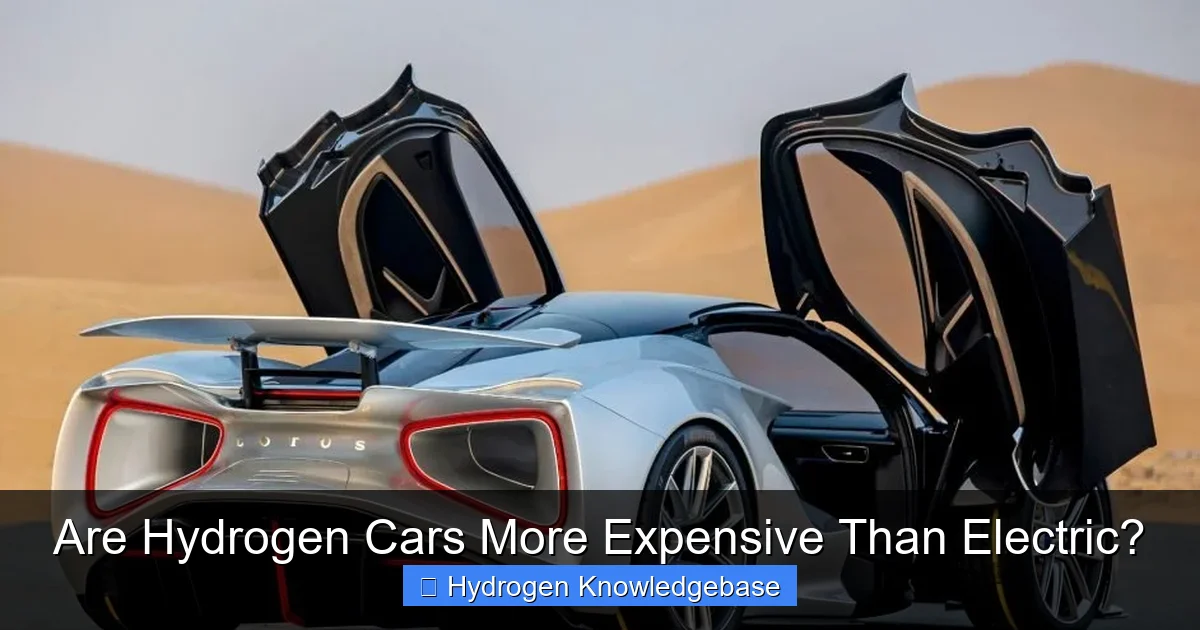
Visual guide about Are Hydrogen Cars More Expensive Than Electric?
Image source: jamesedition.com
When it comes to the initial cost of buying a car, hydrogen vehicles currently sit at a steep premium compared to their electric counterparts.
Most hydrogen cars on the market today—like the Toyota Mirai, Hyundai Nexo, and Honda Clarity Fuel Cell—start around $50,000 to $60,000. That’s before any incentives. In contrast, many popular EVs, such as the Tesla Model 3, Chevrolet Bolt, or Hyundai Kona Electric, start between $30,000 and $45,000. Even premium EVs like the Ford Mustang Mach-E or Volkswagen ID.4 are often priced competitively with or below hydrogen models.
Why the price gap? It boils down to technology and scale. Hydrogen fuel cells rely on complex systems involving platinum-based catalysts, high-pressure tanks, and advanced membranes—materials that are expensive and not yet produced at scale. Meanwhile, battery technology has benefited from massive investment, especially from companies like Tesla and Panasonic, driving down the cost of lithium-ion batteries over the past decade.
For example, the 2023 Toyota Mirai starts at about $58,000, while the similarly sized Tesla Model 3 starts at $40,240. That’s an $18,000 difference right off the bat. Even after federal tax credits (which we’ll discuss later), the gap remains significant.
Production Volume and Economies of Scale
Another factor driving up hydrogen car prices is low production volume. In 2022, only about 15,000 hydrogen fuel cell vehicles were sold globally—compared to over 10 million electric vehicles. This tiny market share means manufacturers can’t achieve the economies of scale that help reduce per-unit costs.
EVs, on the other hand, are being produced in the millions. Tesla alone delivered over 1.8 million vehicles in 2023. This volume allows for streamlined manufacturing, bulk purchasing of components, and continuous innovation that drives prices down.
Until hydrogen vehicles reach similar production levels—or breakthroughs in fuel cell tech reduce material costs—they’ll likely remain a premium option.
Resale Value Considerations
Resale value is another hidden cost. Currently, hydrogen cars tend to depreciate faster than EVs due to limited demand and uncertainty around future infrastructure. If you plan to sell your car in five years, an EV may hold its value better simply because more people can charge it and trust the technology.
That said, early adopters of EVs also faced depreciation concerns a decade ago. As hydrogen infrastructure grows—especially in regions like California and parts of Europe—resale values could stabilize. But for now, EVs have the edge in long-term ownership value.
Fuel Costs: Electricity vs. Hydrogen
Once you’ve bought the car, the next big expense is fuel. And here, the difference between hydrogen and electric becomes even clearer.
Let’s break it down with real-world numbers.
Cost Per Mile: A Side-by-Side Comparison
On average, electricity costs about $0.15 per kilowatt-hour (kWh) in the U.S. Most EVs get around 3 to 4 miles per kWh. That means it costs roughly $0.04 to $0.05 per mile to drive an electric car.
Hydrogen, by contrast, costs about $16 per kilogram at public stations. A hydrogen car like the Toyota Mirai gets about 60–70 miles per kilogram. That works out to around $0.23 to $0.27 per mile—more than five times the cost of driving an EV.
To put it another way: driving 1,000 miles in an EV might cost you $40–$50 in electricity. The same distance in a hydrogen car could cost $230–$270.
That’s a massive difference, especially for drivers who log high mileage.
Home Charging vs. Public Hydrogen Stations
One advantage EVs have is the ability to charge at home. Plug in overnight, wake up with a full “tank,” and avoid gas stations altogether. Home electricity rates are often lower than public rates, and many utilities offer discounted off-peak charging plans.
Hydrogen, however, can’t be produced or stored safely at home (at least not yet). You must rely on public refueling stations, which are scarce and often charge premium prices. There are only about 60 hydrogen stations in the entire U.S.—and nearly all are in California.
Even if you live near a station, the lack of competition keeps prices high. Unlike electricity, which is regulated and widely available, hydrogen fuel is still a boutique commodity.
Future Fuel Price Trends
Could hydrogen become cheaper in the future? Possibly—if production scales up and renewable energy is used to make “green hydrogen” (via electrolysis powered by wind or solar). Right now, most hydrogen is “gray hydrogen,” made from natural gas, which isn’t environmentally friendly and doesn’t reduce costs much.
But green hydrogen is still expensive—around $5–$7 per kilogram—and would need to drop below $2/kg to compete with electricity on cost per mile. That’s a tall order, even with government support.
Meanwhile, electricity prices are expected to remain stable or even decrease as renewable energy grows. Solar and wind power are already among the cheapest sources of new electricity in many regions.
So while hydrogen fuel costs might fall over time, they’re unlikely to catch up to the affordability of electric charging anytime soon.
Maintenance and Repair Costs
Both hydrogen and electric vehicles have fewer moving parts than traditional gasoline cars, which means lower maintenance needs overall. No oil changes, no exhaust systems, no complex transmissions. But there are still differences in long-term upkeep.
Simplicity of Electric Drivetrains
EVs use electric motors, which are incredibly reliable and require minimal servicing. Brake wear is also reduced thanks to regenerative braking, which recaptures energy when you slow down.
Most EV owners report spending far less on maintenance than gasoline car owners. According to a 2022 study by Consumer Reports, EVs cost about 50% less to maintain over their lifetime.
Hydrogen Fuel Cell Complexity
Hydrogen cars, while also zero-emission, have more complex systems. The fuel cell stack, hydrogen storage tanks, and associated plumbing require specialized knowledge to service. If something goes wrong—like a leak in the high-pressure tank or a degradation in the fuel cell—repairs can be costly and hard to find.
There are far fewer technicians trained to work on hydrogen vehicles, and dealerships with the right equipment are rare. This scarcity can lead to longer wait times and higher labor costs.
That said, hydrogen cars don’t have batteries that degrade as quickly as EV batteries (though both are designed to last 10+ years). But the trade-off is the fragility and expense of the fuel cell system itself.
Tire and Brake Wear
Interestingly, both vehicle types face similar wear on tires and brakes. However, some hydrogen cars are heavier due to reinforced tanks, which can increase tire wear slightly. EVs, especially high-performance models, can also be heavy because of large battery packs.
But overall, maintenance costs for both are low compared to internal combustion engines. The bigger difference lies in accessibility—EV repairs are easier to find and often cheaper.
Infrastructure and Convenience Costs
Owning a car isn’t just about the vehicle—it’s about where you can use it. And here, hydrogen cars face a major hurdle: infrastructure.
Charging vs. Refueling Networks
There are over 150,000 public EV charging ports in the U.S., with thousands more added each month. Fast chargers can replenish 80% of an EV’s battery in 20–30 minutes. And with apps like PlugShare and ChargePoint, finding a charger is easier than ever.
Hydrogen refueling stations? Fewer than 70 nationwide. Most are clustered in Southern and Northern California. If you live outside those areas, owning a hydrogen car is practically impossible.
Even in California, stations can be unreliable. Some have been known to run out of fuel or shut down for maintenance. And because hydrogen is a gas, it’s harder to store and transport than electricity, making station operations more complex.
Time and Travel Flexibility
Refueling a hydrogen car takes about 5–10 minutes—similar to gasoline. That’s faster than most EV charging, especially if you’re using a Level 2 charger (which takes hours). But fast chargers are closing the gap, and home charging eliminates the need to stop altogether.
For long road trips, EVs are becoming more practical. Tesla’s Supercharger network offers seamless cross-country travel, and other networks like Electrify America are expanding rapidly.
Hydrogen cars offer quick refueling, but only if you’re near a station. Planning a trip outside California? You’ll need to map your route carefully—and hope the stations are operational.
Home Refueling: A Game-Changer?
One potential future advantage for hydrogen is home refueling. Companies like Plug Power and Hygen are developing small-scale electrolyzers that could let homeowners produce hydrogen from solar power. If this becomes safe, affordable, and widely available, it could level the playing field.
But we’re not there yet. Current home systems are expensive, inefficient, and not approved for residential use in most areas. EVs already dominate the home energy space with simple, safe, and affordable Level 2 chargers.
Government Incentives and Tax Credits
Both hydrogen and electric vehicles qualify for government incentives, but the support isn’t equal.
Federal and State EV Incentives
The U.S. federal government offers a tax credit of up to $7,500 for new EV purchases, depending on battery size and manufacturer. Many states add their own rebates—California offers up to $7,000, New York up to $2,000, and Colorado up to $5,000.
These incentives significantly reduce the effective price of an EV. For example, a $40,000 Tesla Model 3 could cost as little as $25,000 after federal and state credits.
Limited Hydrogen Incentives
Hydrogen vehicles also qualify for the federal $7,500 tax credit, but state support is much weaker. California offers a $5,000 rebate for hydrogen cars through the Clean Vehicle Rebate Project (CVRP), but funding is limited and often runs out quickly.
Other states offer little to no support. This makes hydrogen cars less attractive from a financial standpoint, even if the technology appeals to you.
Used Vehicle Incentives
EVs also benefit from used car incentives. The Inflation Reduction Act includes a $4,000 tax credit for used EVs under $25,000. There’s no equivalent for used hydrogen cars, which are rarely resold and often leased instead of purchased.
Environmental Impact and Long-Term Value
Cost isn’t just about money—it’s also about sustainability and future-proofing your investment.
Carbon Footprint: It Depends on the Source
Both hydrogen and electric cars produce zero emissions while driving. But the environmental impact depends on how the energy is generated.
EVs charged with renewable energy (solar, wind, hydro) have a very low carbon footprint. Even when charged from the grid, they’re typically cleaner than gasoline cars.
Hydrogen’s footprint varies widely. Gray hydrogen (from natural gas) can be more polluting than gasoline. Blue hydrogen (with carbon capture) is better, and green hydrogen (from renewables) is clean—but rare and expensive.
Until green hydrogen becomes mainstream, EVs generally have the environmental edge.
Technology Roadmap
Battery technology is advancing rapidly. Solid-state batteries, faster charging, and longer ranges are on the horizon. EVs are becoming more capable, affordable, and convenient every year.
Hydrogen technology is progressing too, but more slowly. It’s seen as a potential solution for heavy transport—trucks, ships, planes—where batteries are too heavy. For passenger cars, however, the future still belongs to electricity.
Resale and Obsolescence Risk
As EV charging becomes universal and battery tech improves, older EVs may lose value—but they’ll still be usable. Hydrogen cars face a bigger risk: if infrastructure doesn’t grow, they could become stranded assets.
Buying a hydrogen car today is a bet on future adoption. For most drivers, that’s a risky financial move.
Conclusion: Which Is Right for You?
So, are hydrogen cars more expensive than electric? The answer is clear: yes, in almost every way.
From higher purchase prices and fuel costs to limited infrastructure and weaker incentives, hydrogen vehicles currently cost more to buy, drive, and maintain than electric cars. While they offer quick refueling and long range, those benefits come at a steep premium.
That doesn’t mean hydrogen has no future. It may play a key role in aviation, shipping, and long-haul trucking. But for everyday drivers, EVs offer a more practical, affordable, and sustainable path to zero emissions.
If you’re looking to save money, reduce your carbon footprint, and enjoy the convenience of home charging, an electric car is the smarter choice today. Hydrogen cars are impressive feats of engineering—but for now, they’re a luxury, not a mainstream solution.
As technology evolves, the gap may narrow. But until then, electricity remains the more cost-effective way to go green.
Frequently Asked Questions
Why are hydrogen cars so expensive?
Hydrogen cars use costly materials like platinum in their fuel cells and are produced in very low volumes, preventing economies of scale. This drives up manufacturing costs significantly compared to mass-produced EVs.
Will hydrogen fuel ever be cheaper than electricity?
It’s unlikely in the near term. Green hydrogen production is still expensive, and electricity prices are expected to remain low as renewable energy expands. Hydrogen would need major technological breakthroughs to compete on cost.
Are hydrogen cars better for long road trips?
Hydrogen cars refuel quickly, but the lack of stations outside California makes long-distance travel difficult. EVs now offer fast charging networks that support cross-country travel more reliably.
Do hydrogen cars have longer range than electric cars?
Some hydrogen models offer 300–400 miles per fill, similar to long-range EVs. However, real-world range depends on driving conditions, and hydrogen’s higher fuel cost offsets the convenience.
Can hydrogen cars use renewable energy?
Yes, if the hydrogen is produced via electrolysis powered by wind or solar (green hydrogen), the entire process can be clean. But most hydrogen today comes from natural gas, which is not renewable.
Should I buy a hydrogen car in 2024?
Unless you live in California and prioritize quick refueling, an EV is generally the better financial and practical choice. Hydrogen cars remain a niche option with higher costs and limited support.