Hydrogen SUVs and electric SUVs both aim to reduce emissions, but their eco-friendliness depends on how the energy is produced. While hydrogen offers fast refueling and long range, electric vehicles currently have a clearer path to sustainability due to cleaner electricity grids and higher efficiency.
Key Takeaways
- Hydrogen production is often carbon-intensive: Most hydrogen today is made from natural gas, which releases CO₂, reducing its environmental benefits.
- Electric SUVs are more energy-efficient: EVs convert over 77% of electrical energy to power at the wheels, compared to 25–35% for hydrogen fuel cell vehicles.
- Green hydrogen is promising but limited: Hydrogen made using renewable energy is clean, but it’s still rare and expensive.
- Refueling infrastructure favors electric: EV charging stations are far more widespread than hydrogen refueling stations, especially for SUVs.
- Lifecycle emissions matter: Both vehicle types have emissions from manufacturing, but EVs generally have lower total lifecycle emissions.
- Hydrogen excels in specific use cases: Long-haul transport and fleet vehicles may benefit more from hydrogen due to faster refueling and range.
- The future depends on clean energy: Both technologies will become greener as renewable energy grows, but EVs currently lead in real-world eco-friendliness.
Quick Answers to Common Questions
Are hydrogen SUVs really zero-emission?
Only at the tailpipe. The overall emissions depend on how the hydrogen is produced. Most hydrogen today is made from natural gas, which releases CO₂.
Can I charge an electric SUV at home?
Yes! Most EV owners charge overnight using a Level 2 home charger. It’s convenient, cheap, and you wake up with a full “tank.”
How long does it take to refuel a hydrogen SUV?
About 3 to 5 minutes—similar to gasoline. That’s much faster than charging an electric SUV.
Are there enough hydrogen stations to drive across the country?
Not yet. There are fewer than 100 public hydrogen stations in the U.S., mostly in California. Long-distance travel is very limited.
Which is more efficient: hydrogen or electric SUVs?
Electric SUVs are far more efficient. They use about 77% of grid energy, while hydrogen SUVs use only 25–35% due to production and conversion losses.
📑 Table of Contents
Are Hydrogen SUVs More Eco-friendly Than Electric?
Imagine driving an SUV that emits nothing but water vapor from its tailpipe. Sounds like a dream, right? That’s the promise of hydrogen-powered SUVs. But is that dream as green as it seems? And how do they really stack up against electric SUVs, which are already on the roads in growing numbers?
The race to decarbonize transportation is heating up, and both hydrogen and electric vehicles (EVs) are front-runners. SUVs, being larger and heavier, present a unique challenge when it comes to efficiency and emissions. As consumers demand greener options without sacrificing space or performance, automakers are investing heavily in both technologies. But which one is truly more eco-friendly?
In this article, we’ll dive deep into the environmental impact of hydrogen SUVs versus electric SUVs. We’ll look at how each vehicle gets its power, how clean that power really is, and what the future holds. Whether you’re considering your next family car or just curious about clean tech, this guide will help you understand the real story behind the hype.
How Hydrogen SUVs Work
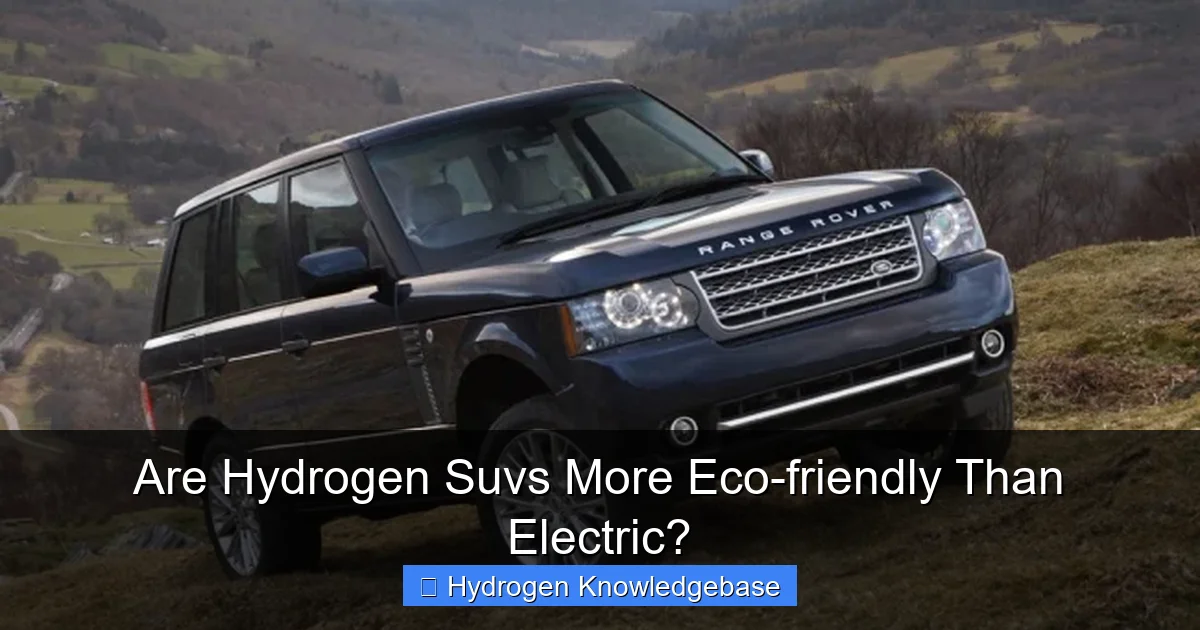
Visual guide about Are Hydrogen Suvs More Eco-friendly Than Electric?
Image source: ecofriend.com
Hydrogen SUVs run on fuel cells, not batteries. Inside the vehicle, hydrogen gas is stored in high-pressure tanks. When you press the accelerator, the hydrogen travels to the fuel cell stack, where it reacts with oxygen from the air. This chemical reaction produces electricity, which powers the electric motor. The only byproduct? Pure water.
It sounds simple and clean—and in many ways, it is. But the real question is: where does the hydrogen come from? Because the eco-friendliness of a hydrogen SUV depends heavily on how that hydrogen is produced.
The Hydrogen Production Process
Most hydrogen today—about 95%—is made through a process called steam methane reforming (SMR). This involves reacting natural gas (methane) with high-temperature steam to produce hydrogen and carbon dioxide. While this method is efficient and cheap, it’s not clean. For every kilogram of hydrogen produced this way, about 10 kilograms of CO₂ are released into the atmosphere.
This type of hydrogen is often called “grey hydrogen.” There’s also “blue hydrogen,” which uses carbon capture technology to trap some of the CO₂ emissions. While better than grey, it’s still not zero-emission.
Then there’s “green hydrogen,” the holy grail. This is made by splitting water into hydrogen and oxygen using electricity from renewable sources like wind or solar. If the electricity is truly clean, the entire process can be carbon-free. But green hydrogen is still rare—less than 1% of global hydrogen production—and expensive to produce and transport.
Refueling and Range
One big advantage of hydrogen SUVs is refueling time. Filling up a hydrogen tank takes about 3 to 5 minutes—similar to gasoline. That’s a major plus for long trips or busy families who don’t want to wait hours to charge.
Hydrogen SUVs also offer impressive range. Models like the Toyota Mirai (a sedan, but similar tech) can go over 400 miles on a full tank. Upcoming hydrogen SUVs from Hyundai and BMW aim for similar numbers. For drivers who frequently travel long distances or live in areas with sparse charging infrastructure, this is a real benefit.
But here’s the catch: hydrogen refueling stations are few and far between. In the U.S., there are fewer than 100 public hydrogen stations, and most are in California. Compare that to over 150,000 public EV charging ports nationwide. For most drivers, finding a place to refuel a hydrogen SUV would be a major challenge.
How Electric SUVs Work
Electric SUVs, on the other hand, run on large lithium-ion batteries. These store electricity that’s either generated at home via solar panels or drawn from the grid. When you drive, the battery powers an electric motor, which turns the wheels. No combustion, no emissions—just quiet, smooth motion.
EVs are already mainstream, with models like the Tesla Model Y, Ford Mustang Mach-E, and Hyundai Ioniq 5 leading the charge. These SUVs offer strong performance, modern tech, and increasingly long ranges—many now exceed 300 miles per charge.
Charging and Convenience
Charging an electric SUV takes longer than refueling a hydrogen one. A Level 2 home charger might take 8 to 10 hours for a full charge. Fast DC chargers can get you to 80% in 30 to 45 minutes, but they’re not always available on road trips.
Still, most EV owners charge at home overnight, which is convenient and cheap. You wake up every morning with a “full tank.” And with more workplaces and shopping centers adding chargers, top-ups during the day are becoming easier.
Energy Efficiency
Here’s where electric SUVs really shine: efficiency. EVs convert about 77% of the electrical energy from the grid to power at the wheels. That’s because electric motors are inherently efficient, and there are fewer energy losses in the system.
Hydrogen SUVs, by contrast, are much less efficient. First, producing hydrogen from natural gas or electricity wastes energy. Then, compressing and transporting it adds more losses. Finally, converting hydrogen back to electricity in the fuel cell is only about 60% efficient. When you add it all up, hydrogen SUVs use about 25% to 35% of the original energy—far less than EVs.
That means for the same amount of renewable energy, you could power multiple electric SUVs—or just one hydrogen SUV. In terms of resource use, EVs are the clear winner.
Environmental Impact: Production to Disposal
To truly compare eco-friendliness, we need to look at the full lifecycle of each vehicle—from manufacturing to end-of-life.
Manufacturing Emissions
Both hydrogen and electric SUVs have higher emissions during production than gasoline vehicles. That’s because their batteries and fuel cells require rare materials like lithium, cobalt, nickel, and platinum.
Electric SUVs have large batteries, which means more mining and processing. A typical EV battery might contain 10–20 kg of lithium and 30–50 kg of nickel. Mining these materials can damage ecosystems and use large amounts of water and energy.
Hydrogen SUVs use fuel cells that contain platinum, a rare and expensive metal. While the amount per vehicle is small, mining platinum is energy-intensive and often done in environmentally sensitive areas.
However, studies consistently show that over the vehicle’s lifetime, EVs more than make up for their higher manufacturing emissions. That’s because they produce zero tailpipe emissions and are more efficient.
Operational Emissions
This is where the source of energy matters most.
For electric SUVs, the carbon footprint depends on the electricity grid. In regions with lots of coal, like parts of China or India, EVs are less green. But in places with clean energy—like Norway, Iceland, or California—EVs are very low-emission.
The good news? Grids are getting cleaner every year. In the U.S., renewable energy now makes up over 20% of electricity generation and is growing fast. As more solar and wind come online, the eco-benefits of EVs will only increase.
For hydrogen SUVs, the story is similar but more complicated. If the hydrogen is grey or blue, the emissions are high—sometimes even worse than gasoline. But if it’s green hydrogen made with renewables, the emissions are very low.
The problem is scale. Green hydrogen is still a tiny fraction of production. And even if we ramp it up, the inefficiencies in the hydrogen supply chain mean we’d need far more renewable energy to power the same number of vehicles.
End-of-Life and Recycling
Both types of SUVs face challenges at the end of their lives.
EV batteries can be recycled, but the process is still developing. Companies like Redwood Materials and Li-Cycle are building facilities to recover lithium, cobalt, and nickel. Recycling can reduce the need for new mining and cut emissions.
Hydrogen fuel cells also contain valuable materials like platinum, which can be recovered. But the recycling infrastructure for fuel cells is even less mature than for batteries.
In both cases, better recycling will improve sustainability. But right now, EVs have a slight edge due to more established battery recycling efforts.
Infrastructure and Real-World Use
Technology is one thing. Real-world usability is another.
Charging vs. Refueling Networks
Electric SUV owners benefit from a rapidly expanding charging network. Home charging is easy and cheap. Public chargers are popping up at malls, hotels, and rest stops. Apps like PlugShare and ChargePoint make it simple to find a plug.
Hydrogen refueling is a different story. As of 2024, there are only about 70 public hydrogen stations in the U.S., and nearly all are in California. That makes long-distance travel nearly impossible for hydrogen SUV owners outside the state.
Even in California, stations can be unreliable. Some have closed due to maintenance issues or lack of demand. And building new stations is expensive—each one can cost $2 million or more.
Cost of Ownership
Electric SUVs are still more expensive upfront than gasoline SUVs, but prices are falling. The Tesla Model Y starts around $50,000, and more affordable options like the Chevrolet Bolt EUV are under $30,000.
Hydrogen SUVs are much pricier. The Toyota Mirai starts at about $50,000, but with limited availability and high fuel costs. Hydrogen fuel currently costs around $16 per kilogram—enough for about 60–70 miles of driving. That’s roughly $0.23 per mile, compared to about $0.04 per mile for a typical EV on home electricity.
Maintenance is another factor. EVs have fewer moving parts and no oil changes, so they’re cheaper to maintain. Hydrogen SUVs are also low-maintenance, but repairs can be costly due to specialized parts and limited service centers.
The Role of Green Hydrogen
Green hydrogen could change the game—but not overnight.
If we can scale up renewable energy and use it to produce hydrogen, fuel cell vehicles could become truly clean. Some experts believe green hydrogen will be key for hard-to-decarbonize sectors like shipping, aviation, and heavy industry.
For passenger SUVs, though, the path is less clear. The inefficiencies in hydrogen production and distribution mean that using renewables to charge EVs directly is far more effective.
Still, hydrogen may have a role in specific niches. For example, fleet operators with central refueling stations—like delivery vans or taxis—might benefit from hydrogen’s fast refueling. And in regions with abundant renewable energy but limited grid capacity, hydrogen could store excess power for later use.
But for the average family SUV, electric remains the more practical and eco-friendly choice—at least for now.
Future Outlook: Which Technology Will Win?
The future of clean SUVs isn’t necessarily a choice between hydrogen and electric. It might be both—but in different roles.
Electric SUVs are likely to dominate the passenger market. They’re efficient, increasingly affordable, and supported by growing infrastructure. As battery technology improves—with solid-state batteries promising longer range and faster charging—EVs will only get better.
Hydrogen may find its place in larger vehicles and commercial transport. Trucks, buses, and trains that need long range and quick refueling could benefit from fuel cells. Some countries, like Japan and South Korea, are betting heavily on a “hydrogen economy,” investing billions in production and infrastructure.
But for everyday drivers, the convenience, cost, and efficiency of electric SUVs make them the smarter, greener choice today.
Conclusion
So, are hydrogen SUVs more eco-friendly than electric? The short answer is: not yet.
While hydrogen SUVs offer clean emissions at the tailpipe and fast refueling, their overall environmental impact is currently higher due to carbon-intensive production and low efficiency. Electric SUVs, powered by increasingly clean electricity, are more energy-efficient and have lower lifecycle emissions.
That said, green hydrogen holds promise for the future—especially in sectors where batteries aren’t practical. But for most consumers, electric SUVs are the more sustainable, practical, and accessible option right now.
The key to true eco-friendliness isn’t just the vehicle—it’s the energy that powers it. Whether you choose hydrogen or electric, the greener the grid, the greener your ride.
As technology evolves and renewable energy grows, both paths will improve. But for today’s drivers looking to reduce their carbon footprint without sacrificing space or performance, electric SUVs are the clear winner.
Frequently Asked Questions
What is green hydrogen?
Green hydrogen is produced by splitting water using renewable electricity, such as wind or solar. It’s the only truly clean form of hydrogen, with no CO₂ emissions.
Do hydrogen SUVs have a longer range than electric SUVs?
Some do. Hydrogen SUVs can exceed 400 miles per tank, while many electric SUVs offer 250–350 miles. But range depends on the model and driving conditions.
Are electric SUVs better for the environment?
Generally, yes. EVs have lower lifecycle emissions due to higher efficiency and cleaner electricity grids. They also benefit from more established recycling programs.
Why aren’t there more hydrogen refueling stations?
Building hydrogen stations is expensive—over $2 million each—and demand is low. Most automakers are focusing on electric vehicles instead.
Can hydrogen SUVs use renewable energy?
Only if the hydrogen is green. Most hydrogen today comes from fossil fuels, so it’s not renewable unless specifically produced with clean power.
Will hydrogen SUVs become more common in the future?
Possibly, but likely in niche markets like commercial fleets. For personal use, electric SUVs are expected to dominate due to better efficiency and infrastructure.