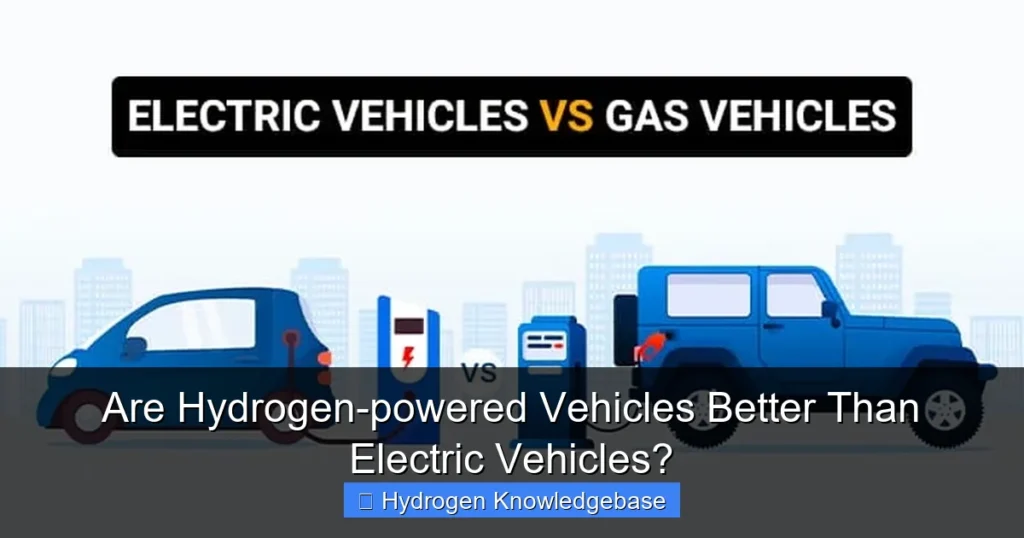
Hydrogen-powered vehicles and electric vehicles each offer unique advantages in the race toward sustainable transportation. While EVs dominate the market today, hydrogen fuel cell vehicles promise faster refueling and longer range—but face infrastructure and cost challenges.
Key Takeaways
- Refueling Speed: Hydrogen vehicles can refuel in 3–5 minutes, similar to gasoline cars, while most EVs take 30+ minutes for a fast charge.
- Range Capability: Hydrogen-powered vehicles often offer longer driving ranges (300–400 miles) compared to many battery-electric models.
- Environmental Impact: Both produce zero tailpipe emissions, but hydrogen’s green credentials depend on how it’s produced—green hydrogen is clean, gray hydrogen is not.
- Infrastructure Limitations: EV charging stations are widespread; hydrogen refueling stations are scarce, especially outside California and select global hubs.
- Energy Efficiency: EVs are more energy-efficient (70–90%) from grid to wheel, while hydrogen vehicles lose more energy in production and conversion.
- Cost and Availability: EVs are more affordable and widely available; hydrogen vehicles remain niche with higher upfront and fuel costs.
- Future Potential: Hydrogen may excel in heavy-duty transport (trucks, buses, ships), while EVs lead in passenger cars and urban mobility.
Quick Answers to Common Questions
Can hydrogen vehicles explode?
No, hydrogen vehicles are designed with multiple safety features, including leak detectors and strong tanks. Hydrogen disperses quickly, making explosions extremely rare.
How long does it take to charge an EV?
Home charging takes 4–12 hours; fast chargers can recharge to 80% in 20–40 minutes, depending on the vehicle and charger.
Where can I refuel a hydrogen car?
Most hydrogen stations are in California, with a few in Hawaii and the Northeast. Europe and Japan have more stations.
Are hydrogen vehicles zero emission?
Yes, they emit only water vapor. But the environmental impact depends on how the hydrogen is produced—green hydrogen is clean, gray is not.
Will hydrogen cars replace EVs?
Unlikely. EVs dominate passenger cars, while hydrogen may serve niche roles in trucks, buses, and industrial transport.
📑 Table of Contents
- Are Hydrogen-powered Vehicles Better Than Electric Vehicles?
- How Do Hydrogen-powered Vehicles Work?
- How Do Electric Vehicles Work?
- Comparing Efficiency: Energy from Source to Wheel
- Refueling and Range: Convenience vs. Capability
- Cost and Ownership: What’s the Real Price?
- Environmental Impact: Beyond the Tailpipe
- The Future: Where Do They Fit?
- Conclusion: It’s Not Either/Or
Are Hydrogen-powered Vehicles Better Than Electric Vehicles?
The world is shifting gears. Climate change, air pollution, and fossil fuel dependence have pushed governments, automakers, and consumers toward cleaner transportation. Two technologies stand out in this green revolution: battery-electric vehicles (EVs) and hydrogen-powered vehicles (often called fuel cell electric vehicles or FCEVs). Both promise zero emissions at the tailpipe, but they take very different paths to get there.
Electric vehicles, like Teslas, Nissan Leafs, and Ford Mustangs Mach-E, run on electricity stored in large batteries. You plug them in, charge them up, and drive. Simple. Familiar. And increasingly common. On the other hand, hydrogen-powered vehicles use a fuel cell to convert hydrogen gas into electricity, powering an electric motor—all while emitting only water vapor. Sounds futuristic, right? But is it better?
This isn’t just a technical debate. It’s about practicality, sustainability, cost, and the future of how we move people and goods. As someone who’s driven both types of vehicles and followed the industry closely, I can tell you: the answer isn’t black and white. It depends on your needs, where you live, and what you value most—convenience, efficiency, or environmental impact.
So, are hydrogen-powered vehicles better than electric vehicles? Let’s dive deep, compare the facts, and explore what the future might hold.
How Do Hydrogen-powered Vehicles Work?
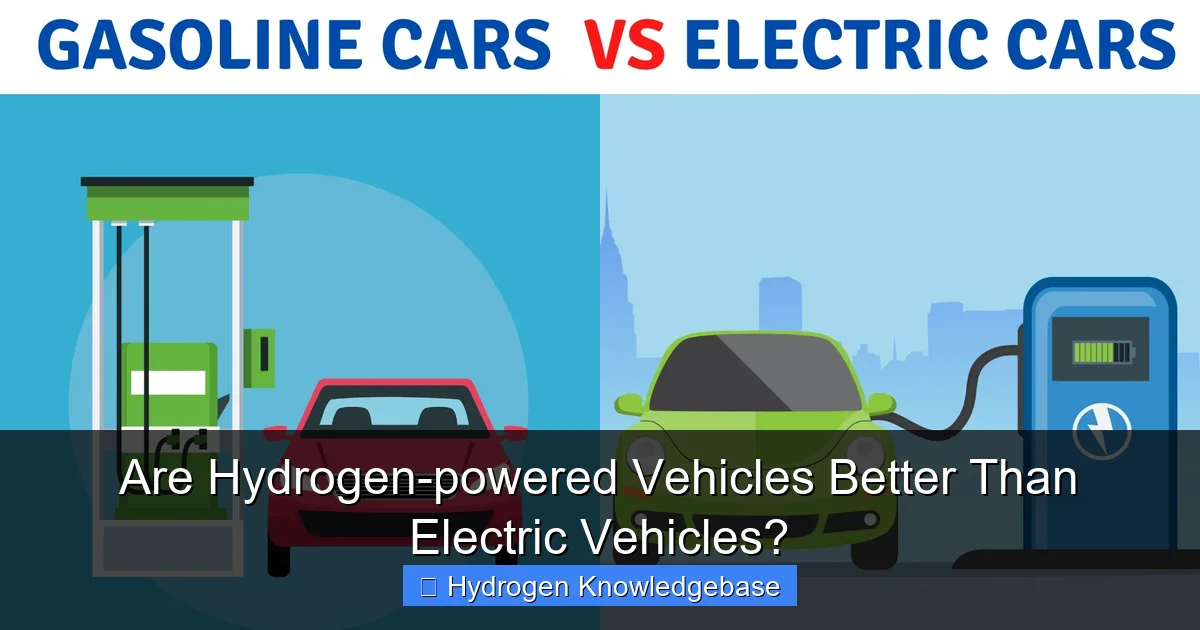
Visual guide about Are Hydrogen-powered Vehicles Better Than Electric Vehicles?
Image source: electriccarspedia.com
Before we can compare hydrogen vehicles to electric ones, it helps to understand how they actually work. Many people think hydrogen cars are like gas cars—you fill up and go. But the science behind them is more complex and fascinating.
The Fuel Cell: Heart of the Hydrogen Vehicle
At the core of every hydrogen-powered vehicle is a fuel cell stack. This isn’t a battery that stores energy—it’s a device that generates electricity on demand. Here’s how it works: hydrogen gas (H₂) from the tank flows into the fuel cell, where it meets oxygen (O₂) from the air. Inside the fuel cell, a catalyst—usually platinum—splits the hydrogen atoms into protons and electrons.
The protons pass through a membrane, while the electrons are forced to travel through an external circuit, creating an electric current. This electricity powers the vehicle’s motor. When the protons and electrons reunite on the other side, they combine with oxygen to form water (H₂O)—the only emission. It’s like a mini power plant on wheels.
Hydrogen Storage and Safety
Storing hydrogen safely is a big challenge. It’s the lightest element and highly flammable, so it must be compressed to extremely high pressures (usually 5,000 to 10,000 psi) and stored in reinforced tanks. Modern hydrogen tanks are made of carbon fiber and designed to withstand crashes and punctures. In fact, they’re tested to survive gunfire and extreme temperatures.
Despite the risks, hydrogen vehicles have an excellent safety record. Sensors detect leaks instantly, and the gas disperses quickly into the air—unlike gasoline, which pools and ignites. Still, public perception lags behind the science. Many people still associate hydrogen with the Hindenburg disaster, even though that was a different gas (helium-filled with a flammable coating) and modern tech is far safer.
Real-World Examples
Today, only a few hydrogen-powered passenger vehicles are available. The Toyota Mirai, Honda Clarity Fuel Cell (now discontinued), and Hyundai Nexo are the main players. The Mirai, for example, offers a range of about 400 miles and refuels in under five minutes. It drives smoothly, quietly, and feels much like a luxury EV.
But here’s the catch: you can’t just pull into any gas station. As of 2024, there are fewer than 100 hydrogen refueling stations in the U.S., and nearly all are in California. That limits where you can drive and how practical ownership can be.
How Do Electric Vehicles Work?
Now let’s look at the other side of the coin: battery-electric vehicles. These are the ones most people are familiar with—Tesla, Chevy Bolt, Rivian, and more. They’re powered by rechargeable lithium-ion batteries, similar to what’s in your phone or laptop, but much larger and more powerful.
Battery Technology and Charging
EVs store electricity in a battery pack, usually mounted under the floor for stability. When you press the accelerator, the battery sends power to an electric motor, which turns the wheels. No engine, no exhaust, no gears—just instant torque and silent operation.
Charging an EV can be done at home, at work, or at public stations. Level 1 charging uses a standard wall outlet and takes 8–12 hours for a full charge. Level 2 chargers (240V) are faster—about 4–8 hours. DC fast chargers, found along highways, can recharge an EV to 80% in 20–40 minutes.
Range and Real-World Performance
Range anxiety—the fear of running out of charge—used to be a major barrier. But today’s EVs offer impressive ranges. The Tesla Model S can go over 400 miles on a single charge. Even affordable models like the Hyundai Kona Electric offer 250+ miles. For most daily commutes and errands, that’s more than enough.
And because EVs have fewer moving parts, they require less maintenance. No oil changes, no spark plugs, no exhaust systems. Just tires, brakes, and software updates.
Charging Infrastructure
One of EVs’ biggest advantages is infrastructure. There are over 150,000 public charging ports in the U.S. alone, and that number grows every month. Apps like PlugShare and ChargePoint help drivers find stations on the go. Plus, many people charge at home overnight, waking up to a “full tank” every morning.
This convenience is hard to beat. No need to visit a station unless you’re on a long trip. And with solar panels and home batteries, some EV owners even generate their own clean energy.
Comparing Efficiency: Energy from Source to Wheel
When it comes to sustainability, it’s not just about what comes out of the tailpipe—it’s about the entire energy chain. How much energy is lost from the power plant to the road? This is where EVs and hydrogen vehicles diverge dramatically.
EV Efficiency: The Clear Winner
Electric vehicles are incredibly efficient. About 77–90% of the energy from the grid makes it to the wheels. Even when you account for power plant losses and transmission, EVs still win. For example, if a coal plant generates electricity, an EV is still cleaner than a gasoline car over its lifetime.
And as the grid gets greener—with more wind, solar, and nuclear—EVs become even cleaner. In regions with high renewable energy use, like California or Norway, driving an EV is nearly carbon-free.
Hydrogen Efficiency: The Energy Penalty
Hydrogen vehicles, by contrast, are much less efficient. Here’s why: producing hydrogen requires energy. If you use electrolysis (splitting water into hydrogen and oxygen using electricity), you lose about 30% of the energy right there. Then, compressing and transporting hydrogen adds more losses. Finally, converting hydrogen back into electricity in the fuel cell loses another 50–60%.
So, from grid to wheel, hydrogen vehicles are only about 25–35% efficient. That means you need nearly three times more energy to go the same distance as an EV. Unless that energy comes from 100% renewable sources, hydrogen’s environmental benefits shrink fast.
Green vs. Gray Hydrogen
Not all hydrogen is created equal. “Gray hydrogen” is made from natural gas through a process called steam methane reforming, which releases CO₂. It’s cheap but not clean. “Blue hydrogen” captures some of that CO₂, but it’s still not zero-emission. “Green hydrogen,” made with renewable electricity, is the only truly sustainable option—but it’s expensive and rare.
Currently, over 95% of hydrogen is gray. Until green hydrogen scales up, hydrogen vehicles may not be as green as they seem.
Refueling and Range: Convenience vs. Capability
One of the biggest arguments for hydrogen vehicles is refueling speed. Let’s break it down.
Refueling Time: Hydrogen Wins
Filling up a hydrogen tank takes 3–5 minutes—just like gasoline. That’s a huge advantage for long trips or commercial fleets that can’t afford downtime. Imagine a delivery truck that refuels in minutes instead of hours. For drivers who value time, this is a game-changer.
In contrast, even the fastest EV chargers take 20–40 minutes to reach 80%. And that’s under ideal conditions. In cold weather or with older batteries, charging slows down. For road trips, you’ll need to plan stops carefully.
Range: A Close Call
Both technologies offer strong range. Many EVs now exceed 300 miles, with some topping 400. Hydrogen vehicles like the Toyota Mirai also offer 300–400 miles. So on paper, they’re comparable.
But real-world range can vary. Cold weather reduces EV range by 20–40%, though heat pumps and battery preconditioning help. Hydrogen vehicles are less affected by temperature, but fuel cell performance can still dip in extreme cold.
Infrastructure: The Big Divide
Here’s where EVs dominate. Charging stations are everywhere—gas stations, malls, offices, highways. You can even charge at a friend’s house. Hydrogen stations? Not so much. Outside California, they’re nearly nonexistent. In Europe and Japan, there are more, but still limited.
Building hydrogen infrastructure is expensive. Each station costs $1–2 million, compared to $50,000–$100,000 for a fast EV charger. And hydrogen is harder to transport and store. Until governments and companies invest heavily, hydrogen will struggle to scale.
Cost and Ownership: What’s the Real Price?
Let’s talk money. Which technology is more affordable—today and in the future?
Upfront Cost
Hydrogen vehicles are expensive. The Toyota Mirai starts around $50,000, and the Hyundai Nexo is similar. That’s before any incentives. EVs, while still pricier than gas cars, are coming down in price. The Chevrolet Bolt starts under $30,000, and Tesla’s Model 3 is around $38,000. Used EVs are even more affordable.
Fuel Cost
Electricity is cheaper than hydrogen. On average, driving an EV costs about $0.04–$0.06 per mile. Hydrogen? Around $0.12–$0.16 per mile—similar to gasoline. And hydrogen prices are volatile, tied to natural gas and production costs.
Maintenance and Incentives
EVs have lower maintenance costs—no oil, fewer parts. Hydrogen vehicles also have few moving parts, but fuel cells and tanks are expensive to repair or replace. Both benefit from tax credits and rebates, but EV incentives are more widely available.
Environmental Impact: Beyond the Tailpipe
Sustainability isn’t just about emissions. It’s about resource use, manufacturing, and end-of-life recycling.
Manufacturing Footprint
Both EVs and hydrogen vehicles have higher upfront emissions due to battery and fuel cell production. Lithium, cobalt, and nickel mining raise ethical and environmental concerns. Hydrogen fuel cells use platinum, a rare and energy-intensive metal.
But over their lifetime, both types of vehicles are far cleaner than gasoline cars—especially as grids get greener.
Recycling and Lifecycle
EV batteries can be recycled, and companies like Redwood Materials are building closed-loop systems. Hydrogen tanks and fuel cells are also recyclable, but the industry is still young. As both technologies mature, recycling will improve.
The Future: Where Do They Fit?
So, which is better? The answer depends on the use case.
Passenger Cars: EVs Lead
For most drivers, EVs are the better choice. They’re cheaper, more efficient, and supported by a growing network. Unless you live in a region with abundant hydrogen stations, an EV makes more sense.
Heavy-Duty and Long-Haul: Hydrogen’s Niche
Hydrogen shines in applications where weight, range, and refueling speed matter. Think trucks, buses, trains, and ships. A semi-truck can’t wait hours to charge. Hydrogen offers a practical solution. Companies like Nikola and Toyota are testing hydrogen trucks for freight.
Regional Differences
In Japan and South Korea, hydrogen is a national priority. Germany and France are investing in hydrogen for industry and transport. The U.S. is more focused on EVs, though the Inflation Reduction Act includes hydrogen incentives.
Hybrid Future?
Some experts believe we’ll see a mix. EVs for cities and short trips. Hydrogen for long-haul and heavy transport. Both will play roles in a decarbonized future.
Conclusion: It’s Not Either/Or
Are hydrogen-powered vehicles better than electric vehicles? Not necessarily. Each has strengths and weaknesses. EVs are more efficient, affordable, and practical for most people today. Hydrogen vehicles offer faster refueling and longer range, but face infrastructure and cost hurdles.
The real question isn’t which is better—it’s which is better for whom, where, and when. For daily driving and urban life, EVs win. For freight, aviation, and remote areas, hydrogen may be the answer.
The future of clean transportation won’t be one-size-fits-all. It will be a mosaic of technologies, tailored to different needs. And that’s okay. As long as we’re moving away from fossil fuels, we’re on the right track.
Frequently Asked Questions
What is a hydrogen-powered vehicle?
A hydrogen-powered vehicle uses a fuel cell to convert hydrogen gas into electricity, which powers an electric motor. The only emission is water vapor.
How does a hydrogen fuel cell work?
Hydrogen enters the fuel cell, splits into protons and electrons, and generates electricity. The electrons power the motor, and the byproduct is water.
Are hydrogen cars safe?
Yes, modern hydrogen vehicles have robust safety systems, including leak sensors and crash-resistant tanks. They have a strong safety record.
Why aren’t there more hydrogen cars on the road?
Limited refueling stations, high costs, and lower efficiency compared to EVs have slowed adoption. Infrastructure and production scaling are key challenges.
Can I convert my gas car to hydrogen?
No, hydrogen conversion is not practical or safe for most vehicles. It requires specialized fuel cells, tanks, and systems not compatible with standard engines.
Is hydrogen better for the environment than electricity?
It depends on how the hydrogen is made. Green hydrogen (from renewables) is clean, but most hydrogen today is gray (from natural gas), which emits CO₂.