Hydrogen fuel cell vehicles (FCEVs) and traditional hybrid SUVs represent two distinct paths toward cleaner transportation. While hybrids combine gasoline engines with electric motors for improved efficiency, FCEVs generate electricity onboard using hydrogen, emitting only water vapor. This article breaks down their pros, cons, and real-world usability to help you choose the right eco-friendly ride.
Key Takeaways
- Zero tailpipe emissions: Both hydrogen fuel cell vehicles and hybrid SUVs reduce emissions, but only FCEVs emit pure water vapor, making them truly zero-emission at the tailpipe.
- Refueling time and range: Hydrogen vehicles refuel in 3–5 minutes with a 300–400 mile range, similar to gas cars, while hybrids rely on gasoline and take longer to recharge if plug-in.
- Infrastructure limitations: Hybrid SUVs benefit from widespread gas stations and charging points, whereas hydrogen refueling stations are scarce, mostly limited to California and parts of Europe.
- Environmental footprint: The sustainability of hydrogen depends on how it’s produced—green hydrogen from renewable energy is clean, but most hydrogen today comes from natural gas.
- Cost and availability: Hybrid SUVs are more affordable and widely available, while FCEVs have higher upfront costs and limited model options.
- Maintenance and longevity: Hybrids have proven reliability and lower maintenance, while FCEVs are newer technology with fewer service centers and higher repair costs.
- Future potential: Hydrogen technology holds promise for long-haul transport and heavy-duty vehicles, while hybrids remain a practical bridge to full electrification.
📑 Table of Contents
- Introduction: The Road to Cleaner Driving
- How They Work: The Science Behind the Wheels
- Environmental Impact: Which Is Greener?
- Performance and Driving Experience
- Cost and Ownership: What’s the Real Price Tag?
- Infrastructure and Practicality: Can You Live With It?
- The Future: Where Are We Headed?
- Conclusion: Which One Is Right for You?
Introduction: The Road to Cleaner Driving
As climate change accelerates and air quality becomes a growing concern, drivers are increasingly looking for greener alternatives to traditional gasoline-powered vehicles. Two leading contenders in the eco-friendly vehicle market are hydrogen fuel cell vehicles (FCEVs) and traditional hybrid SUVs. Both aim to reduce our dependence on fossil fuels and lower greenhouse gas emissions, but they do so in very different ways.
Hybrid SUVs, like the Toyota RAV4 Hybrid or Ford Escape Hybrid, have been on the market for over two decades and are well understood by consumers. They combine a gasoline engine with an electric motor and battery, improving fuel economy and reducing emissions without requiring major changes to driving habits. On the other hand, hydrogen fuel cell vehicles, such as the Toyota Mirai or Hyundai Nexo, represent a newer, more futuristic approach. These cars use hydrogen gas to generate electricity onboard, powering an electric motor and emitting only water vapor from the exhaust.
Choosing between these two technologies isn’t just about picking a car—it’s about aligning your lifestyle, values, and long-term goals with the right kind of innovation. Are you looking for immediate practicality and affordability, or are you willing to embrace emerging technology for the sake of sustainability? In this article, we’ll dive deep into how hydrogen fuel cell vehicles and traditional hybrid SUVs compare across key areas like performance, cost, environmental impact, infrastructure, and future potential. By the end, you’ll have a clear picture of which option might be the better fit for your next vehicle.
How They Work: The Science Behind the Wheels
To truly understand the difference between hydrogen fuel cell vehicles and hybrid SUVs, it helps to know what’s happening under the hood—or rather, under the chassis.
Visual guide about Hydrogen Fuel Cell Vehicle Vs Traditional Hybrid Suv
Image source: static.vecteezy.com
Hydrogen Fuel Cell Vehicles: Power from Thin Air (and Hydrogen)
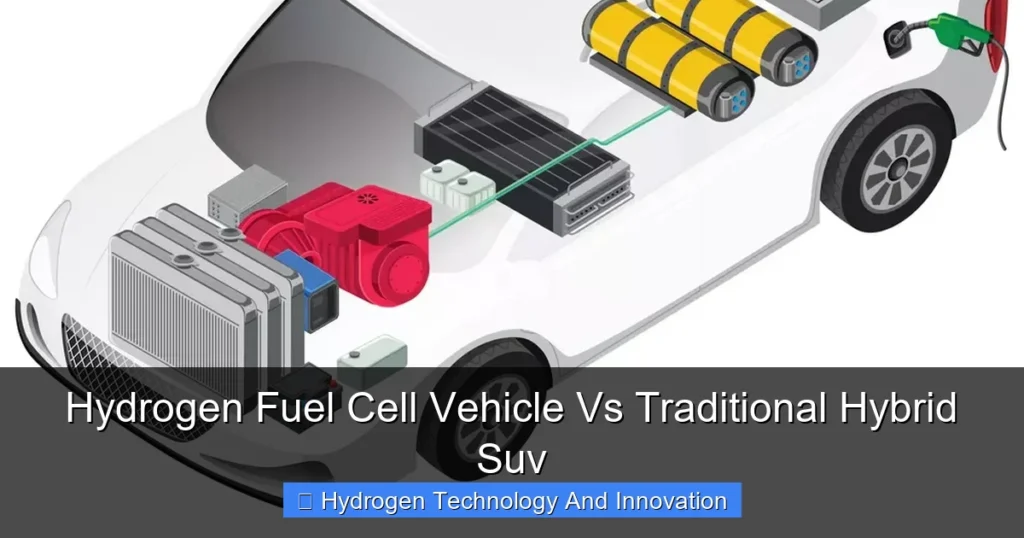
Hydrogen fuel cell vehicles run on electricity, but unlike battery-electric cars, they don’t rely on plugging into the grid. Instead, they generate their own electricity using a fuel cell stack. Here’s how it works: hydrogen gas is stored in high-pressure tanks within the vehicle. When you press the accelerator, hydrogen flows into the fuel cell, where it reacts with oxygen from the air. This chemical reaction produces electricity, which powers the electric motor. The only byproduct? Pure water vapor, which drips out of the tailpipe.
This process is incredibly efficient and silent, giving FCEVs a smooth, quiet ride similar to electric vehicles. The fuel cell itself has no moving parts, which reduces wear and tear. However, the technology is complex and requires precise conditions to operate efficiently. For example, the fuel cell must stay within a certain temperature range, and the hydrogen must be extremely pure to avoid damaging the delicate membranes inside the cell.
Traditional Hybrid SUVs: The Best of Both Worlds
Hybrid SUVs, on the other hand, use a dual-power system. They have a gasoline engine and an electric motor, both of which can power the wheels—sometimes together, sometimes independently. The electric motor is powered by a battery that recharges through regenerative braking and, in some cases, by the gasoline engine itself.
There are two main types of hybrids: full hybrids and plug-in hybrids (PHEVs). Full hybrids, like the Honda CR-V Hybrid, can’t be plugged in—they manage their battery charge automatically. Plug-in hybrids, such as the Toyota RAV4 Prime, have larger batteries and can be charged from an external power source, allowing for short all-electric driving ranges (typically 20–50 miles) before switching to hybrid mode.
The beauty of hybrid technology lies in its simplicity and adaptability. It doesn’t require new infrastructure—you can fill up at any gas station—and it significantly improves fuel economy. For example, a conventional SUV might get 20 miles per gallon (mpg), while a hybrid version could achieve 35–40 mpg. That’s a huge improvement without asking drivers to change their routines.
Key Differences in Energy Source and Storage
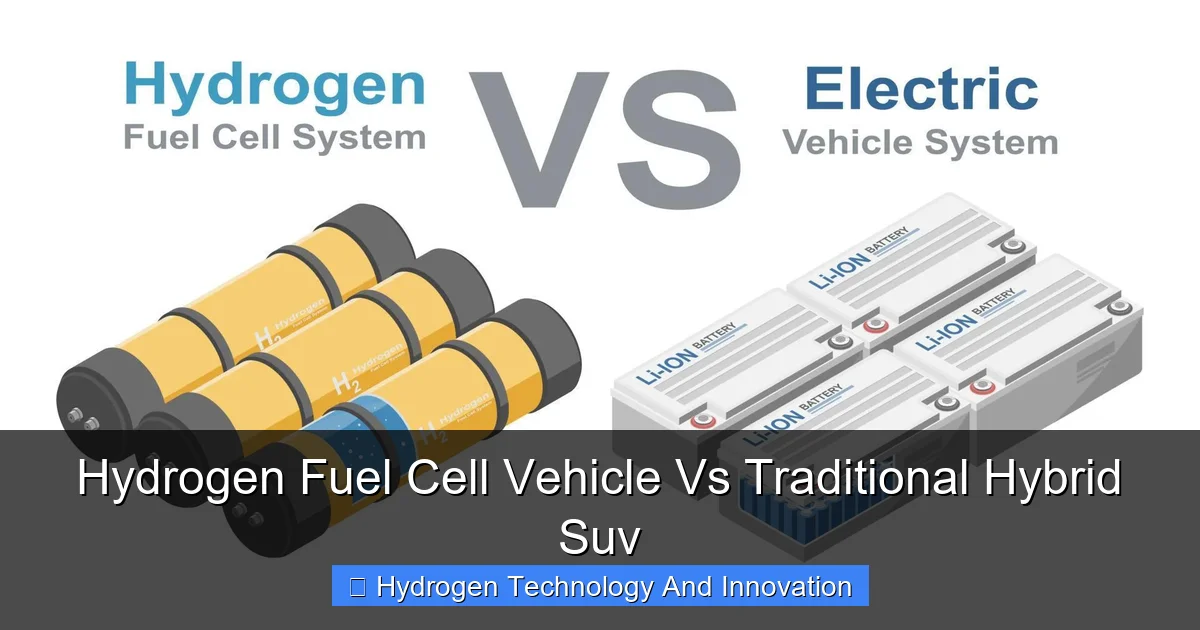
One of the biggest distinctions between these two technologies is how they store and use energy. Hybrid SUVs rely on liquid gasoline and a small battery, both of which are mature, well-understood technologies. Gasoline has a high energy density, meaning it packs a lot of power into a small volume, which is why gas-powered cars can travel long distances on a single tank.
Hydrogen, while also energy-dense by weight, is less dense by volume—even when compressed. That’s why FCEVs need large, heavy tanks to store enough hydrogen for a decent range. These tanks are made of advanced composite materials to withstand high pressures (up to 10,000 psi), but they add weight and cost to the vehicle.
Another key difference is energy conversion. In a hybrid, chemical energy (gasoline) is converted directly into mechanical energy (motion) with some electrical assistance. In a fuel cell vehicle, chemical energy (hydrogen) is converted into electrical energy, which then powers the motor. This extra step can lead to energy losses, but it also allows for smoother, more efficient operation in certain conditions.
Environmental Impact: Which Is Greener?
When it comes to protecting the planet, both hydrogen fuel cell vehicles and hybrid SUVs offer clear advantages over traditional gasoline cars. But which one is truly the greener choice? The answer depends on how you define “green”—and where your energy comes from.
Tailpipe Emissions: The Obvious Winner
Let’s start with the most visible metric: tailpipe emissions. Hybrid SUVs still burn gasoline, so they emit carbon dioxide (CO₂), nitrogen oxides (NOx), and other pollutants—though significantly less than conventional vehicles. For example, the Toyota RAV4 Hybrid emits about 150 grams of CO₂ per kilometer, compared to 200+ grams for a standard RAV4.
Hydrogen fuel cell vehicles, by contrast, emit nothing but water vapor. No CO₂, no smog-forming pollutants, no particulate matter. From a local air quality standpoint, FCEVs are unbeatable. If you live in a city with poor air quality, driving an FCEV could make a real difference in reducing your environmental footprint.
Well-to-Wheel Emissions: The Hidden Story
But here’s the catch: what comes out of the tailpipe is only part of the story. To get a full picture, we need to look at “well-to-wheel” emissions—that is, the total environmental impact from producing the fuel to powering the vehicle.
For hybrid SUVs, this means considering how gasoline is extracted, refined, and transported. While hybrids use less gas, they still rely on fossil fuels, which contribute to climate change throughout their lifecycle.
For hydrogen vehicles, the environmental impact hinges on how the hydrogen is made. Currently, about 95% of hydrogen is produced from natural gas through a process called steam methane reforming (SMR). This method releases CO₂, meaning that most hydrogen today is not truly “clean.” It’s often called “gray hydrogen.”
However, there’s a growing push for “green hydrogen,” which is produced using renewable energy (like wind or solar) to split water into hydrogen and oxygen via electrolysis. This process emits no greenhouse gases. If the hydrogen in your FCEV comes from green sources, its well-to-wheel emissions can be near zero. But right now, green hydrogen makes up less than 1% of global production.
Manufacturing and Battery Concerns
Another factor to consider is the environmental cost of manufacturing. Both types of vehicles require batteries, but the chemistry and size differ. Hybrid SUVs use smaller nickel-metal hydride (NiMH) or lithium-ion batteries, which have a lower environmental impact than the large batteries in electric vehicles.
FCEVs also use small lithium-ion batteries to assist the fuel cell and capture energy from regenerative braking. However, they require expensive materials like platinum in the fuel cell stack, which is mined in environmentally damaging ways. Recycling infrastructure for these materials is still in its infancy.
That said, over the lifetime of the vehicle, FCEVs can offset their manufacturing footprint if they’re powered by clean hydrogen. Hybrids, while cleaner than gas cars, will always have some level of ongoing emissions due to gasoline use.
Real-World Example: California’s Clean Air Push
California offers a great case study. The state has invested heavily in hydrogen infrastructure and offers incentives for FCEV buyers. Drivers in Los Angeles or San Francisco can refuel at one of over 50 hydrogen stations and enjoy access to carpool lanes, even with a single occupant.
But despite these perks, adoption remains low. Why? Because most hydrogen in California is still produced from natural gas. While it’s cleaner than gasoline on a well-to-wheel basis, it’s not the zero-emission solution many hoped for. Meanwhile, hybrid SUVs continue to dominate the market due to their affordability and convenience.
Performance and Driving Experience
Beyond environmental concerns, most drivers care about how a vehicle feels on the road. Is it smooth? Responsive? Fun to drive? Let’s compare the performance of hydrogen fuel cell vehicles and hybrid SUVs.
Acceleration and Power Delivery
Both FCEVs and hybrid SUVs use electric motors to drive the wheels, which means instant torque and smooth acceleration. There’s no lag like you might feel with a traditional gasoline engine.
The Toyota Mirai, for example, can go from 0 to 60 mph in about 9 seconds—decent, but not thrilling. The Hyundai Nexo is slightly quicker. These times are comparable to many hybrid SUVs, like the Ford Escape Hybrid, which also hits 60 mph in around 8.5 seconds.
However, plug-in hybrids like the RAV4 Prime offer a different experience. With 302 horsepower, the RAV4 Prime can sprint to 60 mph in just 5.8 seconds—faster than many gas-powered SUVs. That’s because it combines a powerful electric motor with a gasoline engine, giving it a performance edge.
Range and Refueling
Range anxiety is a real concern for eco-conscious drivers. How far can you go before needing to refuel or recharge?
Hydrogen fuel cell vehicles typically offer a range of 300–400 miles on a full tank—similar to many gasoline cars. Refueling takes just 3–5 minutes at a hydrogen station, making it as convenient as filling up with gas.
Hybrid SUVs, especially non-plug-in models, also offer excellent range—often 500+ miles on a tank of gas. Plug-in hybrids have shorter electric-only ranges (20–50 miles), but once the battery is depleted, they switch to hybrid mode, extending total range to 500+ miles.
The key difference? Refueling time. While hydrogen is fast, charging a plug-in hybrid takes hours unless you have access to a fast charger. For drivers who take long road trips or don’t have home charging, this can be a dealbreaker.
Handling and Ride Quality
In terms of driving dynamics, both types of vehicles are designed for comfort and practicality. Hybrid SUVs tend to have a familiar feel—similar to traditional SUVs but with smoother transitions between gas and electric power.
FCEVs, with their heavy hydrogen tanks and low center of gravity, often feel more planted on the road. The Toyota Mirai, for instance, has a sporty suspension setup that makes it handle like a sedan, despite its SUV-like size.
Noise levels are another advantage for FCEVs. With no internal combustion engine, they’re whisper-quiet, especially at low speeds. Hybrids are also quiet in electric mode, but the gas engine can become noticeable when accelerating or climbing hills.
Practical Example: Daily Commute vs. Road Trip
Imagine two drivers: Sarah, who commutes 30 miles daily in a city, and Mike, who takes monthly road trips across the country.
Sarah might prefer a plug-in hybrid SUV. She can charge it overnight at home, drive most of her commute on electricity, and rarely use gas. She saves money on fuel and reduces emissions without changing her routine.
Mike, on the other hand, values convenience and speed. He doesn’t want to hunt for charging stations on long drives. A hydrogen fuel cell vehicle would suit him better—quick refueling and long range mean less downtime on the road.
Cost and Ownership: What’s the Real Price Tag?
Let’s talk money. Eco-friendly vehicles often come with a premium price tag, but the total cost of ownership includes more than just the sticker price.
Upfront Cost
Hybrid SUVs are generally more affordable. The Toyota RAV4 Hybrid starts around $32,000, while the Ford Escape Hybrid begins at about $28,000. Plug-in hybrids are pricier—the RAV4 Prime starts at $43,000—but still within reach for many buyers.
Hydrogen fuel cell vehicles are significantly more expensive. The Toyota Mirai starts at around $50,000, and the Hyundai Nexo is priced similarly. These vehicles are often leased rather than purchased, with deals that include free hydrogen for several years.
Fuel and Maintenance Costs
Gas prices fluctuate, but hybrids save money by using less fuel. The RAV4 Hybrid gets about 40 mpg combined, compared to 30 mpg for the gas-only version. Over 15,000 miles a year, that’s a savings of $300–$500 annually, depending on gas prices.
Hydrogen is currently expensive—around $16 per kilogram. A Mirai uses about 1 kg per 60 miles, so fueling up costs about $80 for a 300-mile range. That’s comparable to premium gasoline, but with fewer stations and less convenience.
Maintenance is another factor. Hybrids have proven reliability and lower repair costs. Most components are shared with conventional vehicles, so mechanics are familiar with them.
FCEVs are newer and more complex. Fuel cells can degrade over time, and replacement costs are high. There are also fewer service centers, especially outside California. However, because they have fewer moving parts than gas engines, some maintenance items (like oil changes) are eliminated.
Incentives and Resale Value
Both vehicle types qualify for federal and state incentives. In the U.S., plug-in hybrids and FCEVs may be eligible for a federal tax credit of up to $7,500. Some states, like California, offer additional rebates.
Resale value is harder to predict. Hybrids hold their value well due to high demand and proven reliability. FCEVs, with limited models and infrastructure, may depreciate faster—though this could change as the technology matures.
Infrastructure and Practicality: Can You Live With It?
No matter how advanced a vehicle is, it’s only useful if you can actually use it. Infrastructure plays a huge role in real-world adoption.
Refueling and Charging Access
Hybrid SUVs win hands down here. You can fill up at any gas station, and plug-in models can charge at home or public stations. There are over 150,000 gas stations in the U.S. and growing numbers of EV chargers.
Hydrogen stations are scarce. As of 2024, there are fewer than 100 public hydrogen stations in the U.S., with most in California. Planning a road trip? You’ll need to map your route carefully to avoid running out of fuel.
Home Refueling Options
One potential advantage for FCEVs is home refueling. Companies like H2GO and Plug are developing home hydrogen generators that use water and electricity to produce hydrogen on demand. If this technology becomes affordable and safe, it could revolutionize FCEV ownership.
For now, however, home hydrogen refueling is not practical for most people. It requires significant space, permits, and a reliable source of clean electricity.
Urban vs. Rural Living
If you live in a city with good public transit and short commutes, a plug-in hybrid might be ideal. You can charge at home and rarely use gas.
In rural areas, where charging stations are sparse and distances are long, a hybrid SUV offers the best balance of efficiency and convenience. FCEVs are currently impractical outside major metropolitan areas.
The Future: Where Are We Headed?
Technology evolves fast. What’s cutting-edge today might be obsolete tomorrow. So where do hydrogen fuel cell vehicles and hybrid SUVs fit in the future of transportation?
Hydrogen’s Niche: Trucks, Buses, and Beyond
While FCEVs may struggle in the passenger car market, hydrogen has strong potential in heavy-duty applications. Trucks, buses, and trains need long range and quick refueling—exactly where hydrogen shines. Companies like Nikola and Toyota are already testing hydrogen-powered trucks.
Hybrids as a Bridge Technology
Hybrid SUVs are likely to remain popular for years to come. They offer a practical, affordable way to reduce emissions without requiring major infrastructure changes. As battery technology improves, we may see more plug-in hybrids with longer electric ranges.
The Rise of Battery Electric Vehicles
Don’t forget about fully electric vehicles (EVs). With falling battery costs and expanding charging networks, EVs are becoming the dominant force in clean transportation. Both FCEVs and hybrids may eventually be overshadowed by EVs—unless hydrogen infrastructure improves dramatically.
Conclusion: Which One Is Right for You?
Choosing between a hydrogen fuel cell vehicle and a traditional hybrid SUV isn’t a simple decision. It depends on your priorities, lifestyle, and location.
If you value convenience, affordability, and proven technology, a hybrid SUV is likely the better choice. It’s practical, widely available, and significantly cleaner than a gas-powered vehicle.
If you’re passionate about cutting-edge innovation, live in an area with hydrogen infrastructure, and want zero tailpipe emissions, an FCEV could be worth the investment—especially if you can lease it with fuel included.
Ultimately, both technologies play a role in the transition to a cleaner transportation future. As infrastructure improves and production scales up, hydrogen may become more viable. But for now, hybrids remain the most practical path to greener driving for the average consumer.
Frequently Asked Questions
Are hydrogen fuel cell vehicles really zero emission?
Hydrogen fuel cell vehicles emit only water vapor from the tailpipe, making them zero-emission at the point of use. However, the overall environmental impact depends on how the hydrogen is produced—green hydrogen from renewables is truly clean, while most hydrogen today comes from natural gas.
Can I charge a hybrid SUV at home?
Only plug-in hybrid SUVs can be charged at home using a standard outlet or Level 2 charger. Full hybrids recharge their batteries through regenerative braking and the gasoline engine, so they don’t need to be plugged in.
How long does it take to refuel a hydrogen car?
Refueling a hydrogen fuel cell vehicle takes about 3–5 minutes, similar to filling up a gasoline car. This is much faster than charging an electric vehicle, making it ideal for long trips.
Are hybrid SUVs more reliable than hydrogen vehicles?
Yes, hybrid SUVs have been on the market for over 20 years and have proven reliability. Hydrogen vehicles are newer, with fewer service centers and higher repair costs, though they have fewer moving parts than gas engines.
Can I drive a hydrogen car outside California?
Currently, hydrogen refueling stations are mostly limited to California, with a few in Hawaii and the Northeast. Driving an FCEV outside these areas is impractical due to lack of infrastructure.
Will hydrogen cars replace electric vehicles?
Unlikely in the near term. Battery electric vehicles are advancing rapidly with better batteries and charging networks. Hydrogen may find a niche in heavy transport, but for passenger cars, EVs currently have the edge in cost and convenience.