Hydrogen vehicles are engineered using advanced fuel cell technology, lightweight materials, and precision manufacturing. This article breaks down the step-by-step process—from sourcing hydrogen to final assembly—revealing how these eco-friendly cars are built to deliver zero-emission performance.
Key Takeaways
- Hydrogen vehicles rely on fuel cells to convert hydrogen into electricity: Unlike battery-electric cars, they generate power onboard using a chemical reaction between hydrogen and oxygen.
- High-pressure hydrogen tanks are critical for storage: These tanks are made from carbon fiber composites to safely hold hydrogen at up to 700 bar pressure.
- Fuel cell stacks are assembled with precision: Multiple individual cells are layered and compressed to form a stack that powers the electric motor.
- Lightweight materials improve efficiency: Aluminum, carbon fiber, and advanced polymers reduce vehicle weight, extending range and performance.
- Manufacturing integrates electric and hydrogen systems: Engineers combine electric motors, power electronics, and hydrogen infrastructure into a seamless drivetrain.
- Safety is a top priority in design and production: Multiple layers of protection, sensors, and fail-safes prevent leaks and ensure safe operation.
- Production is scaling with growing demand: Automakers are investing in dedicated hydrogen vehicle lines and partnerships to meet future market needs.
📑 Table of Contents
How Are Hydrogen Vehicles Made?
Imagine a car that runs on clean energy, emits only water vapor, and refuels in minutes—just like a gasoline vehicle. That’s the promise of hydrogen vehicles, a revolutionary step in sustainable transportation. But how exactly are these futuristic machines built? From the chemistry inside the fuel cell to the assembly line where every component is carefully integrated, the manufacturing process of hydrogen vehicles is a blend of cutting-edge engineering and meticulous craftsmanship.
Unlike traditional internal combustion engines or even battery-electric vehicles, hydrogen-powered cars use a unique system to generate electricity. Instead of storing large batteries, they carry compressed hydrogen gas in high-strength tanks. This hydrogen is then fed into a fuel cell, where it reacts with oxygen from the air to produce electricity—powering the motor and emitting nothing but water. This process, known as electrochemical conversion, is clean, quiet, and incredibly efficient.
But building a vehicle around this technology isn’t simple. It requires specialized components, advanced materials, and a deep understanding of both hydrogen safety and electric drivetrains. In this article, we’ll take you behind the scenes to explore how hydrogen vehicles are made—from the design phase to final assembly. Whether you’re a tech enthusiast, an eco-conscious driver, or just curious about the future of mobility, this guide will give you a clear, easy-to-understand look at the innovation driving hydrogen transportation.
The Core Technology: Fuel Cells and How They Work
Visual guide about How Are Hydrogen Vehicles Made?
Image source: fleetpoint.org
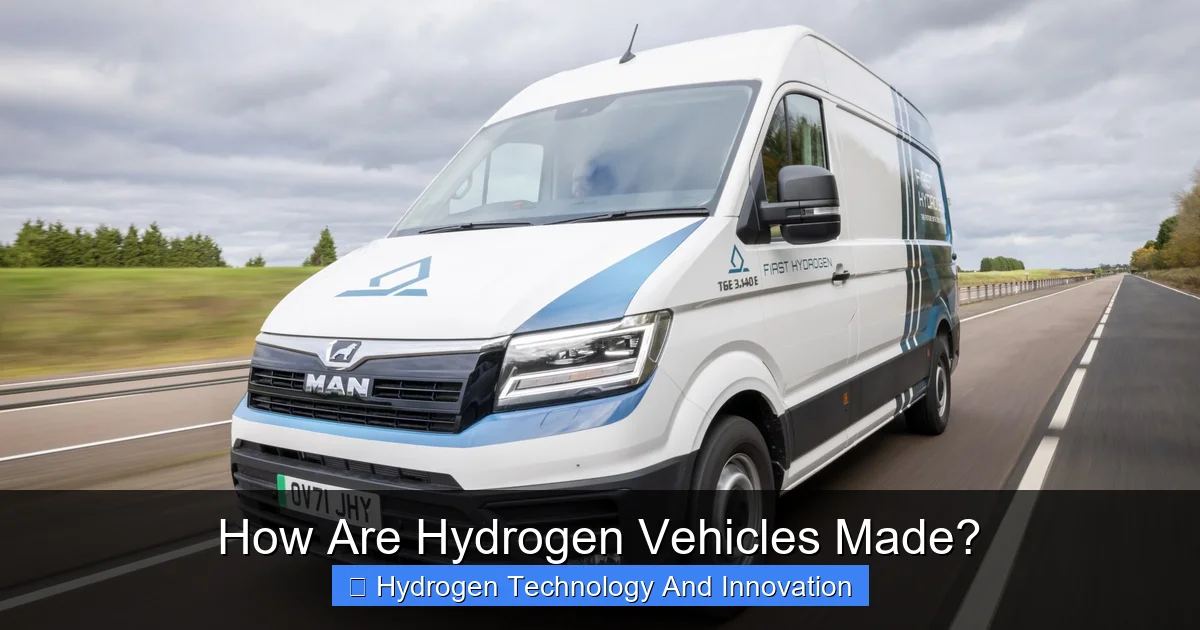
At the heart of every hydrogen vehicle is the fuel cell—a device that converts hydrogen into electricity without combustion. Think of it as a mini power plant on wheels. But how does it actually work, and how is it built?
Understanding the Fuel Cell Stack
A fuel cell isn’t a single unit; it’s made up of many smaller cells stacked together, much like slices of bread in a loaf. Each individual cell contains three main parts: an anode, a cathode, and an electrolyte membrane. When hydrogen gas enters the anode side, it’s split into protons and electrons thanks to a catalyst—usually platinum. The protons pass through the electrolyte membrane to the cathode, while the electrons are forced to travel through an external circuit, creating an electric current. At the cathode, the protons, electrons, and oxygen from the air combine to form water—the only emission.
This entire process happens silently and efficiently, producing electricity to power the vehicle’s motor. The more cells you stack, the more power you generate. A typical fuel cell stack in a passenger car might have 300 to 400 individual cells, producing around 100 kilowatts of power—enough to drive a sedan or SUV.
Materials and Manufacturing Precision
Building a fuel cell stack requires extreme precision. Each membrane electrode assembly (MEA)—the core of the cell—must be perfectly aligned and sealed to prevent gas leaks and ensure optimal performance. These MEAs are sandwiched between bipolar plates, usually made of graphite or coated metal, which distribute hydrogen and oxygen evenly across the surface.
The manufacturing process often involves automated machinery that applies thin layers of catalyst onto the membrane, laminates the components, and compresses the stack under high pressure. Even tiny imperfections can reduce efficiency or cause failure, so quality control is critical. Some manufacturers use laser welding and vacuum sealing to ensure airtight connections.
One challenge is the use of platinum, a rare and expensive metal. Researchers are working to reduce or replace platinum with alternative catalysts, but for now, it remains a key component. To minimize cost, manufacturers use ultra-thin layers—sometimes just a few micrometers thick—maximizing surface area while using as little platinum as possible.
Cooling and Humidification Systems
Fuel cells generate heat, and they also need to stay moist to function efficiently. That’s why every hydrogen vehicle includes a cooling system—similar to a radiator in a gasoline car—to regulate temperature. Coolant flows through channels in the bipolar plates, absorbing excess heat and maintaining the stack at an ideal operating range, usually between 60°C and 80°C.
Additionally, the membrane must stay hydrated. If it dries out, performance drops. So, many systems include a humidifier that adds moisture to the incoming hydrogen and air streams. This ensures the membrane stays flexible and conductive.
All these components—the stack, cooling, humidification, and control electronics—are housed in a protective casing, often made of lightweight aluminum or composite materials. The entire fuel cell system is then mounted in the vehicle, usually under the floor or in the engine bay, depending on the design.
Hydrogen Storage: High-Pressure Tanks and Safety
One of the biggest challenges in hydrogen vehicle design is storing enough fuel to provide a reasonable driving range. Hydrogen is the lightest element, but it’s also the least dense. To carry enough for 300–400 miles, it must be compressed to extremely high pressures—up to 700 bar (over 10,000 psi). That’s where high-pressure hydrogen tanks come in.
Types of Hydrogen Tanks
There are four main types of hydrogen storage tanks, classified by their construction:
– Type I: All-metal tanks, usually steel. Heavy and rarely used in vehicles due to weight.
– Type II: Metal tanks with a partial composite wrap. Still too heavy for most cars.
– Type III: Aluminum liner with a full carbon fiber composite wrap. Lighter and stronger, used in some early models.
– Type IV: Polymer (plastic) liner with full carbon fiber wrap. The lightest and most common in modern hydrogen vehicles.
Most hydrogen cars today use Type IV tanks. They’re made by first forming a hollow plastic liner, then wrapping it layer by layer with carbon fiber tape under high tension. The carbon fiber provides strength, while the plastic liner prevents hydrogen from escaping. The tank is then cured in an oven to harden the composite.
Manufacturing and Testing
Building a hydrogen tank is a highly controlled process. The carbon fiber layers must be applied at precise angles and pressures to ensure even strength. Any weak spots could lead to failure under pressure. After winding, the tank undergoes rigorous testing—including burst tests, where it’s pressurized beyond its limits to ensure safety margins.
Each tank is also equipped with a thermal pressure relief device (TPRD), a safety valve that releases hydrogen if the tank gets too hot—like in a fire. This prevents explosion by venting gas safely away from the vehicle.
In a typical hydrogen car, you’ll find two to four tanks, depending on size and range. They’re strategically placed—often under the rear seats or in the trunk—to maximize space and protect them in a crash. The tanks are connected by a network of valves, sensors, and tubing that regulate flow to the fuel cell.
Safety Features and Redundancies
Safety is paramount in hydrogen vehicle design. Even though hydrogen is lighter than air and disperses quickly, manufacturers build in multiple layers of protection. Sensors monitor for leaks, and if hydrogen is detected, the system can shut off valves and alert the driver. The tanks themselves are designed to withstand impacts, punctures, and extreme temperatures.
In crash tests, hydrogen vehicles perform as well as—or better than—conventional cars. The tanks are tested for side impacts, rollovers, and even gunfire penetration. Automakers like Toyota, Hyundai, and Honda have demonstrated the safety of their hydrogen models through extensive real-world and laboratory testing.
Electric Drivetrain Integration
While hydrogen vehicles use fuel cells to generate electricity, they still rely on many of the same components as battery-electric vehicles (BEVs). The electric motor, power electronics, and transmission must be carefully integrated to deliver smooth, responsive performance.
The Electric Motor and Power Electronics
Most hydrogen vehicles use a permanent magnet synchronous motor (PMSM), similar to those in Tesla or Nissan Leaf models. These motors are efficient, compact, and deliver high torque at low speeds—perfect for city driving and quick acceleration.
The electricity from the fuel cell isn’t used directly. It first passes through a DC-DC converter, which adjusts the voltage to match the motor’s needs. A power control unit (PCU) manages the flow of electricity, directing power to the motor, charging a small auxiliary battery, or sending energy to accessories like air conditioning and infotainment.
Unlike BEVs, hydrogen vehicles don’t need large battery packs for energy storage. Instead, they use a smaller lithium-ion battery—typically 1–2 kWh—to handle peak power demands, such as rapid acceleration or regenerative braking. This battery is charged by the fuel cell and helps balance the load, improving efficiency and responsiveness.
Regenerative Braking and Energy Recovery
Just like in electric cars, hydrogen vehicles use regenerative braking to capture energy when slowing down. When the driver lifts off the accelerator or presses the brake, the electric motor switches to generator mode, converting kinetic energy back into electricity. This energy is stored in the auxiliary battery or used immediately to power the vehicle.
This system improves overall efficiency and reduces wear on the mechanical brakes. It also contributes to a smoother driving experience, with seamless transitions between acceleration and deceleration.
Thermal Management
Electric motors and power electronics generate heat, so a comprehensive thermal management system is essential. Coolant circulates through the motor, inverter, and battery, maintaining optimal temperatures. In cold weather, the system may use electric heaters to warm the battery and cabin, ensuring reliable performance.
Some vehicles also use waste heat from the fuel cell to warm the interior, reducing the need for additional heating systems. This integration of thermal systems improves energy efficiency and passenger comfort.
Vehicle Design and Lightweight Materials
To maximize range and performance, hydrogen vehicles are designed with aerodynamics and weight in mind. Every component is optimized to reduce drag and minimize mass.
Aerodynamic Shaping
Hydrogen cars often feature sleek, streamlined bodies to cut through the air with minimal resistance. Designers use wind tunnels and computer simulations to refine shapes, smoothing edges, adding underbody panels, and integrating active aerodynamics—like adjustable spoilers or grille shutters—that open and close based on speed.
For example, the Toyota Mirai has a low drag coefficient of around 0.24, comparable to high-end sports cars. This helps it achieve a range of over 400 miles on a full tank of hydrogen.
Use of Lightweight Materials
Weight is a major factor in vehicle efficiency. Heavier cars require more energy to accelerate and maintain speed. To offset the weight of hydrogen tanks and fuel cell systems, manufacturers use advanced lightweight materials:
– Aluminum: Used for body panels, suspension components, and frames. It’s lighter than steel and resists corrosion.
– Carbon fiber reinforced polymer (CFRP): Extremely strong and lightweight, used in structural parts, hoods, and even entire body sections.
– High-strength steel: Used in critical safety zones, like the passenger cage, to protect occupants in a crash.
For instance, the Hyundai NEXO uses a mix of aluminum and high-strength steel to reduce weight while maintaining rigidity. The result is a vehicle that’s both safe and efficient.
Modular Platforms and Shared Components
To reduce costs and speed up production, some automakers are developing modular platforms that can support both hydrogen and battery-electric vehicles. These platforms share common architectures, allowing manufacturers to produce multiple models on the same assembly line.
This approach also simplifies maintenance and repairs, as many components—like suspension, steering, and electronics—are interchangeable. It’s a smart strategy as the market for alternative fuel vehicles grows.
Assembly Line: From Components to Finished Vehicle
Once all the parts are manufactured, it’s time to assemble the vehicle. The process is similar to traditional car manufacturing but with added steps for hydrogen systems.
Body-in-White and Frame Construction
The assembly begins with the body-in-white—the bare metal frame of the car. Robots weld and rivet the structure, forming the foundation for all other components. This stage includes installing safety features like crumple zones and side-impact beams.
Next, the lightweight materials are added: aluminum panels, carbon fiber parts, and high-strength steel reinforcements. The frame is then moved to the next station for painting and sealing.
Powertrain and Fuel Cell Installation
The electric motor, transmission, and fuel cell system are installed next. The fuel cell stack is mounted in a secure, vibration-dampened enclosure, often under the floor for better weight distribution. High-pressure hydrogen tanks are carefully positioned and connected to the fuel delivery system.
Technicians use specialized tools to tighten fittings and test for leaks. Every connection is checked with helium leak detectors or pressure sensors to ensure integrity.
Electrical and Software Integration
With the hardware in place, the focus shifts to electronics and software. Wiring harnesses are routed throughout the vehicle, connecting the fuel cell, motor, battery, sensors, and control units. The vehicle’s onboard computer—often called the vehicle control unit (VCU)—is programmed to manage all systems.
Software calibration is critical. Engineers fine-tune parameters like power delivery, braking response, and thermal management to ensure smooth operation. Over-the-air updates may be used later to improve performance or add features.
Final Testing and Quality Assurance
Before a hydrogen vehicle leaves the factory, it undergoes extensive testing. This includes:
– Pressure tests on hydrogen tanks and lines
– Leak detection using sensors and visual inspections
– Road simulations to check handling, acceleration, and braking
– Emissions testing (to confirm only water vapor is produced)
– Cold-weather and high-temperature trials
Each vehicle is also inspected for cosmetic flaws, proper alignment, and functional systems. Only after passing all checks does it receive a certification and move to the dealership.
Challenges and Future Innovations
While hydrogen vehicles offer a clean, efficient alternative to fossil fuels, they face several challenges in manufacturing and adoption.
Cost and Scalability
Currently, hydrogen vehicles are more expensive than gasoline or battery-electric cars. The fuel cell stack, hydrogen tanks, and specialized materials drive up costs. However, as production scales and technology improves, prices are expected to fall.
Automakers are investing in larger production facilities and partnerships with hydrogen suppliers. For example, Toyota and Hyundai are building dedicated hydrogen vehicle lines, while companies like Nikola and Hyzon are focusing on hydrogen trucks and commercial vehicles.
Infrastructure and Refueling
One of the biggest hurdles is the lack of hydrogen refueling stations. Unlike electric chargers, which are becoming common, hydrogen stations are still rare—especially outside California, Japan, and parts of Europe.
Manufacturers are working with governments and energy companies to expand infrastructure. Mobile refueling units and home hydrogen generators are also being explored.
Green Hydrogen and Sustainability
For hydrogen vehicles to be truly sustainable, the hydrogen must be produced using renewable energy. Currently, most hydrogen is made from natural gas, which emits carbon. But “green hydrogen,” produced via electrolysis using solar or wind power, is growing in availability.
As green hydrogen becomes more widespread, the environmental benefits of hydrogen vehicles will increase. Manufacturers are also exploring ways to recycle fuel cells and tanks at the end of their life, reducing waste and conserving resources.
Conclusion
Hydrogen vehicles represent a bold step toward a cleaner, more sustainable future. From the precision engineering of fuel cells to the high-strength tanks that safely store hydrogen, every aspect of their design reflects innovation and care. While challenges remain—especially in cost and infrastructure—the technology is advancing rapidly.
As automakers continue to refine manufacturing processes and governments support clean energy initiatives, hydrogen vehicles are poised to play a key role in the transportation revolution. Whether you’re driving a sedan, SUV, or heavy-duty truck, the future of mobility may well run on hydrogen.
By understanding how these vehicles are made, we gain insight into the science, engineering, and vision behind them. It’s not just about replacing gasoline—it’s about reimagining how we move, with respect for the planet and the generations to come.
Frequently Asked Questions
How do hydrogen vehicles generate electricity?
Hydrogen vehicles use a fuel cell to convert hydrogen gas into electricity through a chemical reaction with oxygen. This process produces only water and heat as byproducts, making it completely clean.
Are hydrogen vehicles safe in a crash?
Yes, hydrogen vehicles are designed with multiple safety features, including high-strength tanks, leak sensors, and pressure relief devices. They undergo rigorous crash testing and perform as well as conventional vehicles.
How long does it take to refuel a hydrogen vehicle?
Refueling a hydrogen vehicle takes about 3 to 5 minutes, similar to filling up a gasoline car. This is much faster than charging a battery-electric vehicle.
What materials are used to make hydrogen tanks?
Most hydrogen tanks are made from a plastic liner wrapped in layers of carbon fiber. This Type IV design is lightweight, strong, and capable of withstanding pressures up to 700 bar.
Can hydrogen vehicles be charged at home?
Currently, home hydrogen refueling is limited, but portable electrolyzers and home refueling units are being developed. Most drivers rely on public hydrogen stations.
How does the range of a hydrogen vehicle compare to electric cars?
Hydrogen vehicles typically offer a range of 300 to 400 miles, similar to many battery-electric cars. However, they refuel much faster, making them ideal for long-distance travel.