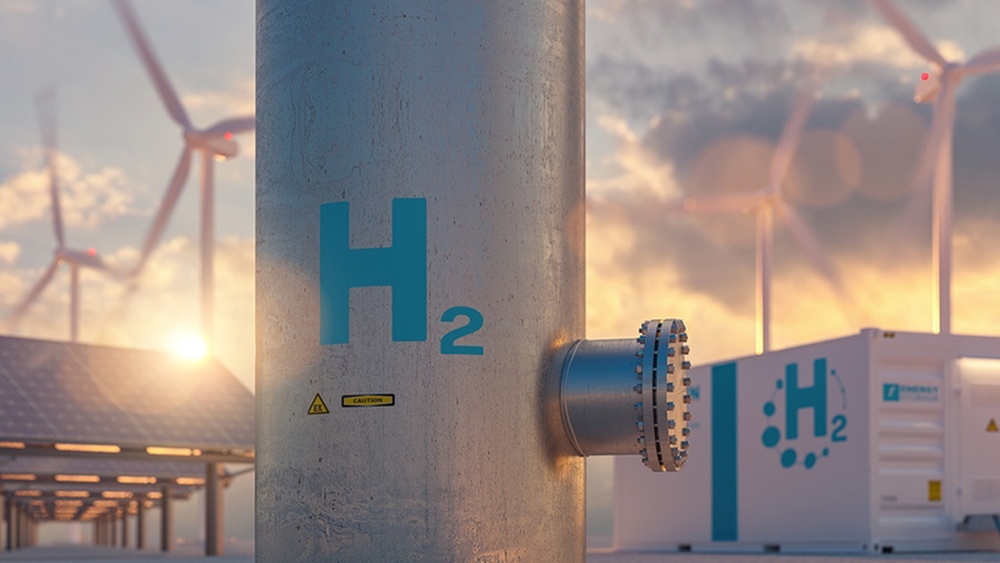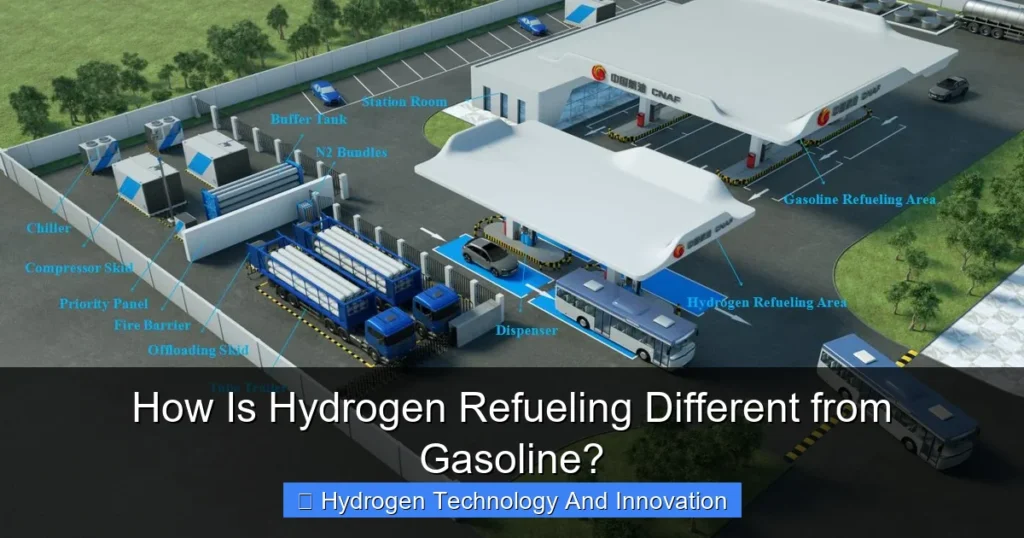
Hydrogen refueling is faster, cleaner, and safer than gasoline, but requires different infrastructure and technology. Unlike gasoline, hydrogen powers fuel cell vehicles with zero emissions—only water vapor exits the tailpipe. While refueling takes minutes, challenges like storage and station availability remain key differences.
Key Takeaways
- Refueling Speed: Hydrogen refueling takes 3–5 minutes, similar to gasoline, making it convenient for daily use.
- Zero Emissions: Hydrogen fuel cell vehicles emit only water vapor, unlike gasoline cars that release CO₂ and pollutants.
- Different Infrastructure: Hydrogen stations are fewer and more complex to build than gas stations due to high-pressure storage needs.
- Energy Density & Storage: Hydrogen has high energy by weight but low energy by volume, requiring compression or liquefaction for practical use.
- Safety Considerations: Hydrogen is flammable but disperses quickly; modern systems include multiple safety features to prevent leaks and fires.
- Cost & Availability: Hydrogen fuel is currently more expensive than gasoline, and refueling stations are mostly limited to California and parts of Europe.
- Environmental Impact: While hydrogen vehicles are clean, most hydrogen today is produced from natural gas—green hydrogen from renewables is the sustainable goal.
📑 Table of Contents
- How Is Hydrogen Refueling Different from Gasoline?
- Refueling Speed: Fast Like Gasoline, But Different Under the Hood
- Safety: Is Hydrogen More Dangerous Than Gasoline?
- Infrastructure: Fewer Stations, But Growing Fast
- Environmental Impact: Cleaner Driving, But How Clean Is the Hydrogen?
- Cost and Availability: Is Hydrogen Affordable?
- Technology and the Future of Hydrogen Refueling
- Conclusion: A Different Kind of Fuel for a Different Kind of Future
How Is Hydrogen Refueling Different from Gasoline?
Imagine pulling up to a fueling station, stepping out of your car, and filling it up in under five minutes—just like you would with gasoline. But instead of releasing harmful emissions, your car only emits clean water vapor. This isn’t science fiction. It’s the reality of hydrogen refueling, a technology that’s quietly reshaping the future of transportation.
Hydrogen refueling is one of the most promising alternatives to traditional gasoline, especially as the world pushes toward cleaner, more sustainable energy solutions. While both hydrogen and gasoline serve the same basic purpose—powering vehicles—they do so in fundamentally different ways. Understanding these differences is key to appreciating the potential of hydrogen as a mainstream fuel source.
In this article, we’ll explore how hydrogen refueling compares to gasoline across several critical areas: speed, safety, infrastructure, environmental impact, cost, and technology. Whether you’re a curious driver, an eco-conscious commuter, or someone interested in the future of clean energy, this guide will give you a clear, practical understanding of what makes hydrogen refueling unique—and why it matters.
Refueling Speed: Fast Like Gasoline, But Different Under the Hood
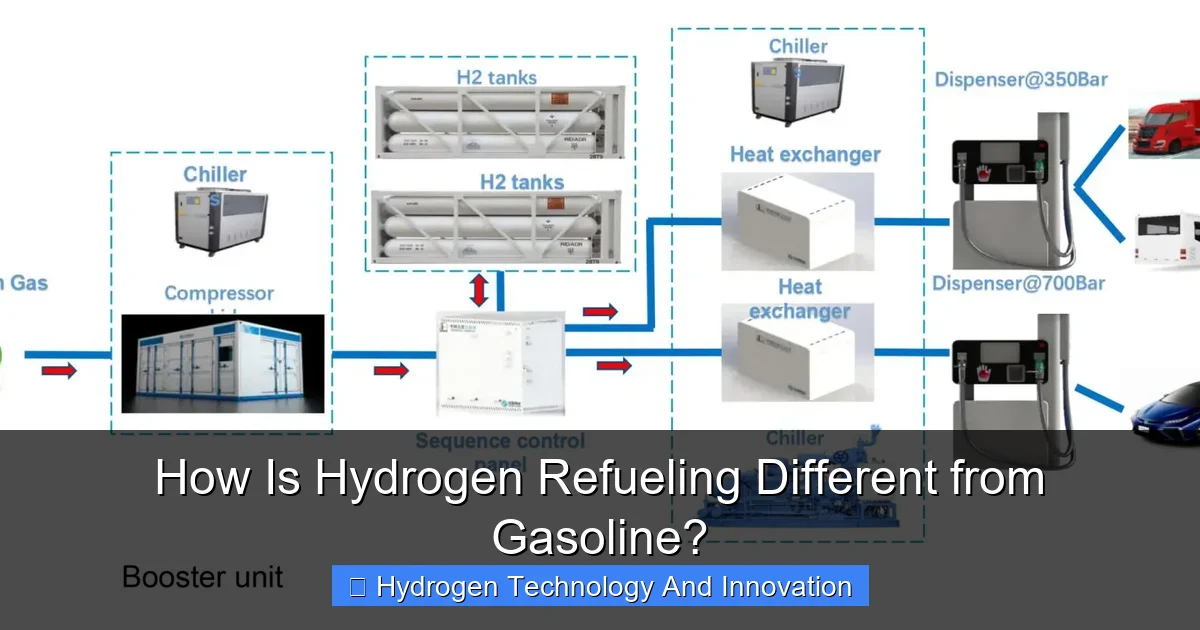
Visual guide about How Is Hydrogen Refueling Different from Gasoline?
Image source: sollant.com
One of the biggest misconceptions about hydrogen vehicles is that refueling takes a long time. In reality, hydrogen refueling is remarkably fast—often comparable to filling up a gasoline tank.
Most hydrogen fuel cell electric vehicles (FCEVs), like the Toyota Mirai or Hyundai NEXO, can be refueled in just 3 to 5 minutes. That’s about the same time it takes to pump gas into a conventional car. This quick turnaround makes hydrogen a strong contender for long-distance travel and commercial fleets, where downtime is costly.
But how does it work so fast? Unlike battery electric vehicles (BEVs), which require hours to recharge, hydrogen vehicles store compressed gas in high-pressure tanks. When you pull up to a hydrogen station, a dispenser connects to your car’s fuel port and pumps hydrogen gas directly into the tank—much like gasoline, but under much higher pressure.
How Hydrogen Refueling Works Step by Step
Here’s what happens during a typical hydrogen refuel:
– You drive up to a hydrogen refueling station and park near the dispenser.
– The nozzle is connected to your vehicle’s fuel receptacle, which is designed to prevent leaks and ensure a secure seal.
– The system checks for compatibility and safety before initiating the transfer.
– Compressed hydrogen gas (usually at 700 bar or 10,000 psi) is pumped into the onboard storage tanks.
– The process takes just a few minutes, and once complete, the nozzle automatically disconnects.
This process is automated and user-friendly, requiring no special training. In fact, many drivers say it feels nearly identical to using a gas pump—except there’s no smell, no fumes, and no risk of spills.
Why Speed Matters for Adoption
Refueling speed is a major factor in consumer acceptance. People are used to the convenience of gasoline—pull up, fill up, go. Any alternative fuel must match or exceed that experience to gain widespread adoption.
Hydrogen does just that. While BEVs are great for city driving and overnight charging, they struggle with long road trips due to charging times and limited range. Hydrogen FCEVs, on the other hand, offer the quick refueling of gasoline with the environmental benefits of electric power.
For example, a cross-country trip in a hydrogen-powered vehicle would involve brief stops every 300–400 miles—similar to a gasoline car. No waiting hours at a charging station. No range anxiety. Just clean, fast, reliable travel.
Safety: Is Hydrogen More Dangerous Than Gasoline?
Safety is one of the most common concerns people have about hydrogen. After all, hydrogen is highly flammable—it was, after all, the gas that caused the Hindenburg disaster in 1937. But modern hydrogen technology has come a long way since then, and today’s systems are designed with multiple layers of safety.
In fact, many experts argue that hydrogen is no more dangerous than gasoline—and in some ways, it’s safer.
Hydrogen vs. Gasoline: A Safety Comparison
Let’s break it down:
– **Flammability:** Hydrogen is flammable, but so is gasoline. However, hydrogen is much lighter than air and disperses quickly if leaked, reducing the risk of fire. Gasoline vapors, by contrast, are heavier than air and can pool near the ground, creating a more persistent fire hazard.
– **Ignition Energy:** Hydrogen requires less energy to ignite than gasoline, but it also has a wider range of flammability. This means it can ignite more easily, but it also burns faster and cleaner.
– **Leak Detection:** Modern hydrogen vehicles are equipped with multiple sensors that detect leaks instantly. If a leak is detected, the system can shut off the fuel supply and alert the driver.
– **Tank Strength:** Hydrogen tanks are made from advanced composite materials—often carbon fiber—that are incredibly strong. They’re designed to withstand high pressure, crashes, and even gunfire in safety tests.
Real-World Safety Records
Despite the fears, hydrogen vehicles have an excellent safety record. The National Fire Protection Association (NFPA) and the U.S. Department of Energy have both concluded that hydrogen is as safe as, or safer than, gasoline when proper protocols are followed.
For example, in crash tests, hydrogen tanks have remained intact even in high-impact collisions. And because hydrogen disperses upward and dissipates quickly, the risk of explosion in open areas is minimal.
Additionally, hydrogen refueling stations are built with safety in mind. They include emergency shut-off systems, flame detectors, ventilation, and remote monitoring. Many are located in open, well-ventilated areas to further reduce risks.
Practical Safety Tips for Drivers
If you’re driving a hydrogen vehicle, here are a few simple tips to stay safe:
– Always follow the manufacturer’s instructions for refueling.
– Never smoke or use open flames near a hydrogen station.
– If you smell a strange odor (hydrogen is odorless, but a scent is added for detection), exit the vehicle and move to a safe distance.
– Report any leaks or malfunctions immediately.
In short, hydrogen is not inherently dangerous—it’s just different. With the right technology and procedures, it’s a safe and reliable fuel for everyday use.
Infrastructure: Fewer Stations, But Growing Fast
One of the biggest differences between hydrogen and gasoline is infrastructure. While gasoline stations are everywhere—over 150,000 in the U.S. alone—hydrogen refueling stations are still rare.
As of 2024, there are fewer than 100 public hydrogen stations in the United States, with the vast majority located in California. Europe and parts of Asia (especially Japan and South Korea) are further ahead, with hundreds of stations in operation.
But why is hydrogen infrastructure so limited?
The Challenges of Building Hydrogen Stations
Building a hydrogen refueling station is more complex and expensive than building a gas station. Here’s why:
– **High-Pressure Storage:** Hydrogen must be stored at extremely high pressures (up to 10,000 psi) or as a liquid at very low temperatures (-253°C). This requires specialized tanks, compressors, and cooling systems.
– **Delivery Logistics:** Unlike gasoline, which can be transported by truck, hydrogen is harder to move. It can be delivered via tube trailers or produced on-site using electrolysis, but both methods are costly.
– **Regulatory Hurdles:** Hydrogen stations must meet strict safety codes and zoning requirements, which can delay construction.
– **High Upfront Costs:** A single hydrogen station can cost $1–2 million to build, compared to $500,000–$1 million for a gas station.
Where Hydrogen Stations Are Growing
Despite these challenges, the hydrogen infrastructure is expanding. California leads the way in the U.S., with over 60 stations and plans to reach 200 by 2025. The state offers incentives for both station developers and vehicle buyers, helping to drive adoption.
In Europe, countries like Germany, France, and the Netherlands are investing heavily in hydrogen. Germany’s H2 Mobility initiative aims to build a nationwide network of 1,000 stations by 2030.
Japan and South Korea are also leaders. Japan has over 160 hydrogen stations and is promoting hydrogen as part of its national energy strategy. South Korea plans to have 1,200 stations by 2040.
The Role of Government and Industry
Government support is crucial for hydrogen infrastructure. In the U.S., the Inflation Reduction Act includes tax credits for hydrogen production and infrastructure. The Department of Energy’s H2@Scale initiative aims to make hydrogen affordable and widely available.
Private companies are also stepping up. Toyota, Hyundai, and Honda have partnered with fuel providers to support station development. Startups like Plug Power and Nikola are building hydrogen production and distribution networks.
As demand grows and costs come down, hydrogen stations will become more common. And just like electric charging stations, they may eventually appear at shopping centers, rest stops, and workplaces.
Environmental Impact: Cleaner Driving, But How Clean Is the Hydrogen?
One of the biggest selling points of hydrogen vehicles is their environmental benefit. When powered by hydrogen, fuel cell vehicles emit only water vapor—no CO₂, no nitrogen oxides, no particulate matter.
But here’s the catch: the environmental impact depends on how the hydrogen is produced.
Grey, Blue, and Green Hydrogen
Not all hydrogen is created equal. There are three main types:
– **Grey Hydrogen:** Produced from natural gas through steam methane reforming. This is the most common method today, but it releases CO₂—about 9–12 kg of CO₂ per kg of hydrogen.
– **Blue Hydrogen:** Also made from natural gas, but the CO₂ is captured and stored (carbon capture and storage). This reduces emissions by 50–90%, but it’s still not zero-emission.
– **Green Hydrogen:** Produced using renewable energy (like wind or solar) to split water into hydrogen and oxygen via electrolysis. This method emits no greenhouse gases and is the most sustainable option.
Currently, over 95% of hydrogen is grey or blue. Green hydrogen makes up less than 1%, but it’s growing fast thanks to falling renewable energy costs and government incentives.
The Full Lifecycle: From Production to Tailpipe
To truly compare hydrogen and gasoline, we need to look at the full lifecycle—from fuel production to vehicle operation.
– **Gasoline:** Extracting, refining, and transporting oil creates significant emissions. Burning gasoline in an engine releases CO₂, NOx, and other pollutants. A typical car emits about 4.6 metric tons of CO₂ per year.
– **Hydrogen (Grey):** Even with high emissions from production, hydrogen FCEVs are still cleaner than gasoline cars over their lifetime—especially if the electricity used in production comes from low-carbon sources.
– **Hydrogen (Green):** When powered by renewable energy, hydrogen vehicles have near-zero lifecycle emissions. They’re among the cleanest vehicles on the road.
Real-World Environmental Benefits
Let’s look at an example: the Toyota Mirai.
– The Mirai has a range of about 400 miles and emits only water vapor.
– If powered by green hydrogen, its total emissions are close to zero.
– Even with grey hydrogen, it’s still 30–50% cleaner than a gasoline car, depending on the energy mix.
As green hydrogen becomes more available, the environmental advantage will only grow. And because hydrogen can be produced locally using solar or wind power, it reduces dependence on imported oil and enhances energy security.
Cost and Availability: Is Hydrogen Affordable?
Cost is a major barrier to hydrogen adoption. Right now, hydrogen fuel is significantly more expensive than gasoline.
In California, where most hydrogen is sold, the average price is around $16 per kilogram. A kilogram of hydrogen contains roughly the same energy as a gallon of gasoline, so that’s equivalent to paying $16 per gallon of gas.
Compare that to the national average gasoline price of about $3.50 per gallon, and the difference is stark.
Why Is Hydrogen So Expensive?
Several factors drive up the cost:
– **Production Costs:** Grey hydrogen costs $1–2/kg, but green hydrogen can cost $4–6/kg due to the expense of electrolyzers and renewable energy.
– **Transportation and Storage:** Moving and storing hydrogen is energy-intensive and costly.
– **Station Costs:** High upfront investment means stations need to charge more to break even.
– **Low Demand:** With few vehicles on the road, economies of scale haven’t kicked in.
Will Prices Come Down?
Yes—experts predict hydrogen prices will drop significantly in the coming years. The U.S. Department of Energy’s “Hydrogen Shot” initiative aims to reduce the cost of clean hydrogen to $1 per kilogram within a decade.
As production scales up, electrolyzers become cheaper, and renewable energy costs fall, green hydrogen could become competitive with gasoline—especially when you factor in fuel efficiency and environmental benefits.
Vehicle Cost and Incentives
Hydrogen vehicles themselves are also expensive. The Toyota Mirai starts around $50,000, and the Hyundai NEXO is similarly priced. That’s more than most gasoline cars and even many electric vehicles.
But incentives can help. In California, buyers can get up to $5,000 in state rebates and $8,000 in federal tax credits. Some utilities also offer free or discounted hydrogen for early adopters.
As production increases and technology improves, vehicle prices are expected to fall. Toyota, for example, is working on a next-generation fuel cell that could cut costs by 50%.
Technology and the Future of Hydrogen Refueling
Hydrogen refueling isn’t just about fuel—it’s about innovation. The technology behind hydrogen vehicles and stations is evolving rapidly, with new breakthroughs on the horizon.
Fuel Cell Efficiency
Hydrogen fuel cells convert chemical energy directly into electricity, with efficiencies of 60% or higher—much better than internal combustion engines, which are only 20–30% efficient.
This means more of the energy in the fuel is used to power the car, not wasted as heat.
Onboard Storage Advances
Storing hydrogen safely and efficiently is a key challenge. Current vehicles use compressed gas tanks, but researchers are exploring new materials like metal-organic frameworks (MOFs) and liquid organic hydrogen carriers (LOHCs) that could store more hydrogen at lower pressures.
Refueling Innovations
New refueling technologies are also emerging. Some companies are developing mobile hydrogen refuelers—trucks that can deliver hydrogen to remote locations. Others are working on automated refueling systems that require no human intervention.
The Role of Hydrogen in a Clean Energy Future
Hydrogen isn’t just for cars. It’s being used in trucks, buses, trains, ships, and even airplanes. It’s also a potential solution for storing excess renewable energy—producing hydrogen when the sun shines or wind blows, then using it later when demand is high.
As the world transitions to clean energy, hydrogen could play a vital role in decarbonizing sectors that are hard to electrify, like heavy industry and long-haul transport.
Conclusion: A Different Kind of Fuel for a Different Kind of Future
Hydrogen refueling is different from gasoline in almost every way—how it’s produced, stored, delivered, and used. It’s faster than electric charging, cleaner than gasoline, and safer than many people realize. But it’s also more expensive and less available, at least for now.
The key difference? Hydrogen represents a shift in thinking. It’s not just about replacing one fuel with another. It’s about reimagining how we power our world—with sustainability, innovation, and long-term thinking at the core.
As infrastructure grows, costs fall, and green hydrogen becomes mainstream, hydrogen refueling could become as common as gasoline. And when that day comes, we’ll look back and wonder why we ever doubted it.
For now, hydrogen is a promising alternative—one that’s already on the road, quietly changing the way we think about fuel.
Frequently Asked Questions
How long does it take to refuel a hydrogen car?
Hydrogen refueling typically takes 3 to 5 minutes, similar to filling up a gasoline car. This makes it much faster than charging an electric vehicle.
Is hydrogen fuel safe to use in vehicles?
Yes, hydrogen is safe when proper safety systems are in place. Modern hydrogen vehicles have strong tanks, leak detectors, and automatic shut-off features to prevent accidents.
Where can I refuel a hydrogen car?
Most hydrogen refueling stations are in California, with growing networks in Europe, Japan, and South Korea. Availability is limited but expanding.
How much does hydrogen fuel cost compared to gasoline?
Hydrogen currently costs about $16 per kilogram in the U.S., equivalent to roughly $16 per gallon of gasoline. Prices are expected to drop as production scales up.
Do hydrogen cars produce any emissions?
Hydrogen fuel cell vehicles emit only water vapor from the tailpipe. However, the environmental impact depends on how the hydrogen is produced—green hydrogen is the cleanest option.
Can hydrogen be produced using renewable energy?
Yes, green hydrogen is made by using renewable electricity to split water into hydrogen and oxygen. This method produces no greenhouse gas emissions.