Hydrogen fuel cell technology is emerging as a game-changer in the automotive sector, offering a clean, efficient alternative to traditional combustion engines and even battery-electric vehicles. With rapid refueling, long-range capabilities, and zero tailpipe emissions, it’s poised to reshape how we think about sustainable transportation.
Key Takeaways
- Zero Emissions at the Tailpipe: Hydrogen fuel cell vehicles (FCEVs) emit only water vapor, making them a truly clean transportation option when hydrogen is produced using renewable energy.
- Faster Refueling Than EVs: FCEVs can be refueled in 3–5 minutes, similar to gasoline vehicles, offering a major advantage over battery-electric vehicles that require longer charging times.
- Long Driving Range: Most hydrogen-powered cars can travel 300–400 miles on a single tank, rivaling or exceeding the range of many conventional and electric vehicles.
- Ideal for Heavy-Duty Transport: Hydrogen is especially promising for trucks, buses, and fleet vehicles where battery weight and charging downtime are major limitations.
- Infrastructure Challenges Remain: Widespread adoption depends on building a reliable network of hydrogen refueling stations, which is currently limited but growing.
- Green Hydrogen is Key: The environmental benefits depend on producing hydrogen using renewable sources like wind or solar, not fossil fuels.
- Government and Industry Support Growing: Major automakers and governments are investing heavily in hydrogen technology, signaling long-term commitment and potential market growth.
📑 Table of Contents
- Introduction: The Rise of Hydrogen in a Changing Automotive World
- How Hydrogen Fuel Cell Technology Works
- Advantages of Hydrogen Fuel Cell Vehicles
- Challenges and Barriers to Adoption
- Current Market Leaders and Innovations
- The Role of Government and Policy
- The Future of Hydrogen in the Automotive Industry
- Conclusion: A Cleaner Road Ahead
Introduction: The Rise of Hydrogen in a Changing Automotive World
The automotive industry is in the middle of a major transformation. Electric vehicles (EVs) have taken center stage in the push toward sustainability, but they’re not the only solution on the horizon. Enter hydrogen fuel cell technology—a quiet contender that’s gaining momentum as a viable, clean alternative for the future of transportation.
Unlike battery-electric vehicles that store energy in large lithium-ion batteries, hydrogen fuel cell vehicles (FCEVs) generate electricity on board using hydrogen gas. This process combines hydrogen from the fuel tank with oxygen from the air, producing electricity to power the motor—and the only byproduct? Water vapor. That’s right: no carbon dioxide, no harmful emissions, just clean energy in motion.
While EVs have dominated headlines, hydrogen fuel cell technology offers unique advantages, especially for certain types of vehicles and use cases. From long-haul trucks to city buses and even passenger cars, hydrogen is proving it can play a critical role in decarbonizing transportation. But it’s not without challenges. Infrastructure, production methods, and cost are all factors that will determine how big—or small—its impact will be.
How Hydrogen Fuel Cell Technology Works
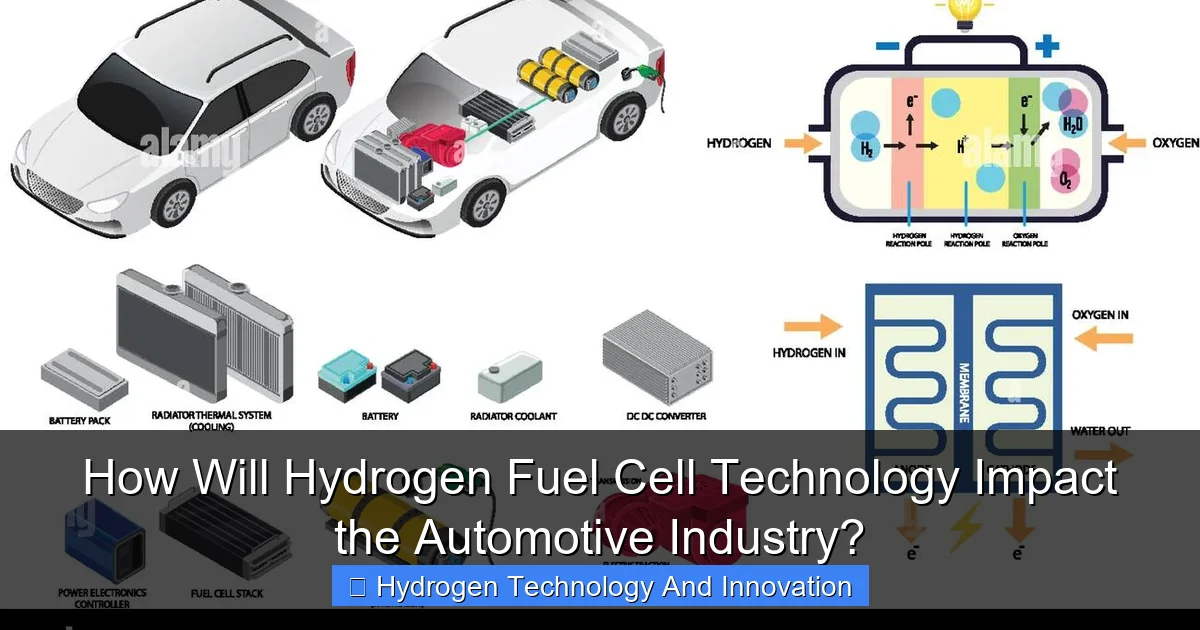
Visual guide about How Will Hydrogen Fuel Cell Technology Impact the Automotive Industry?
Image source: c8.alamy.com
To understand the potential of hydrogen in the automotive world, it helps to know how the technology actually works. At its core, a hydrogen fuel cell is an electrochemical device that converts hydrogen and oxygen into electricity, heat, and water. Think of it like a battery that never runs out—as long as you keep feeding it hydrogen.
The Science Behind the Fuel Cell
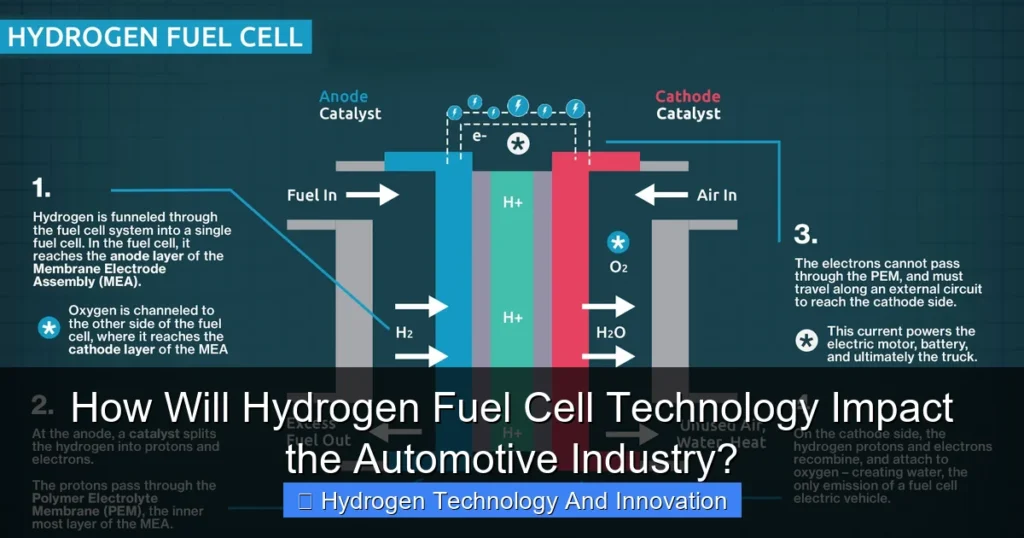
Inside a fuel cell, hydrogen gas (H₂) is fed into the anode side of the cell. At the anode, a catalyst—usually platinum—splits the hydrogen molecules into protons and electrons. The protons pass through a special membrane (the electrolyte) to the cathode side, while the electrons are forced to travel through an external circuit, creating an electric current. This current powers the vehicle’s motor.
At the cathode, the protons, electrons, and oxygen from the air combine to form water (H₂O), which is released as vapor. The entire process is silent, efficient, and emission-free at the vehicle level.
Hydrogen Storage and Delivery
Storing hydrogen safely and efficiently is a key engineering challenge. Most FCEVs store hydrogen in high-pressure tanks (typically at 700 bar or about 10,000 psi), which are designed to be extremely durable and safe. These tanks are often made of carbon fiber and can withstand significant impact—even in crashes.
Refueling is simple: drivers pull up to a hydrogen station, connect a nozzle to the vehicle, and fill the tank in just a few minutes. This is a major advantage over EVs, which can take 30 minutes to several hours to recharge, depending on the charger type.
Efficiency and Energy Use
It’s important to note that hydrogen fuel cells are not 100% efficient. The process of producing, compressing, transporting, and converting hydrogen into electricity involves energy losses. However, when compared to internal combustion engines—which are only about 20–30% efficient—fuel cells (at 40–60% efficiency) are a significant improvement.
The real efficiency gain comes when hydrogen is produced using renewable energy. This “green hydrogen” is made by splitting water (H₂O) into hydrogen and oxygen using electrolysis powered by wind, solar, or hydroelectric power. When the entire lifecycle is considered—from production to driving—green hydrogen can be a truly sustainable option.
Advantages of Hydrogen Fuel Cell Vehicles
Hydrogen fuel cell technology brings several compelling benefits to the automotive industry. While it may not replace battery-electric vehicles entirely, it fills important gaps and offers solutions where EVs fall short.
Zero Tailpipe Emissions
The most obvious advantage is environmental: FCEVs produce no harmful emissions. Unlike gasoline or diesel vehicles that release carbon dioxide, nitrogen oxides, and particulate matter, hydrogen cars emit only water vapor. This makes them ideal for improving air quality in cities and reducing greenhouse gas emissions—especially when the hydrogen is produced cleanly.
For example, Toyota’s Mirai and Hyundai’s NEXO are two production FCEVs already on the road. Both have been praised for their smooth, quiet ride and clean operation. In regions with strict emissions standards, like California or the European Union, FCEVs can help automakers meet regulatory targets.
Fast Refueling and Long Range
One of the biggest pain points for EV owners is charging time. Even with fast chargers, it can take 20–40 minutes to get an 80% charge. For long trips or commercial use, this downtime adds up.
Hydrogen vehicles, on the other hand, can be refueled in 3–5 minutes—just like filling up a gas tank. And with a typical range of 300–400 miles, they match or exceed many EVs. This makes them especially attractive for drivers who need reliability and convenience.
Ideal for Heavy-Duty and Fleet Applications
While battery-electric trucks are being developed, they face challenges with weight, charging time, and energy density. A large battery adds significant weight, reducing payload capacity. And recharging a massive battery can take hours—downtime that’s costly for delivery companies or freight haulers.
Hydrogen fuel cells offer a better solution for heavy-duty vehicles. Companies like Nikola, Toyota, and Hyundai are developing hydrogen-powered trucks for long-haul freight. For example, Toyota has been testing hydrogen fuel cell semi-trucks at the Port of Los Angeles, where they can refuel quickly and operate continuously with minimal emissions.
Similarly, city buses and delivery vans are excellent candidates for hydrogen. They follow fixed routes, return to central depots for refueling, and benefit from the quick turnaround time. Cities like London, Tokyo, and Vancouver are already deploying hydrogen buses as part of their clean transit initiatives.
Energy Security and Diversification
Hydrogen can be produced domestically from a variety of sources—water, natural gas, biomass, or even waste. This reduces dependence on imported oil and enhances energy security. Countries with abundant renewable resources can generate green hydrogen locally, creating jobs and supporting a clean energy economy.
Japan, for instance, has made hydrogen a cornerstone of its national energy strategy. The country aims to become a “hydrogen society,” using the fuel for transportation, industry, and power generation. South Korea and Germany are also investing heavily in hydrogen infrastructure and technology.
Challenges and Barriers to Adoption
Despite its promise, hydrogen fuel cell technology faces significant hurdles. Overcoming these challenges will be essential for widespread adoption in the automotive industry.
Limited Refueling Infrastructure
The biggest barrier today is the lack of hydrogen refueling stations. As of 2024, there are fewer than 200 public hydrogen stations in the United States, mostly concentrated in California. In contrast, there are over 150,000 gas stations and more than 60,000 public EV charging ports.
Building a nationwide hydrogen network requires massive investment. Stations are expensive—costing $1–2 million each—and require specialized equipment to handle high-pressure gas. Without convenient access, consumers are unlikely to adopt FCEVs, no matter how advanced the technology.
High Production and Distribution Costs
Currently, most hydrogen is produced from natural gas through a process called steam methane reforming (SMR). While this method is cheaper, it releases carbon dioxide, undermining the environmental benefits. This “gray hydrogen” is not sustainable in the long term.
Green hydrogen, made with renewable energy, is cleaner but much more expensive—often 2–3 times the cost of gray hydrogen. Electrolyzers, the machines that split water into hydrogen and oxygen, are still costly and not yet produced at scale. Until green hydrogen becomes more affordable, the full environmental potential of FCEVs won’t be realized.
Energy Losses in the Hydrogen Lifecycle
Hydrogen is not an energy source—it’s an energy carrier. That means energy is lost at every step: production, compression, transportation, and conversion in the fuel cell. Studies show that well-to-wheel efficiency for hydrogen vehicles is around 25–35%, compared to 70–80% for battery-electric vehicles.
This inefficiency raises questions about whether hydrogen is the best use of renewable energy. Some experts argue that it’s better to use electricity directly in EVs rather than converting it to hydrogen and back again.
Safety Concerns and Public Perception
Hydrogen is highly flammable and has been associated with safety risks, largely due to historical events like the Hindenburg disaster. While modern hydrogen systems are designed with multiple safety features—including leak detection, automatic shutoffs, and reinforced tanks—public perception remains a challenge.
Education and transparent communication will be key to building trust. Automakers and governments must demonstrate that hydrogen vehicles are as safe—or safer—than conventional cars.
Competition from Battery-Electric Vehicles
Battery technology is advancing rapidly. New chemistries, solid-state batteries, and ultra-fast charging are making EVs more practical and affordable. With falling battery prices and expanding charging networks, EVs are becoming the default choice for many consumers.
For hydrogen to compete, it must offer clear advantages—especially in niches like long-haul transport, aviation, or maritime shipping, where batteries are less feasible.
Current Market Leaders and Innovations
Despite the challenges, several companies are leading the charge in hydrogen fuel cell technology. Their innovations are shaping the future of clean transportation.
Toyota: Pioneering the Mirai
Toyota has been a pioneer in hydrogen vehicles with the Mirai, first launched in 2014. The latest generation (2021+) offers improved range (up to 400 miles), a sleek design, and advanced safety features. Toyota is also investing in hydrogen infrastructure, partnering with energy companies to build refueling stations.
Beyond passenger cars, Toyota is testing hydrogen-powered forklifts, buses, and even a hydrogen-powered race car. The company believes hydrogen will play a key role in a multi-pathway approach to decarbonization—complementing, not replacing, battery-electric vehicles.
Hyundai: Scaling Up with the NEXO and XCIENT
Hyundai’s NEXO is one of the most advanced FCEVs on the market, with a range of over 380 miles and advanced driver-assistance features. But Hyundai is thinking bigger. The company has launched the XCIENT Fuel Cell, a hydrogen-powered heavy-duty truck now operating in Switzerland, South Korea, and the U.S.
Hyundai plans to produce 100,000 hydrogen fuel cell systems annually by 2030, supplying not only its own vehicles but also other manufacturers. This scale could help drive down costs and accelerate adoption.
Nikola and the Future of Hydrogen Trucks
Nikola Corporation is focused exclusively on hydrogen and battery-electric trucks. The Nikola Tre, a hydrogen-powered semi-truck, is already in production and being tested by major freight companies. The company is building a network of hydrogen refueling stations across the U.S., aiming to support long-haul operations.
While Nikola has faced scrutiny over past claims, its focus on real-world deployment and partnerships with companies like Bosch and IVECO shows serious intent.
Startups and Research Breakthroughs
Beyond the big names, startups and research institutions are pushing the boundaries of hydrogen technology. Companies like Hyzon Motors are developing fuel cells for commercial vehicles, while universities are exploring new catalysts to reduce or eliminate the need for expensive platinum.
Innovations in liquid organic hydrogen carriers (LOHCs) and ammonia-based hydrogen storage could make transportation and distribution easier and safer. These technologies are still in early stages but hold promise for the future.
The Role of Government and Policy
Government support is critical for the success of hydrogen fuel cell technology. Policies, incentives, and infrastructure investments can accelerate adoption and help overcome market barriers.
Subsidies and Incentives
Many countries offer financial incentives for hydrogen vehicles. In the U.S., the Inflation Reduction Act includes tax credits for clean hydrogen production and FCEV purchases. California offers rebates of up to $15,000 for hydrogen car buyers and funds for station development.
The European Union has launched the Hydrogen Strategy, aiming to install 40 GW of electrolyzer capacity by 2030. Japan and South Korea have similar national plans, with billions allocated for research and infrastructure.
Public-Private Partnerships
Collaboration between governments, automakers, and energy companies is essential. For example, the H2USA partnership in the U.S. brings together stakeholders to build a hydrogen infrastructure. In Europe, the Clean Hydrogen Alliance is fostering innovation and investment.
These partnerships help share risks, align goals, and create a unified vision for a hydrogen-powered future.
Regulatory Support and Standards
Clear regulations and safety standards are needed to ensure consistency and public trust. Governments must establish guidelines for hydrogen production, storage, transportation, and vehicle safety. International cooperation can also help harmonize standards and enable cross-border trade in hydrogen.
The Future of Hydrogen in the Automotive Industry
So, what does the future hold for hydrogen fuel cell technology? While it may not dominate the passenger car market, it’s likely to play a significant role in specific sectors.
A Complementary, Not Competing, Technology
The future of clean transportation is not a single solution—it’s a mix. Battery-electric vehicles will dominate urban and short-range travel, while hydrogen will shine in long-haul freight, aviation, shipping, and heavy industry.
Think of it like this: EVs are like laptops—great for everyday use. Hydrogen is like a desktop server—powerful, efficient for specific tasks, but not always portable.
Growth in Commercial and Industrial Use
The biggest opportunities for hydrogen are in commercial fleets. Delivery companies, logistics firms, and public transit agencies are already testing hydrogen vehicles. As green hydrogen becomes cheaper and infrastructure expands, adoption will grow.
In the long term, hydrogen could even power trains, planes, and ships. Airbus is developing hydrogen-powered aircraft, and companies like Shell and BP are investing in hydrogen for maritime transport.
Technological Advancements on the Horizon
Research is ongoing to improve fuel cell efficiency, reduce costs, and eliminate rare materials like platinum. Solid-state fuel cells, new membrane technologies, and advanced manufacturing techniques could make hydrogen vehicles more affordable and reliable.
If these innovations succeed, hydrogen could become a mainstream option within the next 10–15 years.
Conclusion: A Cleaner Road Ahead
Hydrogen fuel cell technology is not a silver bullet, but it is a powerful tool in the fight against climate change. With zero emissions, fast refueling, and long range, it offers a compelling alternative to both gasoline and battery-electric vehicles—especially for heavy-duty and long-distance applications.
The road to widespread adoption is still long, with challenges in infrastructure, cost, and public perception. But with strong support from governments, innovation from automakers, and growing demand for clean transportation, hydrogen is poised to make a meaningful impact.
As we move toward a sustainable future, the automotive industry will need all the tools it can get. Hydrogen fuel cell technology is one of those tools—ready to help drive us toward a cleaner, greener world.
Frequently Asked Questions
What is a hydrogen fuel cell vehicle?
A hydrogen fuel cell vehicle (FCEV) uses hydrogen gas to generate electricity through a chemical reaction in a fuel cell stack. This electricity powers an electric motor, producing only water vapor as a byproduct.
How long does it take to refuel a hydrogen car?
Refueling a hydrogen car takes about 3–5 minutes, similar to filling up a gasoline vehicle. This is much faster than charging most battery-electric vehicles.
Are hydrogen cars safe?
Yes, hydrogen cars are designed with multiple safety features, including reinforced tanks, leak detection systems, and automatic shutoffs. They undergo rigorous testing and are considered as safe as conventional vehicles.
Where can I refuel a hydrogen car?
Hydrogen refueling stations are currently limited, with most located in California, Japan, South Korea, and parts of Europe. Infrastructure is expanding, but availability remains a challenge in many regions.
Is hydrogen better than batteries for electric vehicles?
Hydrogen and batteries serve different needs. Hydrogen is better for long-range and heavy-duty applications, while batteries are more efficient for city driving and short trips. Both will likely coexist in a clean transportation future.
How is green hydrogen produced?
Green hydrogen is produced by splitting water into hydrogen and oxygen using electrolysis powered by renewable energy sources like wind, solar, or hydroelectric power. This method emits no carbon dioxide.