Hydrogen fuel cell vehicles are not only innovative but also exceptionally safe. Thanks to strict safety standards, advanced materials, and real-world validation, these vehicles meet or exceed traditional car safety benchmarks.
Key Takeaways
- Hydrogen is not more dangerous than gasoline or batteries: When handled properly, hydrogen poses similar risks to conventional fuels, with added safety due to its light, fast-dispersing nature.
- Fuel tanks are built to withstand extreme conditions: Composite hydrogen tanks undergo rigorous testing, including fire, impact, and pressure tests, to ensure they remain intact in accidents.
- Multiple safety systems prevent leaks and fires: Sensors, automatic shut-off valves, and ventilation systems work together to detect and mitigate any hydrogen release.
- Real-world performance supports safety claims: Millions of miles driven by hydrogen vehicles globally have shown no major safety incidents related to fuel cell systems.
- Regulatory standards are strict and evolving: Governments and international bodies enforce comprehensive safety protocols for hydrogen storage, transport, and vehicle integration.
- Refueling is as safe as pumping gasoline: Hydrogen stations use automated, fail-safe processes that minimize human error and ensure secure fueling.
- Public perception is improving with education: As awareness grows, misconceptions about hydrogen safety are being replaced by facts and confidence.
📑 Table of Contents
- Introduction: The Rise of Hydrogen-Powered Vehicles
- Understanding Hydrogen: Myths vs. Reality
- How Hydrogen Fuel Cells Work in Vehicles
- Safety Systems and Engineering Protections
- Real-World Safety Performance and Testing
- Addressing Public Concerns and Misconceptions
- The Future of Hydrogen Safety
- Conclusion: Driving Confidently into a Hydrogen Future
Introduction: The Rise of Hydrogen-Powered Vehicles
Imagine driving a car that emits nothing but water vapor—no smog, no greenhouse gases, just clean, quiet power. That’s the promise of hydrogen fuel cell vehicles (FCVs), a technology that’s gaining momentum as the world seeks sustainable transportation solutions. Companies like Toyota, Hyundai, and Honda have already launched hydrogen-powered models such as the Mirai, NEXO, and Clarity, proving that this isn’t just a futuristic dream—it’s happening now.
But with any new technology, especially one involving flammable gases, safety concerns naturally arise. People wonder: Is hydrogen safe? Can it explode? What happens in a crash? These are valid questions, and the good news is that decades of research, engineering, and real-world testing have gone into making hydrogen fuel cells one of the safest options on the road today. In fact, hydrogen vehicles are designed with safety as a top priority—often exceeding the standards of gasoline or battery-electric vehicles.
Understanding Hydrogen: Myths vs. Reality
Before diving into the engineering and safety systems, it’s important to separate fact from fiction when it comes to hydrogen. One of the biggest misconceptions is that hydrogen is inherently dangerous—often fueled by images of the Hindenburg disaster. But that event involved a rigid airship filled with hydrogen and coated in flammable materials, a far cry from modern hydrogen storage in vehicles.
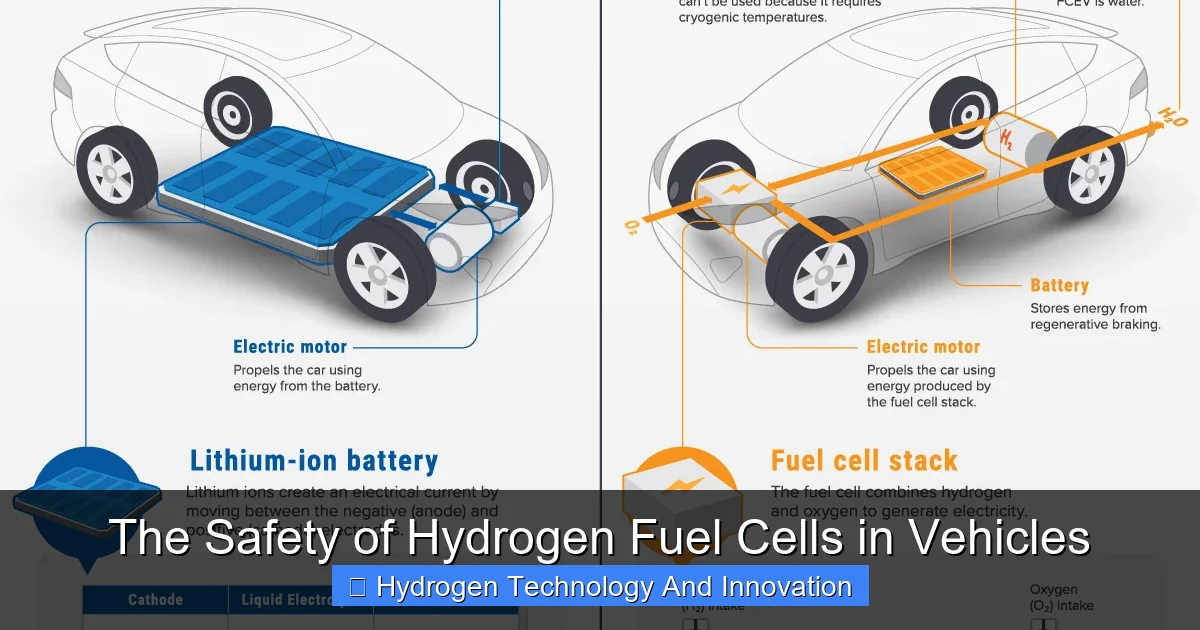
Visual guide about The Safety of Hydrogen Fuel Cells in Vehicles
Image source: elements.visualcapitalist.com
Hydrogen’s Physical Properties
Hydrogen is the lightest and simplest element on the periodic table. It’s colorless, odorless, and tasteless. Unlike gasoline, which pools on the ground and creates toxic fumes, hydrogen rises and disperses quickly into the atmosphere—even in open air. This means that in the rare event of a leak, hydrogen doesn’t linger or accumulate in dangerous concentrations. It escapes upward, reducing the risk of ignition.
Another key point: hydrogen has a wide flammability range (4% to 75% in air), which sounds alarming, but so does gasoline vapor. The real difference lies in how each fuel behaves when released. Gasoline forms heavy vapors that can travel along the ground, creating long-lasting fire hazards. Hydrogen, by contrast, dissipates in seconds, especially outdoors.
Comparing Hydrogen to Other Fuels
Let’s put hydrogen in context. Gasoline is highly flammable and toxic. Lithium-ion batteries, used in electric vehicles, can catch fire if damaged or overheated—a phenomenon known as “thermal runaway.” Both require careful handling and safety systems. Hydrogen is no different. The key isn’t to compare it to an ideal, but to real-world fuels we already accept as safe when properly managed.
For example, natural gas (methane) is widely used in homes and vehicles, yet it’s also flammable. The difference is in the infrastructure and safety protocols. Hydrogen vehicles are designed with the same rigor—if not more—than any other fuel type. In fact, studies by organizations like the U.S. Department of Energy and the National Renewable Energy Laboratory (NREL) have consistently shown that hydrogen is no more dangerous than conventional fuels when proper safety measures are in place.
How Hydrogen Fuel Cells Work in Vehicles
To understand the safety of hydrogen vehicles, it helps to know how they work. A hydrogen fuel cell vehicle doesn’t burn hydrogen like a traditional engine. Instead, it uses a chemical reaction to generate electricity.
The Fuel Cell Stack: Heart of the System
At the core of every FCV is the fuel cell stack. This is where hydrogen gas (H₂) from the tank meets oxygen (O₂) from the air. Inside the stack, a catalyst—usually platinum—splits hydrogen atoms into protons and electrons. The protons pass through a membrane, while the electrons are forced through an external circuit, creating an electric current. This electricity powers the motor, just like in a battery-electric vehicle.
The only byproduct? Water vapor and a little heat. No combustion, no exhaust, no particulates. This process is clean, quiet, and highly efficient.
Hydrogen Storage: Safe and Secure
The hydrogen is stored in high-strength tanks, typically made of carbon fiber composites. These tanks are designed to hold hydrogen at very high pressures—usually 700 bar (about 10,000 psi)—which allows for a longer driving range without taking up too much space.
But here’s the impressive part: these tanks are built to survive extreme conditions. They’re tested to withstand bullets, fires, crashes, and even being dropped from heights. In fact, during certification, tanks are subjected to tests that far exceed real-world scenarios. For example, they’re shot with high-caliber bullets to simulate debris impact, and then filled with hydrogen to ensure no rupture or leak occurs.
Additionally, the tanks are equipped with thermal pressure relief devices (TPRDs). These are small valves that release hydrogen slowly if the tank overheats—such as in a fire—preventing a sudden explosion. The released gas vents upward and dissipates safely, minimizing risk.
Safety Systems and Engineering Protections
Hydrogen vehicles are packed with layers of safety features, both passive and active. These systems work together to prevent accidents and respond quickly if something goes wrong.
Leak Detection and Automatic Shutdown
Every hydrogen vehicle is equipped with multiple hydrogen sensors placed strategically around the fuel system—near the tank, fuel lines, and fuel cell stack. These sensors continuously monitor for even the smallest leaks. If hydrogen is detected, the system triggers an immediate response: the fuel supply is cut off, and the vehicle may enter a safe mode or shut down entirely.
Some vehicles also alert the driver with visual or audible warnings. In extreme cases, the system can even notify emergency services automatically, similar to how some cars now detect crashes and call for help.
Ventilation and Crash Protection
Hydrogen systems are designed with ventilation in mind. Fuel lines and storage areas are often enclosed in protective channels that direct any potential leaks upward and away from the passenger cabin. This ensures that even if a small amount of hydrogen escapes, it doesn’t accumulate in enclosed spaces.
In the event of a crash, the vehicle’s structure is engineered to protect the hydrogen tank. The tank is typically mounted in a reinforced area, such as between the axles or under the floor, away from impact zones. Crash tests have shown that hydrogen tanks remain intact even in high-speed collisions.
Moreover, the fuel system includes automatic shut-off valves that close instantly during a collision. This prevents hydrogen from continuing to flow, reducing the risk of fire or explosion.
Fire Resistance and Material Choices
The materials used in hydrogen vehicles are selected for their durability and fire resistance. Composite tanks don’t corrode like metal, and they’re less likely to fail under stress. The fuel lines are made from high-grade polymers and metals that can withstand high pressure and temperature fluctuations.
Even the fuel cell stack is designed with safety in mind. It operates at relatively low temperatures (around 80°C or 176°F), much cooler than internal combustion engines. This reduces the risk of overheating and thermal runaway, a concern with lithium-ion batteries.
Real-World Safety Performance and Testing
Theoretical safety is one thing, but real-world performance is what truly matters. So far, hydrogen vehicles have an excellent safety record.
Millions of Miles Driven Safely
As of 2024, hydrogen fuel cell vehicles have collectively driven over 100 million miles worldwide—without a single fatality attributed to hydrogen leakage or explosion. This includes fleet vehicles, public transit buses, and personal cars. In countries like Japan, South Korea, and Germany, hydrogen buses and taxis operate daily in urban environments, often in crowded areas.
For example, the city of Aberdeen in Scotland has one of the largest fleets of hydrogen buses in Europe. These vehicles have been in service for years, transporting thousands of passengers daily with no major incidents. Similarly, in California—the U.S. leader in hydrogen infrastructure—hundreds of FCVs are on the road, supported by a growing network of refueling stations.
Rigorous Certification and Standards
Before a hydrogen vehicle can be sold, it must pass a battery of tests set by regulatory bodies. In the U.S., the National Highway Traffic Safety Administration (NHTSA) and the Society of Automotive Engineers (SAE) have established strict guidelines for hydrogen safety. These include crash tests, fire exposure tests, and durability assessments.
Internationally, standards like ISO 15869 and UN Regulation No. 134 ensure that hydrogen vehicles meet global safety benchmarks. These standards cover everything from tank design to refueling procedures, ensuring consistency and reliability across markets.
Refueling Safety: As Easy as Pumping Gas
One of the biggest concerns people have is refueling. Is it safe to fill up with hydrogen? The answer is yes—thanks to advanced station design and automated processes.
Hydrogen refueling stations use standardized connectors that only fit hydrogen vehicles, preventing cross-fueling errors. The process is fully automated: the driver connects the nozzle, the system checks for leaks and compatibility, and then fills the tank in about 3 to 5 minutes—faster than charging an electric vehicle.
Stations are equipped with multiple safety systems, including emergency shut-offs, fire suppression, and ventilation. Operators are trained to handle hydrogen safely, and regular inspections ensure everything is in working order. In fact, hydrogen stations are often safer than gasoline stations because there’s no liquid spill risk and no static buildup during fueling.
Addressing Public Concerns and Misconceptions
Despite the strong safety record, some people remain hesitant about hydrogen vehicles. This is often due to misinformation or lack of familiarity. Let’s address a few common concerns.
“Hydrogen Explodes Easily”
While hydrogen is flammable, it doesn’t explode without the right conditions—specifically, a confined space and an ignition source. In open air, hydrogen disperses too quickly to create an explosive mixture. Even in a garage, proper ventilation prevents buildup. Modern vehicles are designed to minimize these risks further.
“What If the Tank Breaks in a Crash?”
As mentioned earlier, hydrogen tanks are incredibly strong. They’re tested to survive impacts that would destroy a gasoline tank. Plus, automatic shut-off valves stop the flow of hydrogen immediately after a collision. Real-world crash data shows that hydrogen vehicles perform as well as—or better than—conventional cars in safety tests.
“Hydrogen Production Isn’t Clean”
This is a separate issue from vehicle safety, but worth noting. While some hydrogen is currently produced from natural gas (“gray hydrogen”), the industry is shifting toward “green hydrogen” made from renewable energy via electrolysis. As this transition accelerates, the environmental benefits of hydrogen vehicles will only grow.
The Future of Hydrogen Safety
Hydrogen technology is still evolving, and safety continues to improve. Researchers are working on even stronger tank materials, better leak detection systems, and more efficient fuel cells. Innovations like self-healing polymers and AI-powered monitoring could further enhance safety in the coming years.
Governments and automakers are also investing in public education. As more people experience hydrogen vehicles firsthand—through test drives, ride-sharing programs, or public transit—fear of the unknown will fade. Transparency and open dialogue are key to building trust.
Ultimately, the safety of hydrogen fuel cells in vehicles isn’t just about technology—it’s about responsibility. From design and manufacturing to operation and maintenance, every step is guided by a commitment to safety. And as the world moves toward cleaner transportation, hydrogen is proving to be not just viable, but secure.
Conclusion: Driving Confidently into a Hydrogen Future
Hydrogen fuel cell vehicles represent a bold step toward sustainable mobility. They offer long range, fast refueling, and zero emissions—without compromising on safety. Thanks to advanced engineering, rigorous testing, and real-world validation, these vehicles are as safe as, if not safer than, the cars we drive today.
The next time you hear someone say hydrogen is too dangerous, you can confidently share the facts: hydrogen rises and disperses, tanks are built like fortresses, and safety systems are always on guard. With every mile driven, hydrogen vehicles are proving that clean energy and safety can go hand in hand. The road ahead is bright—and it’s powered by hydrogen.
Frequently Asked Questions
Are hydrogen fuel cell vehicles safe in a crash?
Yes, hydrogen vehicles are designed to be safe in crashes. Their tanks are made of strong composite materials that withstand impacts, and automatic shut-off valves stop hydrogen flow immediately after a collision. Crash tests show they perform as well as traditional vehicles.
Can hydrogen tanks explode?
Hydrogen tanks are extremely unlikely to explode. They are tested to survive bullets, fires, and high-pressure conditions. If overheated, thermal relief devices release hydrogen slowly and safely, preventing explosions.
Is refueling with hydrogen dangerous?
No, refueling is safe and similar to pumping gasoline. Stations use automated systems with leak checks and emergency shut-offs. The process takes just 3–5 minutes and is designed to minimize risk.
What happens if there’s a hydrogen leak?
Hydrogen rises and disperses quickly into the air, reducing fire risk. Vehicles have sensors that detect leaks and automatically shut off the fuel supply. Ventilation systems also help prevent gas buildup.
Are hydrogen vehicles more dangerous than electric cars?
No, both types are safe when properly designed. Hydrogen vehicles have different risks than battery-electric cars, but rigorous safety standards ensure they meet high safety benchmarks.
How do hydrogen vehicles compare to gasoline cars in safety?
Hydrogen vehicles are comparable or superior in safety. They don’t carry flammable liquids, and their fuel systems are designed with multiple layers of protection. Real-world data shows no major safety issues.