Hydrogen fuel cell technology holds immense promise for decarbonizing transportation and industry, but scaling it for mass-market adoption requires overcoming infrastructure, cost, and production hurdles. With rapid innovation and strategic investment, scalable hydrogen solutions could reshape the global energy landscape within the next decade.
Key Takeaways
- Hydrogen fuel cells offer zero-emission energy with high efficiency, making them ideal for heavy-duty transport and industrial use.
- Scaling production of green hydrogen—produced using renewable energy—is critical to achieving environmental and economic viability.
- Infrastructure gaps in hydrogen refueling and distribution remain a major barrier to widespread adoption.
- Government policies and public-private partnerships are accelerating investment and pilot projects worldwide.
- Technological advances in fuel cell durability, efficiency, and manufacturing are reducing costs and improving performance.
- Mass-market adoption depends on integrating hydrogen into existing energy systems while ensuring safety and public acceptance.
📑 Table of Contents
- Introduction: The Promise of Hydrogen in a Clean Energy Future
- The Basics of Hydrogen Fuel Cell Technology
- Current Applications and Real-World Examples
- Challenges to Scaling Hydrogen Fuel Cell Technology
- Innovation Driving Scalability
- Global Efforts and Policy Support
- The Path to Mass-Market Adoption
- Conclusion: A Scalable Future Within Reach
Introduction: The Promise of Hydrogen in a Clean Energy Future
Imagine a world where buses, trucks, trains, and even ships run without emitting a single puff of carbon dioxide. Where factories power their operations with clean energy, and homes stay warm without burning fossil fuels. This isn’t science fiction—it’s the vision driving the rapid development of hydrogen fuel cell technology. At its core, a hydrogen fuel cell combines hydrogen and oxygen to produce electricity, with water and heat as the only byproducts. It’s clean, quiet, and incredibly efficient. But the real question isn’t whether hydrogen works—it’s whether it can scale.
The scalability of hydrogen fuel cell technology for mass-market adoption is one of the most pressing topics in clean energy today. As countries race to meet climate goals and reduce greenhouse gas emissions, hydrogen has emerged as a versatile solution for sectors that are hard to electrify with batteries alone. Think long-haul trucking, aviation, steel production, and maritime shipping. These industries need high energy density and fast refueling—something batteries struggle to deliver. Hydrogen fuel cells, on the other hand, can offer the range and speed these sectors demand.
But scaling up isn’t just about building more fuel cells. It’s about creating an entire ecosystem: producing hydrogen sustainably, transporting it safely, building refueling stations, and integrating it into existing infrastructure. The journey from niche applications to mass adoption is complex, but not impossible. With the right mix of innovation, investment, and policy support, hydrogen could play a central role in the global energy transition.
The Basics of Hydrogen Fuel Cell Technology
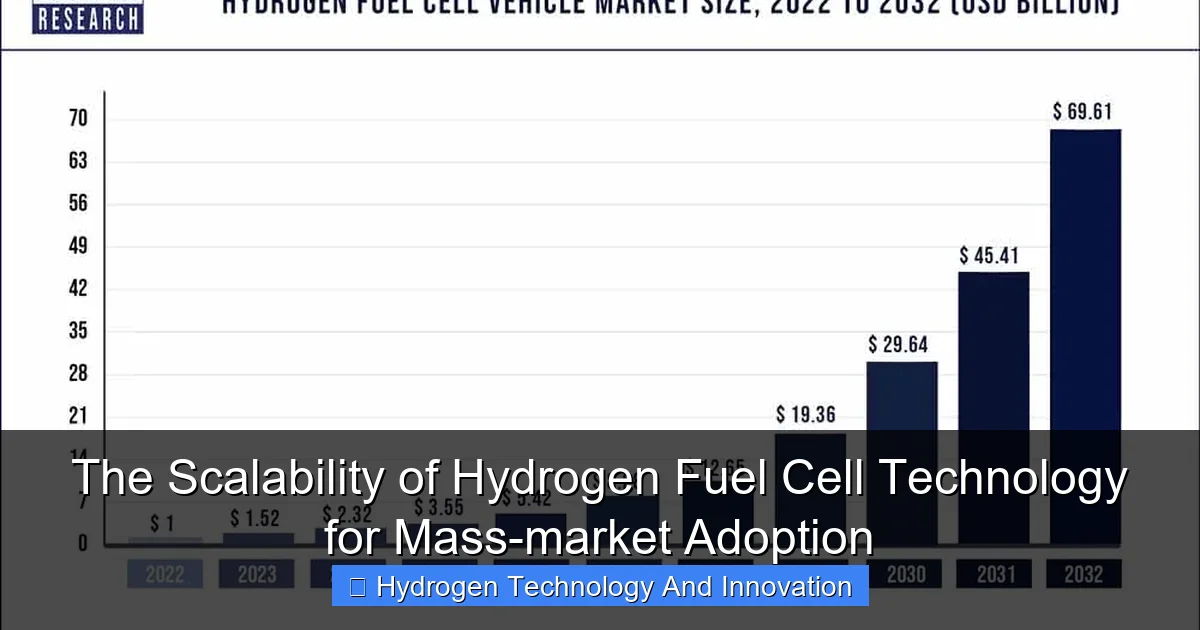
Visual guide about The Scalability of Hydrogen Fuel Cell Technology for Mass-market Adoption
Image source: precedenceresearch.com
Before diving into scalability, it’s important to understand how hydrogen fuel cells work. At their simplest, fuel cells are electrochemical devices that convert hydrogen gas into electricity. Inside a fuel cell, hydrogen molecules are split into protons and electrons at the anode. The protons pass through a membrane to the cathode, while the electrons travel through an external circuit, creating an electric current. At the cathode, oxygen from the air combines with the protons and electrons to form water.
This process is silent, emits no pollutants, and is highly efficient—typically converting 60% of the energy in hydrogen into electricity, compared to around 20–30% for internal combustion engines. Fuel cells can be stacked together to increase power output, making them suitable for everything from small drones to large power plants.
There are several types of fuel cells, but the most common for transportation and portable applications is the proton exchange membrane fuel cell (PEMFC). PEMFCs operate at relatively low temperatures (around 80°C), start quickly, and respond well to changes in power demand—ideal for vehicles.
Hydrogen itself can be produced in different ways. The most common method today is steam methane reforming (SMR), which uses natural gas and releases CO₂. This is known as “gray hydrogen.” When the CO₂ is captured and stored, it becomes “blue hydrogen.” But the real game-changer is “green hydrogen,” produced by electrolyzing water using renewable electricity from wind, solar, or hydropower. Green hydrogen is carbon-free and essential for sustainable scalability.
Current Applications and Real-World Examples
Hydrogen fuel cells are already in use, though not yet at mass-market scale. Their adoption is growing fastest in sectors where batteries fall short. Let’s look at some real-world examples.
Transportation: From Buses to Trucks
In cities like Tokyo, London, and Los Angeles, hydrogen-powered buses are already on the road. Toyota’s Sora bus, for instance, has been operating in Japan since 2018, carrying thousands of passengers with zero emissions. These buses refuel in minutes and can travel over 300 miles on a single tank—something electric buses still struggle with due to battery weight and charging time.
Heavy-duty trucking is another promising area. Companies like Hyundai and Nikola are developing hydrogen-powered trucks for long-haul freight. Hyundai’s XCIENT Fuel Cell trucks are already in commercial use in Switzerland and California, delivering goods across hundreds of miles without stopping for hours to recharge. These trucks can carry heavier loads than battery-electric counterparts and refuel in under 20 minutes.
Industrial and Stationary Power
Beyond vehicles, hydrogen fuel cells are being used for backup power and grid support. In remote areas or during outages, fuel cells can provide reliable electricity without noise or emissions. For example, Apple uses hydrogen fuel cells at some of its data centers to reduce reliance on diesel generators.
In industry, hydrogen is being tested as a replacement for fossil fuels in high-heat processes. Steelmakers like SSAB in Sweden are piloting hydrogen-based direct reduced iron (DRI) processes to eliminate coal from steel production. This could cut CO₂ emissions from steelmaking by up to 90%.
Maritime and Aviation
The shipping industry is exploring hydrogen and ammonia (a hydrogen carrier) as zero-emission fuels. The European Union’s Flagships project is testing hydrogen-powered ferries in Norway and Belgium. Meanwhile, Airbus has unveiled plans for hydrogen-powered aircraft by 2035, aiming to decarbonize short- and medium-haul flights.
These examples show that hydrogen fuel cells are not just theoretical—they’re already proving their value in demanding applications. But to move from pilot projects to mass adoption, scalability is key.
Challenges to Scaling Hydrogen Fuel Cell Technology
Despite its promise, the scalability of hydrogen fuel cell technology faces several major hurdles. Let’s break them down.
High Production Costs
Green hydrogen is still expensive to produce. Electrolyzers, the machines that split water into hydrogen and oxygen, require significant amounts of renewable electricity and precious metals like platinum as catalysts. Currently, green hydrogen costs between $3 and $8 per kilogram, compared to $1–$2 for gray hydrogen. For mass adoption, this cost needs to fall below $2 per kilogram to compete with fossil fuels.
Economies of scale and technological improvements are helping. As more electrolyzers are manufactured, their cost is dropping—similar to the trend seen with solar panels. But we need faster progress.
Lack of Infrastructure
One of the biggest barriers is infrastructure. There are fewer than 1,000 hydrogen refueling stations worldwide, most of them in California, Japan, and Germany. Building a nationwide network would require billions in investment. Unlike electric vehicle charging, which can use existing power grids, hydrogen requires new pipelines, storage facilities, and compression systems.
Transporting hydrogen is also tricky. It’s a small, light molecule that can leak easily and embrittle metals. It must be compressed to high pressures (700 bar for vehicles) or cooled to liquid form (-253°C), both of which are energy-intensive.
Energy Efficiency Concerns
Hydrogen is not the most efficient energy carrier. When you compare the full lifecycle—from renewable electricity to hydrogen production, compression, transport, and conversion back to electricity in a fuel cell—only about 30–40% of the original energy remains. In contrast, battery-electric vehicles retain 70–80% of the energy from grid to wheel.
This means hydrogen is best suited for applications where batteries aren’t practical, not as a replacement for all electrification.
Safety and Public Perception
Hydrogen has a reputation for being dangerous, largely due to historical events like the Hindenburg disaster. While modern hydrogen systems are designed with multiple safety features—leak detection, ventilation, and pressure relief devices—public concerns remain. Education and transparent safety standards are essential to build trust.
Policy and Regulatory Gaps
Inconsistent regulations across regions and countries make it hard to scale. Standards for hydrogen purity, safety, and transportation vary, creating barriers to cross-border trade and deployment. Clear, harmonized policies are needed to support investment and innovation.
Innovation Driving Scalability
Despite these challenges, rapid innovation is paving the way for scalable hydrogen solutions. Let’s look at the breakthroughs making mass adoption more feasible.
Advances in Electrolyzer Technology
New types of electrolyzers are emerging that are cheaper, more efficient, and longer-lasting. Solid oxide electrolyzers (SOECs) operate at high temperatures and can use waste heat from industrial processes, boosting efficiency. Anion exchange membrane (AEM) electrolyzers use non-precious metal catalysts, reducing costs.
Companies like ITM Power, Nel Hydrogen, and Plug Power are scaling up production and driving down prices. The International Energy Agency (IEA) predicts that electrolyzer costs could fall by 60% by 2030 with mass production.
Improving Fuel Cell Durability and Cost
Fuel cells are becoming more durable and less reliant on expensive materials. Researchers are developing platinum-free catalysts and more robust membranes that last longer under real-world conditions. Toyota and Honda have already reduced the platinum content in their fuel cells by over 80% in recent models.
Manufacturing innovations, such as roll-to-roll printing of fuel cell components, are also cutting production costs and enabling higher volumes.
Hydrogen Production from Waste and Biomass
Beyond green hydrogen, new methods are emerging to produce low-carbon hydrogen from waste. Gasification of biomass or municipal solid waste can generate hydrogen with lower emissions than fossil fuels. Some projects are even exploring “turquoise hydrogen,” produced by pyrolysis of methane into hydrogen and solid carbon, which can be stored or used in materials.
Digitalization and Smart Grids
Smart energy systems are helping integrate hydrogen into the grid. Excess renewable energy can be used to produce hydrogen during off-peak hours, storing it for later use. This turns hydrogen into a flexible energy storage solution, balancing supply and demand.
Digital platforms are also optimizing hydrogen logistics—tracking production, storage, and distribution in real time to improve efficiency and reduce waste.
Global Efforts and Policy Support
Governments and international organizations are stepping up to support the scalability of hydrogen fuel cell technology.
National Hydrogen Strategies
Over 30 countries have published national hydrogen strategies. The European Union’s Hydrogen Strategy aims to install 40 GW of electrolyzers by 2030 and produce up to 10 million tons of renewable hydrogen annually. The U.S. Department of Energy’s “Hydrogen Shot” initiative targets reducing the cost of clean hydrogen to $1 per kilogram within a decade.
Japan and South Korea are investing heavily in hydrogen infrastructure, with plans for hydrogen-powered cities and export hubs. Australia is positioning itself as a major exporter of green hydrogen, leveraging its vast renewable resources.
Public-Private Partnerships
Collaboration is key. Initiatives like the Hydrogen Council, a global CEO-led coalition, bring together companies like BMW, Shell, and Air Liquide to accelerate deployment. The U.S.’s H2USA partnership supports fueling infrastructure, while the EU’s Clean Hydrogen Alliance funds research and demonstration projects.
These partnerships help share risks, align standards, and attract private investment.
Funding and Incentives
Governments are offering grants, tax credits, and low-interest loans to support hydrogen projects. The U.S. Inflation Reduction Act includes a production tax credit of up to $3 per kilogram for clean hydrogen. The EU’s Innovation Fund is financing large-scale hydrogen demonstrations.
These incentives are crucial for de-risking early-stage projects and attracting private capital.
The Path to Mass-Market Adoption
So, what will it take for hydrogen fuel cell technology to go mainstream? The path forward involves a combination of technological progress, infrastructure development, and strategic planning.
Phased Deployment
Mass adoption won’t happen overnight. A phased approach is more realistic. Start with niche applications—like buses, forklifts, and backup power—where hydrogen has a clear advantage. Use these early adopters to build experience, reduce costs, and demonstrate reliability.
Then expand to heavy transport, industrial processes, and eventually passenger vehicles. This “learning by doing” model has worked for solar and wind energy and can work for hydrogen too.
Building the Hydrogen Economy
A true hydrogen economy requires more than just fuel cells. It needs a complete value chain: production, storage, transport, distribution, and end-use. This means investing in:
– Renewable energy to power electrolysis
– Pipelines and liquefaction plants for transport
– Refueling stations and hydrogen-ready appliances
– Workforce training and safety certification
Regional hydrogen hubs—clusters of production, storage, and use—can help kickstart this ecosystem. The U.S. Department of Energy is funding seven regional clean hydrogen hubs across the country, each focusing on different applications and feedstocks.
Integration with Other Technologies
Hydrogen shouldn’t be seen as a competitor to batteries, but as a complement. In a decarbonized energy system, batteries will handle short-term storage and light-duty transport, while hydrogen manages long-duration storage and hard-to-abate sectors.
Smart integration with the grid, electric vehicles, and renewable energy sources will maximize efficiency and minimize costs.
Consumer Education and Acceptance
Finally, public support is essential. Consumers need to understand the benefits of hydrogen—clean air, energy security, and job creation. Transparent communication about safety, performance, and environmental impact will build trust.
Pilot programs, test drives, and community engagement can help demystify the technology and show real-world benefits.
Conclusion: A Scalable Future Within Reach
The scalability of hydrogen fuel cell technology for mass-market adoption is no longer a distant dream—it’s a tangible goal within our grasp. While challenges remain in cost, infrastructure, and efficiency, the pace of innovation and global commitment is accelerating. From buses in Tokyo to steel plants in Sweden, hydrogen is proving its value in real-world applications.
The transition won’t be easy, but it’s necessary. As we confront the climate crisis, we need every tool in the box. Hydrogen fuel cells offer a clean, versatile, and powerful solution for sectors that are difficult to decarbonize. With continued investment, smart policies, and public-private collaboration, we can build a hydrogen economy that’s not only scalable but sustainable.
The road ahead is long, but the destination is clear: a cleaner, more resilient energy future powered by hydrogen.
Frequently Asked Questions
What is hydrogen fuel cell technology?
Hydrogen fuel cell technology converts hydrogen gas into electricity through an electrochemical reaction, producing only water and heat as byproducts. It’s used in vehicles, backup power systems, and industrial applications.
How does green hydrogen differ from gray hydrogen?
Green hydrogen is produced using renewable energy to split water via electrolysis, making it carbon-free. Gray hydrogen is made from natural gas through steam methane reforming, which releases CO₂.
Why is hydrogen better than batteries for some applications?
Hydrogen offers higher energy density and faster refueling, making it ideal for heavy-duty transport, aviation, and long-duration energy storage—areas where batteries are less practical.
What are the main barriers to scaling hydrogen fuel cells?
Key barriers include high production costs, lack of refueling infrastructure, energy inefficiency in the hydrogen lifecycle, and public safety concerns.
Are hydrogen fuel cells safe?
Yes, modern hydrogen systems include multiple safety features like leak detection, ventilation, and pressure relief. When handled properly, hydrogen is as safe as other fuels.
When will hydrogen fuel cells be widely available?
Mass-market adoption is expected in the 2030s, driven by falling costs, infrastructure expansion, and supportive policies. Early adoption is already underway in buses, trucks, and industrial sectors.