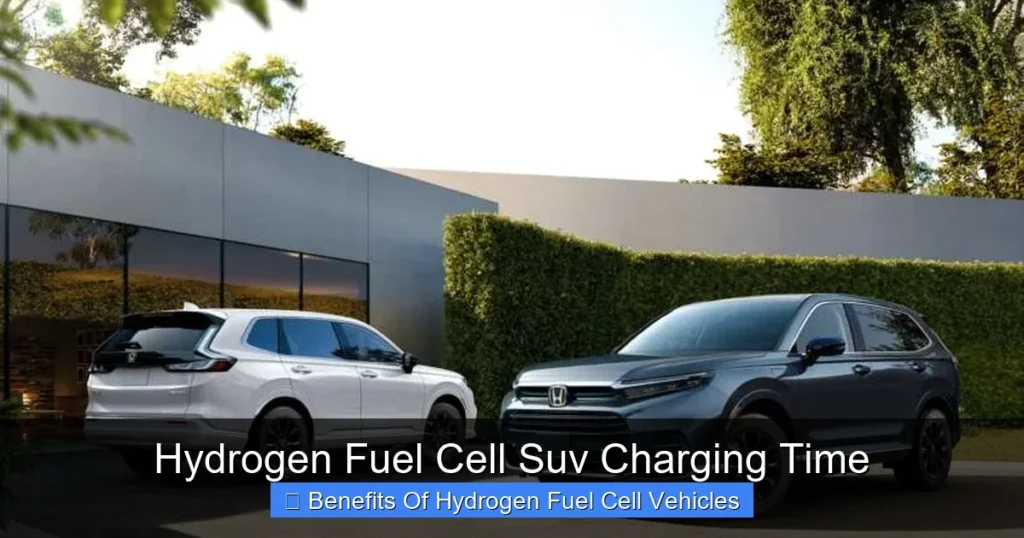
Hydrogen fuel cell SUV charging time is one of the biggest advantages over battery electric vehicles—refueling takes just 3 to 10 minutes, matching traditional gas-powered SUVs. This quick turnaround, combined with long driving ranges and zero emissions, makes hydrogen SUVs a compelling option for eco-conscious drivers who value convenience and efficiency.
Imagine pulling up to a fueling station, stepping out of your sleek, modern SUV, and filling it up in less time than it takes to grab a coffee and use the restroom. No waiting hours for a battery to charge. No range anxiety on a long road trip. That’s the reality of driving a hydrogen fuel cell SUV. While electric vehicles (EVs) have dominated the clean transportation conversation, hydrogen fuel cell electric vehicles (FCEVs) are quietly emerging as a powerful alternative—especially when it comes to one critical factor: hydrogen fuel cell SUV charging time.
Unlike battery-powered EVs that require anywhere from 30 minutes (on a fast charger) to several hours (on a standard outlet), hydrogen fuel cell SUVs refuel in just a few minutes. This isn’t science fiction—it’s happening right now. Models like the Toyota Mirai, Hyundai Nexo, and the upcoming Honda CR-V Fuel Cell are proving that hydrogen can deliver the convenience of gasoline with the environmental benefits of electric power. But how exactly does this work? And what does “charging time” really mean for hydrogen vehicles?
Let’s break it down. When people talk about “charging” an EV, they’re referring to replenishing the battery with electricity. For hydrogen SUVs, the process is different—there’s no battery to charge in the traditional sense. Instead, hydrogen gas is pumped into a high-pressure tank, where it’s stored until needed. Inside the fuel cell stack, hydrogen reacts with oxygen from the air to produce electricity, which powers the motor. The only emission? Pure water vapor. This means you’re driving a zero-emission vehicle that refuels as quickly as a gas-powered car.
The speed of refueling is one of the most compelling reasons to consider a hydrogen fuel cell SUV. Whether you’re a busy parent shuttling kids to school, a sales rep covering long distances, or a family planning a cross-country vacation, time is precious. With hydrogen, you spend less time at the pump and more time on the road. And as hydrogen infrastructure continues to grow—particularly in regions like California, where over 50 public stations are already operational—access is becoming more convenient.
But it’s not just about speed. The combination of quick refueling, long range, and environmental benefits makes hydrogen SUVs a smart choice for the future of sustainable transportation. In this article, we’ll dive deep into hydrogen fuel cell SUV charging time, explore how it compares to EVs and gasoline vehicles, examine real-world performance, and discuss what the future holds for this promising technology.
Key Takeaways
- Refueling is fast: Hydrogen fuel cell SUVs can be refueled in 3 to 10 minutes, similar to gasoline vehicles.
- Long driving range: Most hydrogen SUVs offer 300–400 miles per fill-up, ideal for long trips.
- Zero tailpipe emissions: The only byproduct is water vapor, making them environmentally friendly.
- Growing infrastructure: Hydrogen refueling stations are expanding, especially in California, Japan, and parts of Europe.
- Ideal for heavy-duty use: Hydrogen SUVs perform well in cold weather and maintain efficiency under heavy loads.
- Lower downtime: Quick refueling reduces downtime for fleets and frequent travelers.
- Future-ready technology: As green hydrogen production grows, these vehicles will become even cleaner and more sustainable.
📑 Table of Contents
How Hydrogen Fuel Cell SUVs Work
To truly appreciate the speed of hydrogen fuel cell SUV charging time, it helps to understand how these vehicles operate. Unlike battery electric vehicles (BEVs) that store energy in large lithium-ion batteries, hydrogen fuel cell electric vehicles (FCEVs) generate electricity on demand using a chemical reaction.
At the heart of every hydrogen SUV is the fuel cell stack. This is where the magic happens. Compressed hydrogen gas is fed into the stack, where it meets oxygen from the surrounding air. Through a process called electrolysis (but in reverse), the hydrogen splits into protons and electrons. The protons pass through a membrane, while the electrons are forced to travel through an external circuit, creating an electric current. This electricity powers the vehicle’s motor, propelling it forward.
The only byproduct of this reaction is water—literally, just H₂O. That means no carbon dioxide, no nitrogen oxides, and no particulate matter. It’s clean, quiet, and efficient. The hydrogen is stored in high-strength carbon-fiber tanks, typically located under the floor of the vehicle for safety and space efficiency. These tanks can hold enough hydrogen to deliver a range of 300 to 400 miles, depending on the model and driving conditions.
One of the key advantages of this system is that it doesn’t rely on a large, heavy battery pack. While FCEVs do have a small battery to assist with acceleration and store regenerative braking energy, it’s much smaller than those in BEVs. This reduces weight and frees up space, allowing for more passenger and cargo room—something SUV buyers definitely appreciate.
Another benefit is performance in cold weather. Unlike lithium-ion batteries, which can lose efficiency in freezing temperatures, hydrogen fuel cells maintain consistent power output. This makes hydrogen SUVs especially appealing in colder climates where EV range can drop significantly in winter.
So, while the term “charging” might be a bit misleading—since you’re not plugging in—the process of refueling a hydrogen SUV is just as straightforward as filling up at a gas station. You drive up, connect the nozzle, and within minutes, you’re back on the road. No waiting, no scheduling charging sessions, no worrying about finding a compatible charger. It’s simple, fast, and familiar.
Hydrogen Fuel Cell SUV Charging Time: What to Expect

Visual guide about Hydrogen Fuel Cell Suv Charging Time
Image source: thumbs.dreamstime.com
When it comes to hydrogen fuel cell SUV charging time, the numbers are impressive. Most hydrogen SUVs can be fully refueled in just 3 to 10 minutes. That’s faster than many gasoline vehicles and dramatically quicker than even the fastest EV fast chargers.
Let’s put that into perspective. A typical EV with a 300-mile range might take 30 to 45 minutes to charge from 10% to 80% on a Level 3 DC fast charger. And that’s under ideal conditions—charging slows down as the battery fills up to protect its longevity. In contrast, a hydrogen SUV like the Hyundai Nexo can go from empty to full in about 5 minutes, giving you a full 380-mile range almost instantly.
This speed is possible because refueling hydrogen is a physical process, not an electrochemical one. You’re simply pumping compressed gas into a tank, much like filling a scuba tank or a propane cylinder. The process is governed by pressure and flow rate, not by the complex chemistry of battery charging. As long as the station has sufficient hydrogen supply and the correct pressure (typically 700 bar for light-duty vehicles), the refuel is quick and efficient.
Real-world examples back this up. In California, where hydrogen infrastructure is most developed, drivers routinely report refueling times of 5 to 7 minutes at public stations. The Toyota Mirai, for instance, has been praised for its seamless refueling experience—drivers simply pull up, connect the dispenser, and wait a few minutes while the system automatically fills the tank. There’s no need to monitor the process or worry about overcharging.
It’s also worth noting that hydrogen refueling is consistent. Unlike EV charging, which can vary based on battery temperature, state of charge, and charger availability, hydrogen refueling time remains relatively stable. Whether you’re at 10% or 50%, the fill-up takes roughly the same amount of time. This predictability is a major advantage for drivers who rely on their vehicles for work or travel.
Of course, refueling speed depends on the station’s capacity and the vehicle’s tank design. Some older or smaller stations may take slightly longer, but as technology improves and infrastructure expands, these times are expected to decrease. Newer stations are being built with higher flow rates and better automation, making the process even faster and more user-friendly.
For families, commuters, and commercial users, this speed translates into real-world benefits. Imagine being able to refuel during a quick stop at a grocery store or while dropping off a package—no need to plan your day around charging sessions. For ride-sharing services or delivery fleets, reduced downtime means higher productivity and lower operating costs.
Comparing Hydrogen SUV Charging Time to EVs and Gasoline Vehicles
To fully grasp the advantage of hydrogen fuel cell SUV charging time, it’s helpful to compare it directly with both battery electric vehicles (BEVs) and traditional internal combustion engine (ICE) vehicles.
Let’s start with gasoline SUVs. These vehicles typically take 5 to 10 minutes to refuel, depending on the pump speed and tank size. The process is familiar: pull up, insert the nozzle, and wait while the fuel flows. Hydrogen SUVs match this experience almost exactly. In fact, many drivers say refueling a hydrogen vehicle feels just like filling up with gas—except cleaner and quieter.
Now, compare that to BEVs. Even with the fastest DC fast chargers (350 kW), most electric SUVs take at least 20 to 30 minutes to go from 10% to 80% charge. And that’s only if the charger is available, compatible, and operating at full capacity. In colder weather or when the battery is already warm, charging can slow down significantly. Plus, you can’t charge to 100% quickly—most fast chargers taper off after 80% to protect the battery.
This means that for long trips, EV drivers often need to plan multiple charging stops, each adding 30 minutes or more to their journey. In contrast, a hydrogen SUV driver can refuel in the time it takes to stretch their legs and grab a snack, then continue driving for another 300+ miles.
Another factor is infrastructure availability. While EV charging stations are more common overall, fast chargers are still limited in many areas—especially outside urban centers. Hydrogen stations are fewer in number, but they’re strategically placed along major highways and in metropolitan areas, making them ideal for long-distance travel.
Let’s look at a real-world example. Suppose you’re driving from Los Angeles to San Francisco—a 380-mile trip. In a hydrogen SUV like the Hyundai Nexo, you could make the journey with one quick refuel stop in Santa Barbara, taking less than 10 minutes. In a Tesla Model Y Long Range, you’d likely need two charging stops, each taking 30–40 minutes, adding 1.5 to 2 hours to your trip.
Of course, EVs have their own advantages—lower operating costs, home charging convenience, and a rapidly expanding network. But when it comes to refueling speed and long-range travel, hydrogen SUVs hold a clear edge.
It’s also important to consider total energy efficiency. While hydrogen production and distribution are less efficient than direct electricity use, the speed and convenience of refueling can outweigh this for many drivers. As green hydrogen—produced using renewable energy—becomes more widespread, the environmental footprint of FCEVs will continue to shrink.
Real-World Performance and User Experiences
So, how does hydrogen fuel cell SUV charging time hold up in everyday use? According to drivers and fleet operators, the experience is overwhelmingly positive.
Take John, a sales manager in Sacramento who drives a Toyota Mirai. “I used to drive a plug-in hybrid, and I was always worried about finding a charger,” he says. “Now, I just pull up to a hydrogen station, fill up in five minutes, and I’m good for 350 miles. It’s like having a gas car, but cleaner.”
Similarly, ride-sharing companies in California have begun adopting hydrogen SUVs for their fleets. The quick refueling time allows drivers to maximize their hours on the road, increasing earnings and reducing downtime. One Lyft driver reported refueling three times a day with no delays, thanks to the speed and reliability of hydrogen stations.
Cold weather performance is another area where hydrogen SUVs shine. In a test conducted by the Idaho National Laboratory, FCEVs maintained over 90% of their range in sub-zero temperatures, while comparable EVs lost up to 40% of their range. This is because hydrogen fuel cells don’t rely on battery chemistry, which slows down in the cold.
Maintenance is also simpler. With no engine oil, spark plugs, or complex transmission, hydrogen SUVs have fewer moving parts and require less upkeep. The fuel cell stack is designed to last over 100,000 miles, and many manufacturers offer extended warranties to cover it.
Of course, challenges remain. Hydrogen stations are still limited, and fuel costs can be higher than electricity or gasoline in some areas. But as production scales up and green hydrogen becomes more affordable, these issues are expected to improve.
The Future of Hydrogen Refueling Infrastructure
The growth of hydrogen fuel cell SUV charging time depends heavily on infrastructure development. While the technology is ready, widespread adoption requires more refueling stations.
Currently, California leads the way with over 50 public hydrogen stations, with plans to reach 200 by 2025. Japan and South Korea have also invested heavily, with hundreds of stations supporting government-backed FCEV initiatives. In Europe, countries like Germany and the UK are expanding their networks, particularly along major transport corridors.
New technologies are also improving station efficiency. Mobile refuelers, hydrogen trailers, and on-site production using solar or wind power are making hydrogen more accessible. Some companies are even exploring home refueling units, though these are still in early development.
As demand grows, costs are expected to fall. The U.S. Department of Energy aims to reduce hydrogen production costs to $1 per kilogram by 2031—down from around $16 today. This would make hydrogen competitive with gasoline on a cost-per-mile basis.
Environmental and Economic Benefits
Beyond speed, hydrogen SUVs offer significant environmental and economic advantages. When powered by green hydrogen—produced using renewable energy—they emit zero greenhouse gases. Even with current production methods, FCEVs produce far fewer emissions than gasoline vehicles.
Economically, the fast refueling time reduces operational costs for fleets and commercial users. Less downtime means more productivity, and the simplicity of the fuel cell system lowers maintenance expenses over time.
As the world moves toward decarbonization, hydrogen SUVs represent a practical, scalable solution for sustainable transportation—especially for those who need the range and convenience of traditional vehicles.
Conclusion
Hydrogen fuel cell SUV charging time is a game-changer in the world of clean transportation. With refueling times of just 3 to 10 minutes, these vehicles offer the speed and convenience of gasoline cars with the environmental benefits of electric power. As infrastructure expands and technology improves, hydrogen SUVs are poised to become a mainstream choice for drivers who value efficiency, range, and sustainability. Whether you’re commuting, road-tripping, or managing a fleet, the future of driving is fast, clean, and hydrogen-powered.
Frequently Asked Questions
How long does it take to refuel a hydrogen fuel cell SUV?
Most hydrogen fuel cell SUVs can be fully refueled in just 3 to 10 minutes, depending on the station and vehicle model. This is comparable to filling up a gasoline SUV and much faster than charging an electric vehicle.
Is hydrogen refueling safe?
Yes, hydrogen refueling is safe. Hydrogen is lighter than air and disperses quickly if leaked. Modern hydrogen tanks are made of strong carbon fiber and undergo rigorous safety testing to withstand impacts and extreme conditions.
Where can I refuel a hydrogen SUV?
Hydrogen refueling stations are currently concentrated in California, with growing networks in Japan, South Korea, and parts of Europe. The infrastructure is expanding, especially along major highways and in urban centers.
How far can a hydrogen SUV go on one tank?
Most hydrogen fuel cell SUVs offer a driving range of 300 to 400 miles per fill-up, similar to many gasoline-powered SUVs. This makes them ideal for long-distance travel.
Is hydrogen more expensive than gasoline or electricity?
Currently, hydrogen can be more expensive per mile than gasoline or electricity, but costs are expected to decrease as production scales up and green hydrogen becomes more widely available.
Can hydrogen SUVs be charged at home?
Home refueling for hydrogen vehicles is not yet widely available, though experimental systems are being developed. Most drivers rely on public hydrogen stations for refueling.