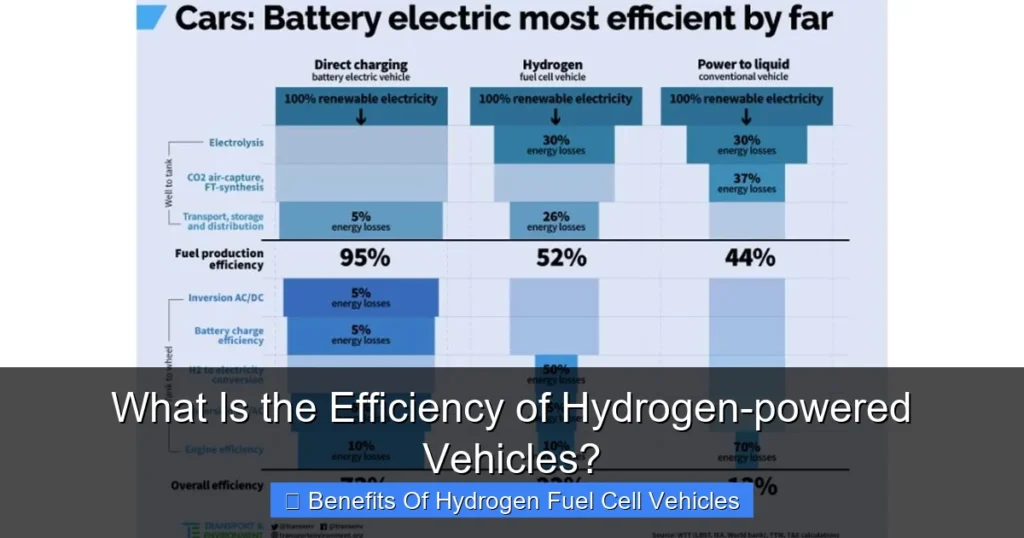
Hydrogen-powered vehicles offer impressive efficiency, with fuel cell systems converting 40-60% of hydrogen’s energy into motion—outperforming many gasoline engines but lagging behind some EVs in well-to-wheel analysis. Their efficiency depends on factors like infrastructure, storage tech, and driving conditions, making them a promising yet evolving solution for zero-emission mobility.
This is a comprehensive guide about What is the efficiency of hydrogen-powered vehicles?.
Key Takeaways
- Efficiency Range: Fuel cells convert 40-60% of hydrogen’s energy into power, while gasoline engines average 20-30%. However, well-to-wheel efficiency (including production/transport) can be lower due to energy losses.
- Fuel vs. Electricity: Hydrogen refueling is faster than charging EVs but requires more energy per mile compared to battery-electric vehicles (BEVs).
- Infrastructure Costs: Building hydrogen stations is expensive ($1M–$2M each), limiting current adoption and efficiency gains.
- Weight Matters: Heavy storage tanks reduce payload capacity, offsetting efficiency benefits for heavy-duty trucks.
- Green Hydrogen Growth: Renewable-powered electrolysis could improve overall efficiency by cutting emissions from production.
- Real-World Data: Toyota Mirai achieves ~67 MPGe (miles per gallon equivalent), similar to mid-range BEVs.
—
[FEATURED_IMAGE_PLACEHOLDER]
Introduction: Why Efficiency Matters for Hydrogen Vehicles
You’ve probably heard about hydrogen fuel cell vehicles (FCEVs) as the future of clean transport. But how efficient are they really? Unlike battery-electric cars that store energy in batteries, FCEVs generate electricity on-board using hydrogen gas. This makes them unique—faster refueling, longer range, and different efficiency dynamics.
Efficiency isn’t just about miles per kilogram of hydrogen (MPkg). It’s a chain: production, compression, transportation, storage, and conversion. Each step adds energy loss. Yet, hydrogen still shines in specific niches like buses, trucks, and emergency vehicles where quick refueling and cold-weather performance matter. Let’s break it down.
How Hydrogen Fuel Cells Work: The Efficiency Breakdown
The Fuel Cell Process
A fuel cell stack combines hydrogen and oxygen via an electrochemical reaction, producing only water and heat. Modern PEM (Proton Exchange Membrane) fuel cells achieve 40-60% efficiency in converting hydrogen’s chemical energy into electricity—far better than internal combustion engines (ICEs) at 20-30%. But here’s the catch:
- Well-to-Wheel Efficiency: Factoring in hydrogen production (steam methane reforming or electrolysis), compression, and transport drops total efficiency to 25-35% for gray hydrogen (from fossil fuels). Green hydrogen (renewable-powered) improves this to 30-40% if produced efficiently.
- Energy Losses: Compressing hydrogen to 700 bar for storage wastes ~30% of its potential energy. Pipelines also lose 5-15% during transit.
Practical Example: Toyota Mirai
The Mirai’s fuel cell system delivers 98 kW of power, enabling 402-mile EPA-rated range. At 1 kg of hydrogen (~39 kWh usable energy), it averages 10-11 MPkg. That’s competitive with a Tesla Model 3 Long Range (~3.5 mi/kWh) when accounting for hydrogen’s energy density.
Comparing Hydrogen vs. Electric Cars: Efficiency Battle
Battery-Electric Vehicles (BEVs)
BEVs pack high-density lithium-ion batteries with 90%+ round-trip efficiency (charging to wheels). A Nissan Leaf gets ~4 mi/kWh, while a Rivian R1T hits 3.5 mi/kWh. No fuel conversion means less waste.
“BEVs win in well-to-wheel efficiency, but FCEVs excel in fast refueling and extreme climates.”
When Hydrogen Shines
- Heavy-Duty Transport: Trucks and buses need frequent, rapid refueling—hydrogen fits better than slow EV charging.
- Cold Weather: Hydrogen doesn’t suffer from battery degradation in sub-zero temps, unlike many EVs.
- Energy Storage: Excess renewable energy can produce hydrogen, storing “spare” solar/wind power for later use.
Factors Affecting Hydrogen Vehicle Efficiency
1. Hydrogen Production Method
- Gray Hydrogen: Made from natural gas, emitting CO₂. Cheap but inefficient long-term.
- Blue Hydrogen: Captures 90% of emissions via CCS. Better but not zero-emission.
- Green Hydrogen: Electrolysis powered by renewables. Ideal for sustainability, but costs are dropping ($1–3/kg by 2030).
2. Infrastructure Gaps
Only ~1,000 hydrogen stations exist globally (vs. 200,000+ EV chargers). Sparse stations mean detours, reducing effective efficiency. For example, a truck traveling between California and Texas may face multiple stops, adding time and energy.
3. Vehicle Design Trade-offs
Hydrogen tanks add weight (~1,000 lbs for a 500 kg tank), reducing payload space. Engineers optimize for aerodynamics and lightweight materials, but every pound matters for efficiency.
Future Improvements Boosting Efficiency
Advanced Materials
New catalysts like platinum-group metal alloys could reduce fuel cell costs and improve durability, boosting lifetime efficiency.
Hydrogen Recycling
Reusing hydrogen from industrial processes (e.g., steel mills) cuts production energy needs. Projects like HyDeal Ambition aim to green hydrogen prices below $2/kg.
Smart Refueling Tech
AI-optimized refueling stations can match supply with demand, minimizing compression waste. Pilot projects in Japan show 10-15% savings.
Real-World Efficiency Metrics
| Vehicle | Range (mi) | Hydrogen Used (kg) | MPkg |
|---|---|---|---|
| Toyota Mirai | 402 | 5.2 | 77 |
| Nissan X-Trail FCV | 360 | 4.8 | 75 |
| Honda Clarity F-Cell | 366 | 5.5 | 67 |
Note: MPkg varies based on driving style and climate. Aggressive acceleration reduces efficiency by ~15%.
Conclusion: Is Hydrogen Worth It?
Hydrogen FCEVs aren’t universally the most efficient option—EVs often outperform them in energy use per mile. However, hydrogen’s strengths (fast refueling, scalability for heavy transport, and resilience in extreme weather) make it vital for decarbonizing sectors like aviation and freight. As green hydrogen production scales and infrastructure grows, efficiency will rise. For now, FCEVs are a complementary technology, not a replacement for all EVs.
“Think of hydrogen as the ‘quick fix’ for hard-to-electrify industries, while EVs lead in passenger cars.”
—
### QUICK Q&A
Question 1?
Hydrogen FCEVs are less efficient than EVs in terms of energy use per mile because of production and transport losses. However, they win in refueling speed and certain applications.
Question 2?
Yes! Green hydrogen (made via renewables) has the lowest carbon footprint and higher well-to-wheel efficiency compared to gray/blue hydrogen.
Question 3?
Hydrogen works well for trucks, buses, ships, and planes where batteries are too heavy or slow to recharge. EVs dominate cars and light trucks.
Question 4?
Costs are falling. By 2030, analysts project hydrogen fuel cell stacks to drop below $100/kW, narrowing the price gap with BEVs.
Question 5?
No. Hydrogen’s energy density (kWh/kg) is low, so you need more fuel for the same distance as gasoline. But tanks store more energy per volume than batteries.
### FAQs
What’s the difference between gray, blue, and green hydrogen?
Gray hydrogen uses natural gas, emitting CO₂; blue hydrogen adds carbon capture; green hydrogen runs entirely on renewables, offering the cleanest option.
Can hydrogen cars run on regular gasoline?
No. FCEVs require pure hydrogen; mixing other fuels damages the fuel cell stack.
Are hydrogen stations safe?
Yes. Stations use leak detection, pressure relief valves, and are built to safety standards (NFPA 2). Risks are comparable to natural gas stations.
How far can a hydrogen car go on one tank?
Most FCEVs have ranges of 300–400 miles (Mirai: 402 mi; Hyundai Nexo: 379 mi), rivaling long-range EVs.
Is hydrogen more expensive than electricity for driving?
Currently, yes. Hydrogen costs ~$16/kg (vs. $0.14/kWh for grid electricity). Green hydrogen under $2/kg would level the playing field.
Will hydrogen replace batteries completely?
Unlikely. They’ll coexist: batteries for urban commuting, hydrogen for heavy transport and niche uses.
Quick Answers to Common Questions
What is What is the efficiency of hydrogen-powered vehicles??
What is the efficiency of hydrogen-powered vehicles? refers to essential knowledge and techniques.
Frequently Asked Questions
What is What is the efficiency of hydrogen-powered vehicles??
What is the efficiency of hydrogen-powered vehicles? is an important topic with many practical applications.