Hydrogen cars and electric cars both aim to cut emissions, but they differ in environmental impact, energy efficiency, and infrastructure. While hydrogen vehicles emit only water, their production and distribution often rely on fossil fuels. Electric cars are more energy-efficient and increasingly powered by renewables, making them generally greener—unless you’re driving a hydrogen model powered by green hydrogen.
Key Takeaways
- Hydrogen cars emit only water vapor during operation — but the environmental benefit depends heavily on how the hydrogen is produced.
- Electric cars are more energy-efficient from well to wheel, using about 77% of their energy to power the vehicle, compared to just 30–35% for hydrogen cars.
- Green hydrogen is clean but rare — most hydrogen today is “gray” or “blue,” made from natural gas, which releases CO₂.
- Charging infrastructure favors electric vehicles — EV charging stations are far more common and easier to install than hydrogen refueling networks.
- Hydrogen may shine in heavy transport — for trucks, ships, and planes, hydrogen’s energy density offers advantages over batteries.
- Battery production has environmental costs — mining lithium, cobalt, and nickel raises ecological and ethical concerns, though recycling is improving.
- Long-term sustainability depends on clean energy — both technologies are only as green as the electricity grid powering them.
Quick Answers to Common Questions
Do hydrogen cars produce any emissions?
Hydrogen cars emit only water vapor from the tailpipe. However, if the hydrogen is produced from fossil fuels (like gray or blue hydrogen), there are significant CO₂ emissions upstream.
Are electric cars really better for the environment?
Yes, on average. EVs have lower lifetime emissions than gasoline or hydrogen cars, especially when charged with renewable energy. Their higher manufacturing emissions are offset within a year or two of driving.
Can I refuel a hydrogen car at home?
Not easily. Home hydrogen refueling is technically possible but not commercially available. Most hydrogen stations are public and located in urban areas, primarily in California.
Is green hydrogen the future?
It has potential, especially for industries hard to electrify. But it’s currently expensive and rare. Widespread adoption depends on cheaper renewable energy and better electrolysis technology.
Which is more efficient: battery or hydrogen?
Battery electric vehicles are far more efficient — using about 77% of energy from grid to wheel, compared to 30–35% for hydrogen fuel cell vehicles.
📑 Table of Contents
Introduction: The Green Car Dilemma
When it comes to fighting climate change, transportation is a major player. Cars, trucks, and buses burn fossil fuels and release tons of carbon dioxide into the atmosphere every year. That’s why the world is shifting toward cleaner alternatives — and two of the most talked-about options are hydrogen cars and electric cars.
At first glance, both seem like winners for the planet. Electric vehicles (EVs) run on batteries and don’t emit tailpipe pollution. Hydrogen fuel cell vehicles (FCEVs) combine hydrogen with oxygen to produce electricity, and their only emission is water vapor. Sounds perfect, right?
But here’s the catch: just because a car doesn’t pollute while driving doesn’t mean it’s 100% green. The real environmental impact comes from how the energy is made, how the car is built, and how it’s powered over its lifetime. So, are hydrogen cars better for the environment than electric cars? The answer isn’t a simple yes or no. It depends on a lot of factors — from where your electricity comes from to how the hydrogen is produced.
How Do Hydrogen and Electric Cars Work?
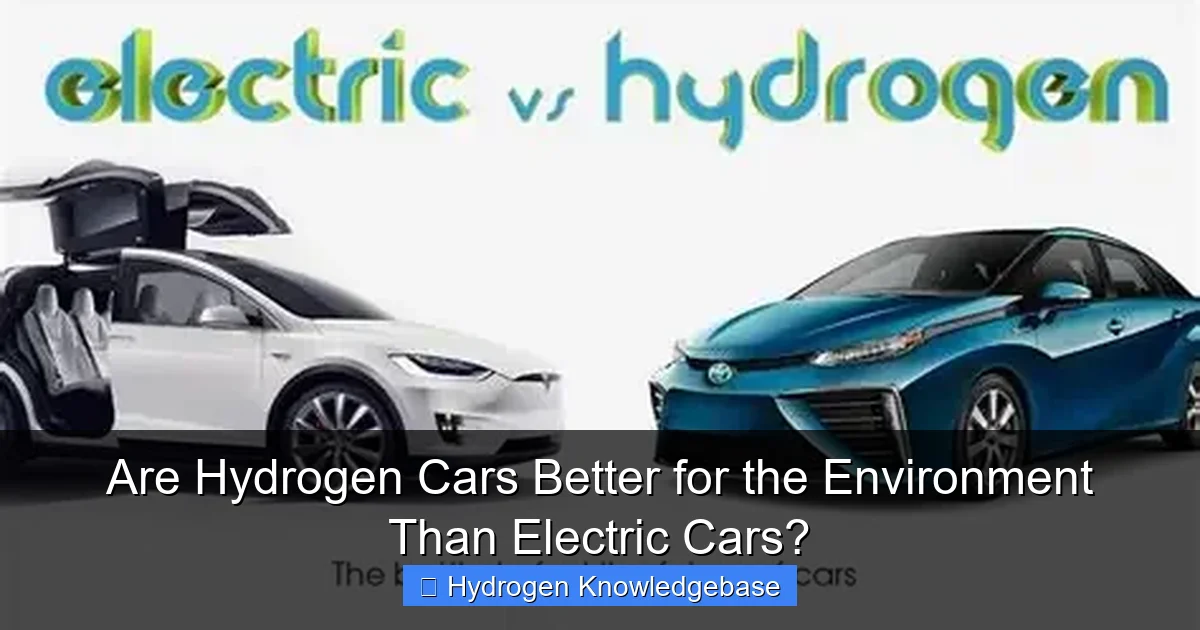
Visual guide about Are Hydrogen Cars Better for the Environment Than Electric Cars?
Image source: autozonic.com
Before we compare their environmental footprints, let’s break down how each technology actually works.
Electric Cars: Power from the Plug
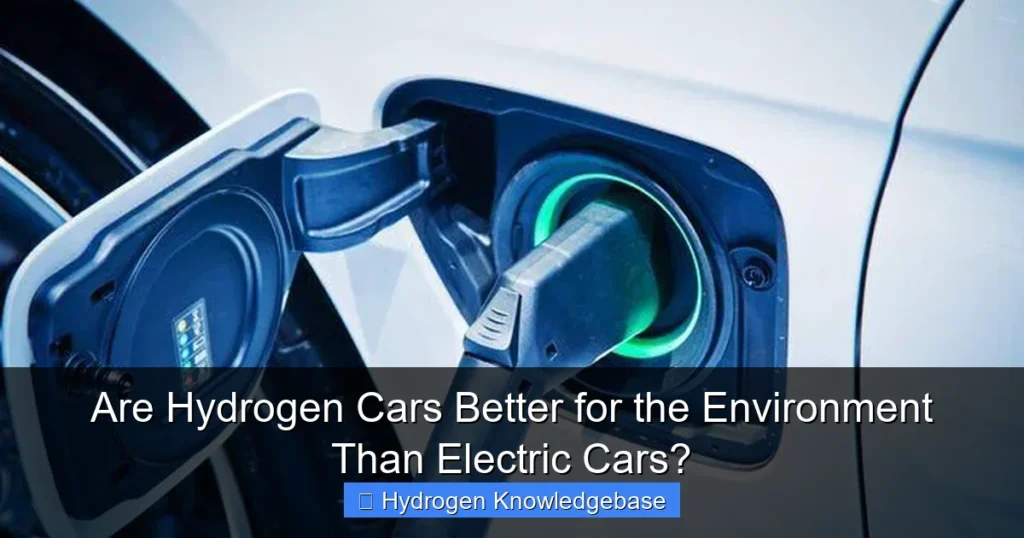
Electric cars store energy in large lithium-ion batteries, similar to what’s in your phone or laptop — just much bigger. When you plug in your EV, electricity from the grid charges the battery. That stored energy then powers an electric motor, which turns the wheels. No engine, no gasoline, no emissions while driving.
Charging can happen at home, at work, or at public stations. The speed depends on the charger — from slow overnight charging to fast DC chargers that can refill 80% of the battery in 30 minutes.
Hydrogen Cars: Fuel Cells and Water Vapor
Hydrogen cars, on the other hand, use a fuel cell stack. Hydrogen gas is stored in high-pressure tanks inside the vehicle. When you drive, hydrogen flows into the fuel cell, where it reacts with oxygen from the air. This chemical reaction produces electricity, which powers the motor — and the only byproduct is water, which drips out as vapor.
Refueling a hydrogen car is quick — about 3 to 5 minutes — similar to filling up a gas tank. But unlike EVs, hydrogen cars don’t rely on the electrical grid directly. Instead, they depend on a separate hydrogen production and delivery system.
Environmental Impact: From Production to Disposal
Now let’s dig into the real environmental costs — not just what comes out of the tailpipe, but the full lifecycle of each vehicle.
Manufacturing: Batteries vs. Fuel Cells
Building any car has an environmental cost, but EVs and hydrogen cars have different hotspots.
Electric cars require large batteries, which means mining for lithium, cobalt, nickel, and graphite. These materials are often extracted in countries with weak environmental regulations, leading to deforestation, water pollution, and human rights concerns. A typical EV battery can weigh over 1,000 pounds and takes significant energy to produce.
Hydrogen cars also have environmental costs in manufacturing. Fuel cells use platinum as a catalyst, a rare and expensive metal that requires energy-intensive mining. However, hydrogen cars don’t need massive batteries, so their overall material footprint can be smaller — depending on the model.
Studies show that EVs generally have a higher carbon footprint during production than gasoline cars, mostly due to the battery. But this “carbon debt” is usually paid back within 6 to 18 months of driving, thanks to zero tailpipe emissions.
Energy Source: The Big Difference
This is where the environmental debate really heats up.
For electric cars, the cleanliness depends on how your local electricity is generated. If your grid runs on coal, your EV isn’t as green. But if it’s powered by wind, solar, or hydro, your car is practically emissions-free.
In the U.S., the average grid is getting cleaner every year. According to the U.S. Department of Energy, EVs already produce less than half the emissions of a gasoline car over their lifetime — even when charged on a fossil-fuel-heavy grid.
Hydrogen cars face a different challenge: most hydrogen today is not green.
There are three main types of hydrogen, based on how it’s made:
- Gray hydrogen: Made from natural gas through a process called steam methane reforming. This releases CO₂ — about 9–12 kg of CO₂ per kg of hydrogen. This is the most common type, accounting for about 95% of global hydrogen production.
- Blue hydrogen: Also made from natural gas, but the CO₂ is captured and stored (carbon capture and storage, or CCS). It’s cleaner than gray, but not perfect — some CO₂ still leaks, and CCS isn’t 100% efficient.
- Green hydrogen: Produced by splitting water into hydrogen and oxygen using renewable electricity (like wind or solar). This is the only truly clean method — but it’s expensive and makes up less than 1% of global hydrogen today.
So unless your hydrogen car is fueled by green hydrogen, it’s not as clean as it seems.
Efficiency: The Energy Loss Problem
Another major factor is energy efficiency — how much of the original energy actually makes it to the wheels.
Let’s follow the energy path for both types of cars:
For electric cars:
- Electricity is generated (from coal, gas, wind, solar, etc.).
- It’s transmitted to a charging station (small losses).
- The battery charges (about 10–15% loss).
- The motor uses the energy to move the car (very efficient — over 90%).
Overall, EVs use about 77% of the original energy to power the wheels.
For hydrogen cars:
- Electricity is used to produce hydrogen (electrolysis — about 30% loss).
- Hydrogen is compressed and transported (another 10–15% loss).
- It’s stored in the car’s tank (small losses).
- The fuel cell converts hydrogen back to electricity (40–60% efficiency).
- The motor uses that electricity (90% efficient).
By the time the energy reaches the wheels, only about 30–35% of the original energy is used.
That means hydrogen cars need nearly three times more energy to go the same distance as an electric car. Even if that energy comes from renewables, it’s a huge waste of resources.
Infrastructure and Real-World Use
Technology is one thing — but can you actually use these cars in everyday life?
Charging vs. Refueling: Availability Matters
Electric cars have a clear advantage here. There are over 150,000 public charging stations in the U.S. alone, and that number is growing fast. Many people charge at home overnight, making EVs convenient for daily use.
Hydrogen refueling stations, by contrast, are extremely rare. As of 2024, there are fewer than 100 public hydrogen stations in the entire U.S. — and most are in California. If you live outside that state, you’re out of luck. Building hydrogen stations is expensive — each one can cost $1–2 million — and requires specialized equipment to handle high-pressure gas.
This lack of infrastructure makes hydrogen cars impractical for most drivers today.
Range and Refueling Time
Hydrogen cars do have one advantage: fast refueling. Like gasoline cars, you can fill up in minutes and get a range of 300–400 miles. That’s appealing for long trips or commercial use.
Most EVs take 30 minutes to an hour to fast-charge to 80%, though home charging overnight is usually sufficient. Newer EVs are pushing 300+ mile ranges, narrowing the gap.
But again, convenience means little if you can’t find a place to refuel.
Where Hydrogen Might Win: Heavy Transport
While hydrogen cars struggle in the passenger market, hydrogen could be a game-changer for heavy-duty transport.
Trucks, Ships, and Planes
Batteries are heavy and take a long time to charge — not ideal for long-haul trucks or cargo ships. A fully loaded truck might need a battery weighing several tons, reducing cargo capacity.
Hydrogen, on the other hand, has a high energy density by weight. A hydrogen-powered truck can travel long distances without losing much payload. Companies like Toyota, Hyundai, and Nikola are already testing hydrogen trucks.
Similarly, airplanes and ships need a lot of energy in a small space. Batteries are too heavy for most aviation uses. Hydrogen — especially in liquid form — could be the answer for zero-emission flights and shipping.
So while hydrogen may not dominate the car market, it could play a key role in decarbonizing industries where batteries fall short.
The Future: Can Hydrogen Catch Up?
The environmental case for hydrogen cars hinges on one thing: green hydrogen.
If we can scale up renewable energy and use it to produce hydrogen efficiently and cheaply, hydrogen vehicles could become much cleaner. Governments and companies are investing in green hydrogen projects — from solar-powered electrolyzers in Australia to wind farms in Europe.
But progress is slow. Green hydrogen is still 2–3 times more expensive than gray hydrogen. And building a whole new fuel infrastructure — from production plants to pipelines to refueling stations — will take decades and trillions of dollars.
Meanwhile, electric cars are already here, getting cheaper, and benefiting from massive investment in batteries and charging networks.
Policy and Incentives
Governments are also shaping the future. The U.S. Inflation Reduction Act includes tax credits for both EVs and clean hydrogen production. The European Union has set ambitious targets for green hydrogen.
But policies often favor EVs because they’re more mature and widely adopted. For example, many countries offer purchase rebates for EVs but not for hydrogen cars.
Conclusion: Which Is Better for the Environment?
So, are hydrogen cars better for the environment than electric cars?
The short answer: not today — and probably not for most passenger vehicles in the near future.
Electric cars are more energy-efficient, have lower lifecycle emissions (especially on clean grids), and benefit from a rapidly growing charging network. Even with the environmental costs of battery production, EVs are currently the greener choice for everyday drivers.
Hydrogen cars have potential — especially if powered by green hydrogen — but they’re held back by inefficiency, high costs, and lack of infrastructure. Right now, most hydrogen is made from fossil fuels, which undermines their environmental benefits.
That said, hydrogen isn’t a lost cause. It could be a vital tool for decarbonizing heavy transport, aviation, and industry — areas where batteries struggle.
The best path forward? Use the right tool for the job. For most people, that means electric cars. For long-haul trucks and planes, hydrogen might be the future.
And remember: no technology is perfect. The real goal isn’t just switching from gas to electric or hydrogen — it’s building a clean, renewable energy system that powers everything, from our homes to our highways.
Frequently Asked Questions
What is green hydrogen?
Green hydrogen is produced by splitting water into hydrogen and oxygen using renewable electricity, such as wind or solar power. It’s the only truly zero-emission method of hydrogen production.
Why aren’t there more hydrogen cars on the road?
Hydrogen cars face challenges like high costs, limited refueling stations, and lower efficiency compared to electric vehicles. Most automakers have focused on EVs instead.
Do hydrogen cars have a longer range than electric cars?
Some hydrogen models offer ranges of 300–400 miles, similar to long-range EVs. However, real-world range depends on driving conditions and vehicle design.
Is hydrogen safe to use in cars?
Yes, hydrogen is safe when handled properly. It’s lighter than air and disperses quickly if leaked. Modern hydrogen tanks are rigorously tested and designed to withstand crashes.
Can hydrogen be transported like gasoline?
Hydrogen can be transported via pipelines or trucks, but it’s more challenging due to its low density and high flammability. Specialized infrastructure is required.
Will hydrogen cars ever be as common as electric cars?
Unlikely for passenger vehicles. EVs are already mainstream, while hydrogen lacks infrastructure and efficiency. Hydrogen may find niche roles in trucks, buses, and aviation.