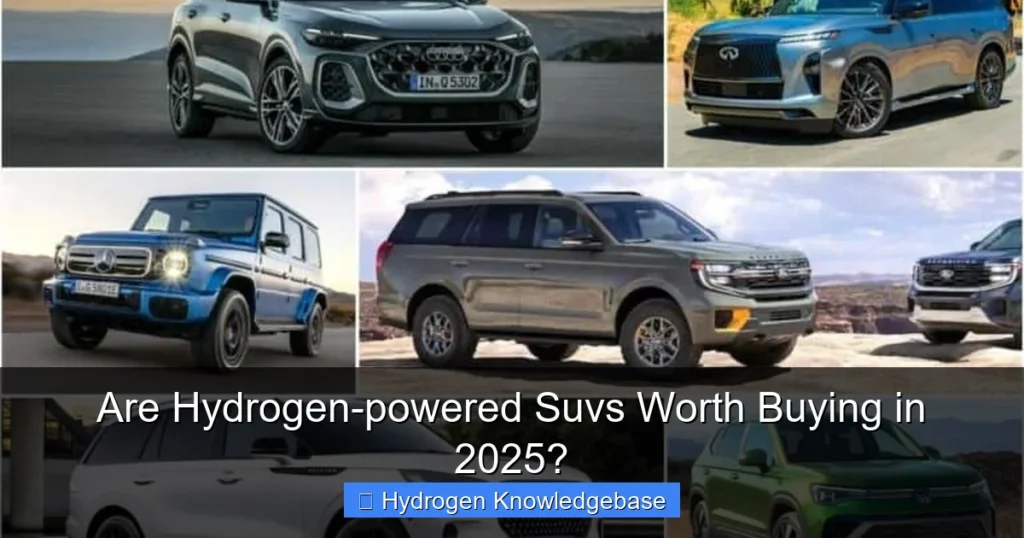
Hydrogen-powered SUVs offer zero-emission driving with quick refueling, but limited infrastructure and high costs remain key challenges in 2025. While they’re ideal for long-range, eco-conscious drivers in well-supported regions, most buyers may still find battery electric SUVs more practical—for now.
Key Takeaways
- Limited refueling infrastructure: Hydrogen stations are scarce outside select regions like California, Japan, and parts of Europe, making long-distance travel difficult.
- Zero tailpipe emissions: Hydrogen SUVs emit only water vapor, offering a clean alternative for eco-conscious drivers who need SUV space and range.
- Higher upfront cost: Hydrogen SUVs like the Toyota Mirai and Hyundai NEXO cost significantly more than comparable battery electric or gasoline models.
- Fast refueling time: A hydrogen tank fills in 3–5 minutes, similar to gasoline, unlike hours-long EV charging sessions.
- Strong government support in key markets: Incentives and investments in hydrogen infrastructure are growing in countries committed to green energy transitions.
- Improving technology and efficiency: Fuel cell efficiency and durability are advancing, with newer models offering better performance and longer lifespans.
- Best suited for niche users: Ideal for fleet operators, long-haul drivers, or those in hydrogen-friendly regions—less practical for average daily commuters.
Quick Answers to Common Questions
Can I charge a hydrogen SUV at home?
No, you cannot “charge” a hydrogen SUV at home like an EV. You need to refuel with hydrogen gas at a specialized station. Home hydrogen production systems exist but are expensive and not widely available.
How long does it take to refuel a hydrogen SUV?
Refueling takes just 3 to 5 minutes—similar to filling a gasoline tank. This is much faster than charging an EV, even with a fast charger.
Are hydrogen SUVs safe in a crash?
Yes. Hydrogen SUVs are designed with multiple safety features, including high-strength tanks, leak sensors, and automatic shut-off systems. Studies show they are as safe as other vehicle types.
What happens if I run out of hydrogen?
Like running out of gas, your SUV will stop. But roadside assistance for hydrogen vehicles is limited. It’s best to plan routes with known refueling stations.
Do hydrogen SUVs work in cold weather?
Yes. Hydrogen fuel cells perform well in cold climates, unlike some batteries that lose efficiency in the cold. However, water vapor from the exhaust can freeze, so manufacturers include drainage systems.
📑 Table of Contents
- Are Hydrogen-powered SUVs Worth Buying in 2025?
- How Hydrogen-powered SUVs Work
- Pros and Cons of Hydrogen-powered SUVs in 2025
- Cost Analysis: Are Hydrogen SUVs Affordable in 2025?
- Hydrogen Infrastructure: Where Can You Refuel in 2025?
- Environmental Impact: Are Hydrogen SUVs Truly Green?
- The Future of Hydrogen SUVs: What’s Next?
- Conclusion: Should You Buy a Hydrogen-powered SUV in 2025?
Are Hydrogen-powered SUVs Worth Buying in 2025?
Imagine driving a spacious, powerful SUV that emits nothing but water vapor—no smog, no carbon, just clean air behind you. That’s the promise of hydrogen-powered SUVs. As we move deeper into 2025, the automotive world is buzzing with talk about sustainable transportation. Electric vehicles (EVs) dominate the headlines, but hydrogen fuel cell vehicles (FCEVs) are quietly gaining traction, especially in the SUV segment. But are they really worth your money and attention this year?
Hydrogen-powered SUVs use fuel cells to convert hydrogen gas into electricity, which then powers an electric motor. Unlike battery electric vehicles (BEVs), which rely on large, heavy batteries, hydrogen SUVs generate their own electricity on board. This means they can offer longer ranges and faster refueling—closer to the experience of driving a traditional gasoline vehicle. But despite these advantages, hydrogen SUVs face real-world hurdles: high prices, limited refueling stations, and questions about overall sustainability.
So, should you consider buying one in 2025? The answer isn’t a simple yes or no. It depends on your driving habits, location, budget, and environmental priorities. In this guide, we’ll break down everything you need to know—from how hydrogen SUVs work to their real-world performance, costs, and future outlook. Whether you’re a green tech enthusiast, a family needing cargo space, or a fleet manager looking to go zero-emission, this article will help you decide if a hydrogen-powered SUV fits your life.
How Hydrogen-powered SUVs Work

Visual guide about Are Hydrogen-powered Suvs Worth Buying in 2025?
Image source: tractionlife.com
At first glance, hydrogen-powered SUVs might seem like science fiction. But the technology behind them is both elegant and practical. Let’s break it down in simple terms.
The Basics of Hydrogen Fuel Cells
Hydrogen fuel cell vehicles (FCEVs) use a chemical reaction to generate electricity. Inside the fuel cell stack, hydrogen from the onboard tank combines with oxygen from the air. This reaction produces electricity, water, and a little heat—nothing else. The electricity powers the SUV’s electric motor, just like in a battery EV, but without the need for constant recharging.
The fuel cell itself is made up of multiple individual cells stacked together. Each cell has an anode, a cathode, and an electrolyte membrane. When hydrogen enters the anode, it splits into protons and electrons. The protons pass through the membrane to the cathode, while the electrons take a detour through an external circuit—creating an electric current. At the cathode, the protons, electrons, and oxygen reunite to form water (H₂O), which is released as vapor from the tailpipe.
This process is incredibly clean. Unlike internal combustion engines, there are no harmful emissions like nitrogen oxides (NOx) or particulate matter. The only byproduct is pure water—so clean, in fact, that some drivers joke they could drink it (though we don’t recommend it!).
Hydrogen Storage and Safety
One of the biggest concerns about hydrogen vehicles is safety. After all, hydrogen is highly flammable. But modern hydrogen SUVs are designed with multiple safety layers. The hydrogen is stored in high-strength carbon-fiber tanks that can withstand extreme pressure—typically around 10,000 psi. These tanks are rigorously tested for impact, fire, and puncture resistance.
In the event of a collision, sensors detect leaks and automatically shut off the hydrogen supply. The tanks are also designed to vent gas upward and away from the vehicle, reducing fire risk. In fact, studies by organizations like the National Renewable Energy Laboratory (NREL) have shown that hydrogen vehicles are as safe—or safer—than gasoline or battery EVs in crashes.
Refueling is also straightforward. You drive up to a hydrogen pump, connect the nozzle (similar to a gas pump), and fill the tank in 3 to 5 minutes. No waiting hours for a charge. This makes hydrogen SUVs especially appealing for people who need quick turnarounds, like delivery drivers or long-distance travelers.
Real-World Performance
So how do hydrogen SUVs actually perform on the road? Take the Hyundai NEXO, one of the most popular models in 2025. It offers a range of about 380 miles on a full tank—comparable to many gasoline SUVs and better than most battery EVs. The NEXO accelerates smoothly, handles well, and offers a quiet, comfortable ride. It also comes with advanced features like adaptive cruise control, lane-keeping assist, and a high-tech infotainment system.
The Toyota Mirai, another leading hydrogen SUV, delivers similar performance with a sleek, futuristic design. It’s not a rugged off-roader, but it’s perfect for city driving, highway cruising, and family trips. Both vehicles offer ample cargo space and seating for five, making them practical for everyday use.
One thing to note: hydrogen SUVs are heavier than their battery EV counterparts because of the fuel cell system and high-pressure tanks. This can affect handling slightly, but the difference is minimal for most drivers. The real advantage is the combination of long range and fast refueling—something no current EV can match.
Pros and Cons of Hydrogen-powered SUVs in 2025
Like any technology, hydrogen-powered SUVs come with trade-offs. Let’s look at the biggest advantages and disadvantages you’ll face in 2025.
Advantages
Zero Tailpipe Emissions: The most obvious benefit is environmental. Hydrogen SUVs produce no CO₂, NOx, or particulate emissions during operation. If the hydrogen is produced using renewable energy (like wind or solar), the entire lifecycle can be nearly carbon-neutral.
Fast Refueling: Filling up takes just 3–5 minutes—about the same as a gasoline vehicle. This is a huge advantage over battery EVs, which can take 30 minutes to several hours to recharge, depending on the charger.
Long Range: Most hydrogen SUVs offer ranges between 300 and 400 miles. That’s better than many EVs and ideal for road trips or drivers who can’t charge at home.
Quiet and Smooth Driving: Like all electric vehicles, hydrogen SUVs are nearly silent and deliver instant torque for smooth acceleration.
Growing Government Support: Countries like Japan, South Korea, Germany, and the U.S. (especially California) are investing heavily in hydrogen infrastructure and offering purchase incentives.
Disadvantages
Limited Refueling Stations: This is the biggest hurdle. As of early 2025, there are fewer than 150 public hydrogen stations in the U.S., mostly in California. In Europe and Asia, the network is slightly better, but still sparse. If you live outside these areas, owning a hydrogen SUV could be impractical.
High Upfront Cost: Hydrogen SUVs are expensive. The Hyundai NEXO starts around $60,000, and the Toyota Mirai is similar. That’s $10,000–$20,000 more than comparable battery EVs like the Tesla Model Y or Ford Mustang Mach-E.
Hydrogen Production Isn’t Always Clean: Most hydrogen today is made from natural gas through a process called steam methane reforming, which releases CO₂. Only about 1% of global hydrogen is “green” (produced using renewable energy). Until green hydrogen scales up, the environmental benefit is reduced.
Lower Energy Efficiency: Converting electricity to hydrogen, transporting it, and converting it back to electricity in the fuel cell is less efficient than charging a battery directly. Studies show hydrogen FCEVs use 2–3 times more energy per mile than battery EVs.
Resale Value and Maintenance Concerns: The used market for hydrogen SUVs is tiny, so resale values are uncertain. Maintenance is also more complex due to the fuel cell system, though reliability is improving.
Cost Analysis: Are Hydrogen SUVs Affordable in 2025?
Let’s talk money. Buying a hydrogen-powered SUV isn’t just about the sticker price—it’s about the total cost of ownership.
Upfront Purchase Price
As mentioned, hydrogen SUVs are pricey. The Hyundai NEXO starts at $58,000, while the Toyota Mirai begins at $62,000. Compare that to the Tesla Model Y Long Range at $53,000 or the Ford Mustang Mach-E Premium at $50,000. You’re paying a premium for the technology and limited production scale.
However, incentives can help. In California, buyers can get a $5,000 state rebate on top of the federal tax credit (if available). Some utility companies also offer additional rebates. Leasing is another option—Hyundai and Toyota often offer low monthly payments with included hydrogen fuel for the first few years.
Fuel Costs
Hydrogen fuel is expensive. As of 2025, the average cost is about $16 per kilogram. A full tank (around 5–6 kg) costs $80–$96 and gives you 300–400 miles of range. That’s roughly $0.20–$0.25 per mile—similar to gasoline but much higher than electricity.
For comparison, charging a Tesla Model Y at home costs about $0.04–$0.06 per mile. Even public fast charging is cheaper than hydrogen. So while refueling is fast, it’s not cheap.
That said, some manufacturers include free hydrogen for 3–5 years with purchase, which can offset early costs. But once that ends, fuel expenses add up.
Maintenance and Insurance
Maintenance for hydrogen SUVs is generally low—no oil changes, fewer moving parts than gasoline engines. But repairs can be costly if the fuel cell or tanks need service. Specialized technicians are still rare, so service may require visiting a certified dealer.
Insurance tends to be higher due to the vehicle’s value and complexity. Expect premiums 10–20% above comparable EVs or SUVs.
Long-Term Value
Depreciation is a concern. With low demand and limited resale market, hydrogen SUVs may lose value faster than EVs. However, as infrastructure grows and technology improves, this could change. Early adopters may benefit from future appreciation if hydrogen becomes mainstream.
Hydrogen Infrastructure: Where Can You Refuel in 2025?
The biggest question for most buyers isn’t performance or cost—it’s: “Can I actually fill it up?”
Current State of Hydrogen Stations
As of early 2025, the global hydrogen refueling network is still in its infancy. The U.S. has about 140 public stations, with over 90% in California. Europe has around 200 stations, led by Germany, France, and the UK. Japan and South Korea have the most developed networks, with over 150 stations each.
This means your ability to own a hydrogen SUV depends heavily on where you live. If you’re in Los Angeles, San Francisco, or Sacramento, you’re in luck—there are multiple stations within a 30-mile radius. But if you’re in Texas, Florida, or the Midwest, you’re out of luck.
Expansion Plans
The good news? Governments and private companies are investing heavily. The U.S. Department of Energy has pledged $8 billion to build hydrogen “hubs” across the country. California aims to have 200 stations by 2026. In Europe, the H2ME2 project is expanding networks in Germany, France, and Scandinavia.
Automakers are also stepping up. Toyota and Hyundai are partnering with energy companies to install stations near dealerships and along major highways. Shell and BP are adding hydrogen pumps to existing gas stations in key markets.
Home Refueling: A Future Possibility?
One solution on the horizon is home hydrogen refueling. Companies like Ivys Energy Solutions are developing small-scale electrolyzers that can produce hydrogen at home using solar power. These systems are still expensive ($20,000–$50,000) and not widely available, but they could revolutionize ownership for early adopters.
For now, though, most hydrogen SUV owners rely on public stations—and that limits practicality for many.
Environmental Impact: Are Hydrogen SUVs Truly Green?
It’s easy to assume that because hydrogen SUVs emit only water, they’re automatically eco-friendly. But the full picture is more complex.
The Source of Hydrogen Matters
Hydrogen itself is clean, but how it’s made determines its environmental footprint. Today, about 95% of hydrogen is “gray” hydrogen—produced from natural gas, which releases CO₂. “Blue” hydrogen captures and stores some of that CO₂, reducing emissions by 50–90%. Only “green” hydrogen, made with renewable energy, is truly zero-emission.
In 2025, green hydrogen is still a small fraction of supply, but it’s growing. Countries like Australia, Canada, and Chile are investing in large-scale green hydrogen projects. The EU’s REPowerEU plan aims to produce 10 million tons of green hydrogen annually by 2030.
Lifecycle Emissions Compared to EVs
When you consider the entire lifecycle—from production to disposal—hydrogen SUVs have higher emissions than battery EVs, mainly due to energy losses in hydrogen production and transport. A 2024 study by the International Council on Clean Transportation (ICCT) found that battery EVs emit 60–70% less CO₂ over their lifetime than hydrogen FCEVs using gray hydrogen.
However, if green hydrogen becomes widespread, that gap could shrink. And for heavy-duty applications like trucks and buses, hydrogen may be more practical than batteries due to weight and range limitations.
Recycling and Sustainability
Fuel cells contain precious metals like platinum, which can be recycled. Hyundai and Toyota have take-back programs to recover materials at end-of-life. The carbon-fiber tanks are harder to recycle, but research is ongoing.
Overall, hydrogen SUVs are cleaner than gasoline vehicles, but not as clean as battery EVs—unless the hydrogen is green.
The Future of Hydrogen SUVs: What’s Next?
So, where is this technology headed? Will hydrogen SUVs become mainstream, or remain a niche option?
Technological Advances
Fuel cell efficiency is improving. Newer models use less platinum and last longer—up to 200,000 miles or more. Solid-state fuel cells, still in development, promise even greater efficiency and durability.
Hydrogen production is also getting greener. Electrolyzer costs are falling, and renewable energy is cheaper than ever. By 2030, green hydrogen could be cost-competitive with gray hydrogen.
Market Trends
Sales of hydrogen vehicles are growing slowly but steadily. In 2024, global FCEV sales exceeded 20,000 units, with SUVs making up over 60%. Hyundai and Toyota lead the market, but new entrants like BMW (with the iX5 Hydrogen) and General Motors (with Hydrotec fuel cells) are expanding options.
Fleet adoption is a key driver. Companies like Amazon and UPS are testing hydrogen delivery vans. Public transit agencies are adding hydrogen buses. These large-scale uses help build infrastructure and reduce costs.
Will Hydrogen SUVs Win in the Long Run?
It’s unlikely hydrogen SUVs will replace battery EVs for most consumers. But they could carve out a strong niche—especially for long-range, heavy-duty, or fleet applications. In regions with strong hydrogen support, they may become a viable alternative.
For the average buyer in 2025, a battery EV is still the more practical, affordable, and sustainable choice. But if you’re in a hydrogen-friendly area, need fast refueling, and want zero emissions, a hydrogen-powered SUV could be worth considering.
Conclusion: Should You Buy a Hydrogen-powered SUV in 2025?
So, are hydrogen-powered SUVs worth buying in 2025? The short answer: it depends.
If you live in California, Japan, or parts of Europe, and you value long range, fast refueling, and zero emissions, a hydrogen SUV could be a smart, forward-thinking choice. Models like the Hyundai NEXO and Toyota Mirai offer impressive performance, comfort, and environmental benefits—especially if you can access green hydrogen.
But for most drivers, the high cost, limited infrastructure, and lower efficiency make battery electric SUVs a better option. EVs are cheaper to buy and fuel, have a vast charging network, and are more energy-efficient.
Hydrogen SUVs aren’t for everyone—but they’re not a dead end either. They represent an important piece of the clean transportation puzzle. As technology improves and infrastructure expands, they could become more accessible and appealing.
In 2025, hydrogen-powered SUVs are best suited for early adopters, fleet operators, and eco-conscious drivers in supportive regions. If that sounds like you, it might be time to take one for a test drive. The future of clean driving is here—it just looks a little different than we expected.
Frequently Asked Questions
How much does it cost to fill up a hydrogen SUV?
Filling a hydrogen SUV costs around $80–$96 for a full tank, giving you 300–400 miles of range. This is more expensive per mile than electricity but comparable to gasoline.
Where can I find hydrogen refueling stations?
Most stations are in California, Japan, South Korea, and parts of Europe. Use apps like H2.Live or PlugShare to locate stations near you.
Are there tax incentives for buying a hydrogen SUV?
Yes, in some regions. California offers a $5,000 rebate, and federal incentives may apply. Check local programs for the latest offers.
How long do hydrogen fuel cells last?
Modern fuel cells are designed to last 150,000–200,000 miles or more, similar to a well-maintained gasoline engine.
Can hydrogen SUVs tow or haul heavy loads?
Yes, but towing reduces range significantly. The Hyundai NEXO, for example, has a towing capacity of around 1,500 lbs, but range may drop by 30–40%.
Will hydrogen SUVs be cheaper in the future?
Yes, as production scales up and technology improves, prices are expected to fall. Green hydrogen production will also become more affordable by 2030.