Hydrogen-powered SUVs offer zero-emission driving with quick refueling, but face challenges like limited infrastructure and high costs. While promising for long-range and heavy-duty use, they’re currently a niche option compared to electric vehicles.
Key Takeaways
- Zero tailpipe emissions: Hydrogen SUVs only emit water vapor, making them environmentally friendly during operation.
- Fast refueling: Fill up in 5–10 minutes, similar to gasoline, unlike hours needed for most EVs.
- Limited refueling stations: Hydrogen stations are scarce, mostly concentrated in California and parts of Europe.
- High upfront cost: Hydrogen SUVs are significantly more expensive than electric or gas-powered models.
- Strong performance: These SUVs offer smooth, quiet rides with instant torque and long driving ranges.
- Emerging technology: Still in early adoption phase, with ongoing improvements in efficiency and infrastructure.
- Best for specific users: Ideal for fleet operators or those with access to hydrogen stations, not yet practical for average drivers.
Quick Answers to Common Questions
How far can a hydrogen-powered SUV go on one tank?
Most hydrogen SUVs, like the Hyundai NEXO, can travel between 350 and 380 miles on a full tank—similar to gas-powered SUVs and better than many electric models.
How long does it take to refuel a hydrogen SUV?
Refueling takes just 5 to 10 minutes, comparable to filling up a gas tank and much faster than charging an electric SUV.
Are hydrogen SUVs safe in a crash?
Yes. Hydrogen tanks are rigorously tested and designed to withstand high pressure and impact. Safety systems prevent leaks and explosions.
Can I install a hydrogen pump at home?
Not easily. Home hydrogen refueling systems are expensive and not widely available. Public stations are currently the only practical option.
Do hydrogen SUVs qualify for tax credits?
Yes, in some regions. California offers rebates up to $15,000, and federal incentives may apply depending on the vehicle and usage.
📑 Table of Contents
- Are Hydrogen-Powered SUVs Worth It? A Realistic Look at the Future of Clean Driving
- How Hydrogen-Powered SUVs Work
- Environmental Benefits: Are They Really Clean?
- Cost Analysis: Are Hydrogen SUVs Affordable?
- Infrastructure: The Biggest Hurdle
- Performance and Practicality: How Do They Stack Up?
- Who Should Consider a Hydrogen SUV?
- The Future of Hydrogen SUVs: What’s Next?
- Conclusion: Are Hydrogen-Powered SUVs Worth It?
Are Hydrogen-Powered SUVs Worth It? A Realistic Look at the Future of Clean Driving
Imagine pulling up to a fueling station, filling your SUV in under ten minutes, and driving 300+ miles on a single tank—all while emitting nothing but clean water vapor. Sounds like science fiction, right? But that’s exactly what hydrogen-powered SUVs promise. As the world races toward cleaner transportation, hydrogen fuel cell vehicles (FCEVs) are gaining attention as a potential alternative to battery-electric vehicles (BEVs). But are they actually worth it?
Hydrogen-powered SUVs use fuel cells to convert hydrogen gas into electricity, which powers an electric motor. Unlike traditional gasoline vehicles, they produce zero harmful emissions. Unlike many electric SUVs, they don’t require hours of charging. Instead, you refuel with hydrogen gas in minutes—just like pumping gas. On paper, it’s a win-win: clean, fast, and convenient. But the reality is more complicated.
While hydrogen SUVs sound futuristic and eco-friendly, they come with real-world challenges. The technology is still young, the infrastructure is limited, and the costs are high. So, before you trade in your gas guzzler or consider skipping EVs altogether, let’s dive deep into what hydrogen-powered SUVs really offer—and whether they’re a smart choice for you today.
How Hydrogen-Powered SUVs Work
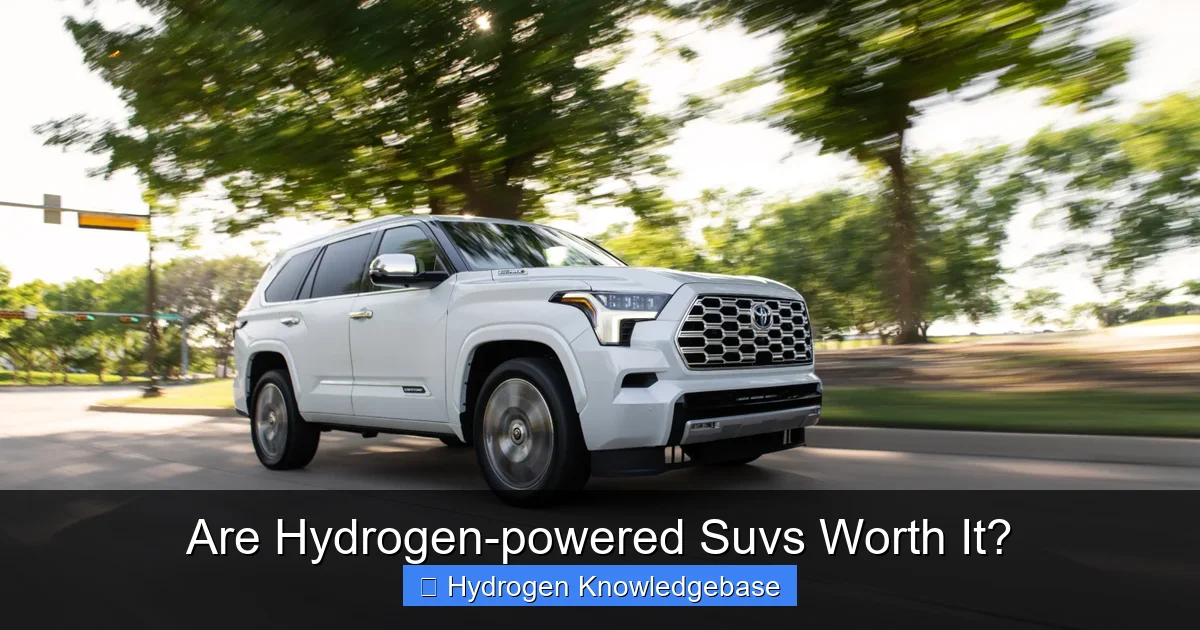
Visual guide about Are Hydrogen-powered Suvs Worth It?
Image source: motorbiscuit.com
To understand whether hydrogen SUVs are worth it, you first need to know how they actually work. At their core, these vehicles are electric—but instead of relying solely on a large battery, they generate electricity on the go using hydrogen.
The Fuel Cell System
Hydrogen-powered SUVs use a device called a fuel cell stack. Inside this stack, hydrogen gas from the onboard tanks reacts with oxygen from the air in a chemical process called electrolysis. This reaction produces electricity, water, and a little heat. The electricity powers the electric motor, while the only byproduct released is water vapor—hence the “zero emissions” claim.
The fuel cell system is compact and can be integrated into SUVs without sacrificing passenger or cargo space. Unlike battery-electric SUVs, which need heavy lithium-ion batteries, hydrogen SUVs store energy in lightweight tanks filled with compressed hydrogen gas. This allows for longer ranges without adding excessive weight.
Hydrogen Storage and Refueling
Hydrogen is stored in high-pressure tanks—usually around 700 bar (10,000 psi)—mounted securely in the vehicle’s chassis. These tanks are made of advanced composite materials to ensure safety and durability. Despite the high pressure, modern hydrogen tanks are designed to withstand crashes and extreme conditions.
Refueling is simple: you drive up to a hydrogen station, connect a nozzle to the vehicle’s fuel port, and fill up in about 5 to 10 minutes. This is a major advantage over electric SUVs, which can take 30 minutes to several hours to recharge, depending on the charger type and battery size.
Performance and Driving Experience
Hydrogen SUVs deliver smooth, quiet, and responsive performance. Because they use electric motors, they offer instant torque—meaning quick acceleration from a stop. Models like the Toyota Mirai and Hyundai NEXO can go from 0 to 60 mph in around 9 seconds, which is respectable for a midsize SUV.
They also offer long driving ranges. The Hyundai NEXO, for example, has an EPA-estimated range of 380 miles on a full tank. That’s more than many electric SUVs and comparable to gas-powered models. Plus, since the fuel cell generates electricity continuously, there’s no “range anxiety” during long trips—as long as you can find a hydrogen station.
Environmental Benefits: Are They Really Clean?
One of the biggest selling points of hydrogen-powered SUVs is their environmental impact—or lack thereof. But are they truly green?
Zero Tailpipe Emissions
The most obvious benefit is that hydrogen SUVs emit only water vapor. No carbon dioxide (CO₂), no nitrogen oxides (NOx), no particulate matter. This makes them ideal for reducing urban air pollution and improving public health in cities.
For drivers concerned about climate change and air quality, this is a major plus. Unlike hybrid or plug-in hybrid SUVs, which still burn fossil fuels part of the time, hydrogen FCEVs are 100% emission-free at the tailpipe.
The Catch: How Is the Hydrogen Made?
Here’s the catch: while the vehicle itself is clean, the environmental benefit depends heavily on how the hydrogen is produced. Currently, over 95% of hydrogen is made using natural gas in a process called steam methane reforming (SMR). This process releases CO₂, which undermines the green claims.
Only a small fraction of hydrogen is produced using renewable energy through electrolysis—splitting water into hydrogen and oxygen using electricity from solar or wind. This “green hydrogen” is truly sustainable, but it’s expensive and not widely available.
So, unless you’re refueling with green hydrogen, your SUV’s environmental footprint may not be as clean as you think. That said, the industry is working to scale up green hydrogen production, and some hydrogen stations already use renewable sources.
Lifecycle Emissions Compared to EVs
When you consider the full lifecycle—manufacturing, fuel production, and driving—hydrogen SUVs currently have higher emissions than battery-electric vehicles (BEVs). A 2022 study by the International Council on Clean Transportation (ICCT) found that FCEVs powered by natural gas-based hydrogen produce about 20% more lifecycle emissions than comparable BEVs.
However, if the hydrogen comes from renewable sources, FCEVs can match or even beat BEVs in terms of total emissions. The key is scaling up green hydrogen and improving fuel cell efficiency.
Cost Analysis: Are Hydrogen SUVs Affordable?
Now let’s talk money. Are hydrogen-powered SUVs worth the price tag?
Upfront Purchase Price
Hydrogen SUVs are expensive. The 2024 Hyundai NEXO starts at around $60,000, and the Toyota Mirai is priced similarly. That’s significantly more than comparable electric SUVs like the Tesla Model Y (~$50,000) or the Ford Mustang Mach-E (~$45,000).
Why the high cost? Fuel cell technology is still niche, with low production volumes. The materials used—like platinum in the fuel cell catalysts—are costly. Plus, hydrogen storage tanks and safety systems add to the price.
Fuel Costs: Hydrogen vs. Electricity vs. Gas
Hydrogen fuel is also expensive. As of 2024, the average cost of hydrogen in California—the only state with a significant number of public stations—is about $36 per kilogram. A typical hydrogen SUV uses about 1 kg per 60–70 miles, so a 300-mile trip could cost around $150.
Compare that to electricity: charging a Tesla Model Y for 300 miles might cost $15–$25 at home, or $30–$50 at public fast chargers. Gasoline is cheaper too—filling a Toyota RAV4 for 300 miles costs around $50–$70.
So, hydrogen is currently the most expensive fuel option per mile. However, some manufacturers include free hydrogen for several years with purchase. For example, Toyota offers up to $15,000 in free fuel for Mirai buyers, which can offset the high cost—at least initially.
Maintenance and Long-Term Costs
On the plus side, hydrogen SUVs have fewer moving parts than internal combustion engines, so maintenance is simpler. No oil changes, no spark plugs, no exhaust systems. The electric motor and fuel cell require minimal servicing.
But repairs can be costly if something goes wrong. Fuel cells are complex and not yet widely understood by mechanics. If the fuel cell stack fails, replacement can cost thousands of dollars. And since hydrogen vehicles are rare, finding qualified technicians is a challenge.
Infrastructure: The Biggest Hurdle
Even if you can afford a hydrogen SUV, can you actually use it? That depends entirely on where you live.
Hydrogen Refueling Stations: Where Are They?
As of 2024, there are fewer than 100 public hydrogen refueling stations in the United States—and over 80% are in California. Outside of the Golden State, options are extremely limited. A few stations exist in Hawaii, and some are planned in the Northeast, but coverage is sparse.
In contrast, there are over 150,000 public EV charging stations across the U.S., with fast chargers along major highways. Even rural areas have growing networks.
This means hydrogen SUVs are only practical if you live near a station or are willing to plan your trips carefully. Long road trips? Forget it—unless you’re sticking to California’s I-5 corridor.
Home Refueling: Is It Possible?
Unlike electric vehicles, you can’t plug a hydrogen SUV into your garage outlet. Home hydrogen refueling is technically possible with a home electrolyzer, but these systems are expensive ($20,000+) and require a reliable source of renewable electricity.
Some companies are working on compact home hydrogen stations, but they’re not yet commercially viable. For now, refueling means visiting a public station—which may be miles away.
The Future of Hydrogen Infrastructure
Governments and private companies are investing in hydrogen infrastructure. The U.S. Department of Energy has launched the H2@Scale initiative to support hydrogen development. California aims to have 200 hydrogen stations by 2025.
In Europe, countries like Germany, France, and the UK are building hydrogen corridors for trucks and buses. Japan and South Korea are also leaders in hydrogen technology.
But progress is slow. Building hydrogen stations is expensive—each one costs $1–$3 million—and requires specialized equipment and safety protocols. Until the network expands, hydrogen SUVs will remain a regional novelty.
Performance and Practicality: How Do They Stack Up?
Let’s look at how hydrogen SUVs perform in real-world use.
Range and Refueling Speed
Hydrogen SUVs shine in range and refueling. The Hyundai NEXO offers up to 380 miles per fill-up, and refueling takes just 5–10 minutes. That’s a game-changer for road trips or busy families who don’t want to wait hours at a charging station.
Compare that to a Tesla Model Y, which takes 20–30 minutes for a fast charge (10–80%) and has a range of about 330 miles. While fast charging is improving, it still can’t match the speed of hydrogen.
Towing and Cargo Capacity
Hydrogen SUVs are built like traditional SUVs, so they offer good cargo space and towing capacity. The NEXO can tow up to 1,500 pounds, which is decent for a midsize SUV. It also has 27.1 cubic feet of cargo space behind the rear seats—comparable to gas-powered rivals.
However, the hydrogen tanks and fuel cell system take up some space, so you won’t get as much room as in a conventional SUV. Still, it’s practical for daily use and weekend adventures.
Driving Dynamics and Comfort
Hydrogen SUVs are smooth, quiet, and refined. The electric motor delivers instant power, and the ride is comfortable thanks to well-tuned suspensions. The NEXO, for example, has a plush interior with premium materials, a large touchscreen, and advanced driver-assistance features.
They’re not sporty like some electric SUVs, but they’re more than capable for highway cruising and city driving. The quiet operation is a plus—no engine noise, just the hum of the electric motor.
Who Should Consider a Hydrogen SUV?
Given the pros and cons, who actually benefits from a hydrogen-powered SUV?
Fleet Operators and Commercial Users
Hydrogen SUVs make sense for fleets that need long range, fast refueling, and zero emissions. Delivery companies, taxi services, and government agencies in California are already using them. For example, the city of Los Angeles has deployed hydrogen-powered SUVs for municipal use.
Commercial users can also take advantage of tax incentives and grants for clean vehicles.
Early Adopters and Tech Enthusiasts
If you love cutting-edge technology and want to be part of the hydrogen revolution, a hydrogen SUV could be a fun choice. You’ll be driving a vehicle that most people have never seen—and you’ll be supporting innovation.
Just be prepared for the limitations: high cost, limited stations, and potential repair challenges.
People in Hydrogen-Friendly Regions
If you live in Southern California, where hydrogen stations are concentrated, a hydrogen SUV might work for you. You can refuel easily, enjoy long range, and reduce your carbon footprint.
But if you’re in Texas, Florida, or the Midwest, you’re out of luck—unless you’re willing to drive hundreds of miles just to refuel.
The Future of Hydrogen SUVs: What’s Next?
Hydrogen-powered SUVs are still in their infancy, but the future looks promising—if certain conditions are met.
Advances in Fuel Cell Technology
Researchers are working to make fuel cells cheaper and more efficient. New catalysts that use less platinum—or none at all—could reduce costs. Solid-state fuel cells and improved membranes may boost performance and longevity.
Scaling Up Green Hydrogen
The biggest shift will come from green hydrogen. As renewable energy becomes cheaper, electrolysis will become more viable. Countries like Australia, Saudi Arabia, and Chile are investing in massive green hydrogen projects.
If green hydrogen becomes mainstream, hydrogen SUVs could truly become a clean, sustainable option.
Government Support and Incentives
Policies will play a key role. The U.S. Inflation Reduction Act includes tax credits for hydrogen production and clean vehicles. California offers rebates of up to $15,000 for hydrogen vehicle purchases.
Continued support could accelerate adoption and infrastructure growth.
Competition with Battery EVs
Still, hydrogen SUVs face stiff competition from battery-electric vehicles. EVs are improving rapidly—longer ranges, faster charging, lower prices. By 2030, most new SUVs may be electric.
Hydrogen may find a niche in heavy-duty transport—trucks, buses, trains—where batteries are too heavy and charging too slow. For passenger SUVs, the battle is far from over.
Conclusion: Are Hydrogen-Powered SUVs Worth It?
So, are hydrogen-powered SUVs worth it? The answer depends on your priorities, location, and budget.
If you value zero emissions, fast refueling, and long range—and you live near hydrogen stations—then yes, they can be a compelling choice. They’re ideal for fleet operators, early adopters, and eco-conscious drivers in supportive regions.
But for most people, the high cost, limited infrastructure, and uncertain fuel sourcing make hydrogen SUVs a tough sell. Battery-electric SUVs offer similar benefits with better infrastructure, lower operating costs, and faster adoption.
Hydrogen-powered SUVs are not yet ready for the mainstream. But they’re not a dead end, either. With advances in green hydrogen, fuel cell tech, and infrastructure, they could play a key role in the clean transportation future—especially for long-haul and heavy-duty applications.
For now, they’re a niche option with big potential. If you’re curious, consider a test drive—if you can find one. But unless you’re in the right place at the right time, you might be better off waiting a few more years.
Frequently Asked Questions
Are hydrogen-powered SUVs really zero emission?
Hydrogen SUVs emit only water vapor from the tailpipe, making them zero-emission during operation. However, the environmental impact depends on how the hydrogen is produced—green hydrogen is clean, while hydrogen from natural gas is not.
How much does it cost to fuel a hydrogen SUV?
Hydrogen fuel costs about $36 per kilogram in the U.S., with most SUVs getting 60–70 miles per kg. A 300-mile trip could cost $150, making it more expensive than electricity or gasoline.
Where can I refuel a hydrogen SUV?
As of 2024, most public hydrogen stations are in California, with a few in Hawaii and the Northeast. Coverage is limited outside these areas.
Are hydrogen SUVs more expensive than electric SUVs?
Yes. Hydrogen SUVs like the Hyundai NEXO start around $60,000, while comparable electric SUVs like the Tesla Model Y start around $50,000. Maintenance is simpler, but repairs can be costly.
Can hydrogen SUVs tow trailers?
Yes. The Hyundai NEXO can tow up to 1,500 pounds, which is suitable for small trailers, boats, or campers. However, towing reduces range significantly.
Will hydrogen SUVs replace electric SUVs?
Unlikely in the near term. Battery-electric SUVs have better infrastructure, lower costs, and faster adoption. Hydrogen may find a niche in heavy transport, but EVs dominate passenger vehicles.