Hydrogen fuel cell SUVs and electric SUVs both offer clean driving, but they differ in fuel efficiency, refueling speed, and infrastructure. While electric SUVs currently lead in energy efficiency, hydrogen models shine in long-range and quick refueling, making them ideal for certain lifestyles and regions.
Key Takeaways
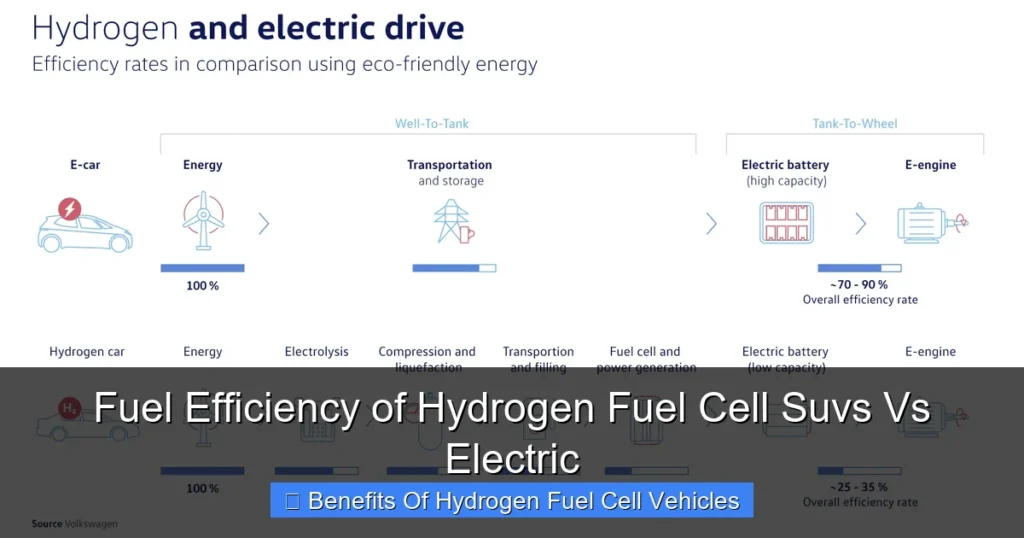
- Electric SUVs are more energy-efficient: They convert over 77% of grid energy to power at the wheels, compared to hydrogen’s 25–35% efficiency from production to wheel.
- Hydrogen SUVs refuel faster: A 5-minute hydrogen fill-up rivals gasoline, while even fast-charging electric SUVs take 20–40 minutes for an 80% charge.
- Range varies by model and conditions: Top hydrogen SUVs like the Toyota Mirai offer 400+ miles, while premium electric SUVs like the Tesla Model X reach similar ranges under ideal conditions.
- Infrastructure is a major differentiator: Electric charging stations are widespread; hydrogen refueling is limited to select regions like California and parts of Europe.
- Environmental impact depends on energy source: EVs are cleaner when powered by renewables; green hydrogen (made with renewable energy) is needed for true sustainability.
- Total cost of ownership favors EVs today: Lower fuel and maintenance costs make electric SUVs more economical, though hydrogen prices may drop with scale.
- Hydrogen suits specific use cases: Ideal for long-haul drivers, fleet operators, and areas with limited charging access but growing hydrogen networks.
📑 Table of Contents
- Introduction: The Rise of Clean SUVs
- Understanding Fuel Efficiency in Clean Vehicles
- Electric SUVs: Efficiency Leaders
- Hydrogen Fuel Cell SUVs: The Efficiency Trade-Off
- Refueling Speed and Convenience
- Environmental Impact: Beyond Tailpipe Emissions
- Cost Comparison: Fuel, Maintenance, and Ownership
- Future Outlook: Which Technology Will Win?
- Conclusion: Choosing the Right Clean SUV
Introduction: The Rise of Clean SUVs
The SUV market is undergoing a green revolution. As consumers demand more space, power, and sustainability, automakers are responding with cleaner alternatives to traditional gas-guzzlers. Two leading technologies have emerged: battery electric SUVs and hydrogen fuel cell SUVs. Both promise zero tailpipe emissions, but they take very different paths to get there.
Electric SUVs, like the Tesla Model Y or Ford Mustang Mach-E, store energy in large lithium-ion batteries and use electric motors to drive the wheels. Hydrogen fuel cell SUVs, such as the Toyota Mirai or Hyundai NEXO, generate electricity on-board by combining hydrogen with oxygen, emitting only water vapor. While both are eco-friendly at the tailpipe, their real-world fuel efficiency, refueling experience, and environmental footprint vary significantly.
This article dives deep into the fuel efficiency of hydrogen fuel cell SUVs versus electric SUVs. We’ll compare energy use, range, refueling speed, infrastructure, cost, and environmental impact. Whether you’re a daily commuter, a road-trip enthusiast, or a fleet manager, understanding these differences will help you choose the right clean SUV for your needs.
Understanding Fuel Efficiency in Clean Vehicles
When we talk about “fuel efficiency” in clean vehicles, we’re not just looking at miles per gallon equivalent (MPGe)—we’re examining the entire energy journey. For electric SUVs, that means how efficiently electricity from the grid powers the wheels. For hydrogen SUVs, it’s about how well hydrogen is produced, transported, and converted into motion.
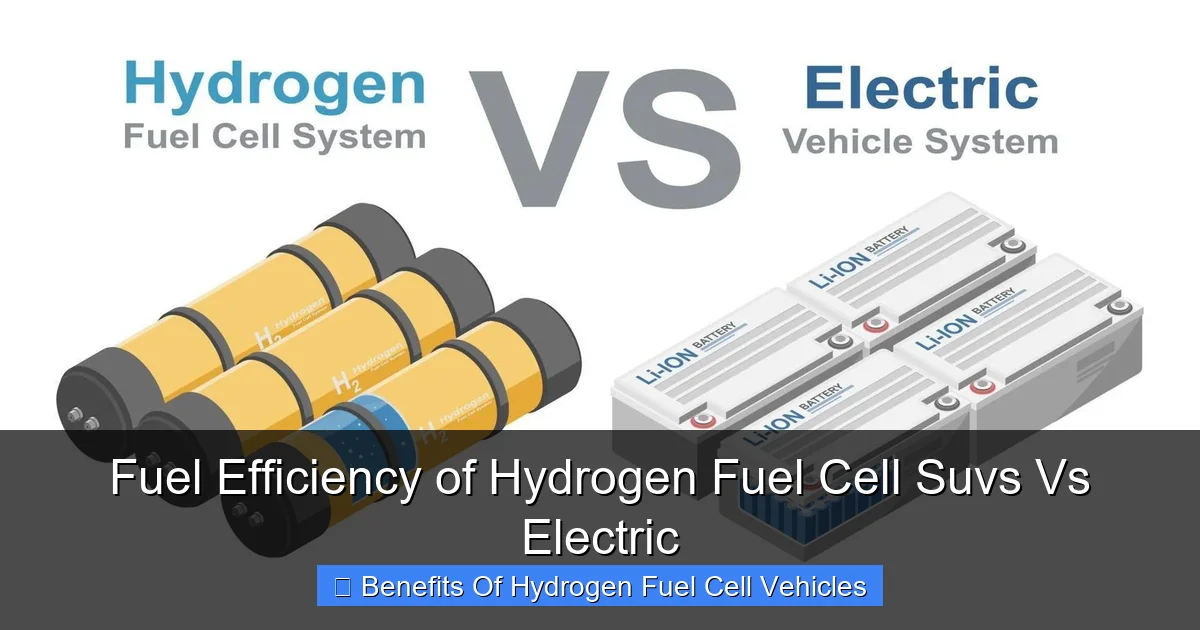
Visual guide about Fuel Efficiency of Hydrogen Fuel Cell Suvs Vs Electric
Image source: static.vecteezy.com
How Efficiency Is Measured
Both vehicle types use MPGe (miles per gallon of gasoline equivalent) to standardize efficiency. The U.S. Department of Energy defines 33.7 kWh of electricity or 1 kg of hydrogen as equivalent to one gallon of gasoline. This allows direct comparison across technologies.
For example, a Tesla Model Y Long Range achieves about 120 MPGe, meaning it travels 120 miles using the energy equivalent of one gallon of gas. The Hyundai NEXO, a hydrogen fuel cell SUV, rates around 65 MPGe. On paper, the electric SUV is nearly twice as efficient. But real-world factors like driving conditions, climate, and energy sources can shift this balance.
The Energy Chain: From Source to Wheel
True fuel efficiency considers the “well-to-wheel” energy path. For electric SUVs, this includes electricity generation, transmission, battery charging, and motor efficiency. For hydrogen SUVs, it involves hydrogen production (often from natural gas), compression, transport, refueling, and fuel cell conversion.
Studies show that battery electric vehicles (BEVs) convert about 77% of grid energy to power at the wheels. In contrast, hydrogen fuel cell vehicles (FCEVs) achieve only 25–35% efficiency due to energy losses at every stage. This means it takes roughly three times more primary energy to power a hydrogen SUV the same distance as an electric one.
However, this doesn’t mean hydrogen is obsolete. In certain scenarios—like long-distance travel or heavy-duty use—hydrogen’s advantages in refueling speed and energy density can outweigh its lower efficiency.
Electric SUVs: Efficiency Leaders
Electric SUVs currently dominate the clean vehicle market, and for good reason: they’re highly efficient, increasingly affordable, and supported by a growing charging network. Their simplicity—fewer moving parts, direct energy conversion—gives them a clear edge in energy use.
Top Electric SUVs and Their Efficiency
Leading electric SUVs combine impressive range with high efficiency. The Tesla Model Y Long Range, for instance, offers up to 330 miles of range and 120 MPGe. The Ford Mustang Mach-E Premium AWD achieves around 100 MPGe, while the Hyundai Ioniq 5 and Kia EV6 both exceed 110 MPGe in rear-wheel-drive configurations.
These numbers translate to real savings. At an average U.S. electricity rate of $0.15 per kWh, driving an electric SUV costs about $0.04–$0.06 per mile. That’s roughly half the cost of fueling a gasoline SUV and significantly cheaper than hydrogen.
Factors Affecting Electric SUV Efficiency
While electric SUVs are inherently efficient, several factors can impact their real-world performance:
- Climate: Cold weather reduces battery efficiency and range. Preconditioning the cabin while plugged in helps, but winter driving can cut range by 20–40%.
- Driving habits: Aggressive acceleration and high speeds drain the battery faster. Smooth, steady driving maximizes efficiency.
- Tire pressure and aerodynamics: Underinflated tires and roof racks increase drag and energy use. Regular maintenance keeps efficiency high.
- Charging source: Home charging with a Level 2 charger is most efficient. Public fast chargers are convenient but can reduce battery longevity if used excessively.
Despite these variables, electric SUVs consistently outperform hydrogen models in energy efficiency. Their ability to recapture energy through regenerative braking further boosts their advantage in stop-and-go traffic.
Hydrogen Fuel Cell SUVs: The Efficiency Trade-Off
Hydrogen fuel cell SUVs offer a compelling alternative, especially for drivers who need long range and quick refueling. However, their lower overall efficiency is a significant drawback—one that stems from the challenges of hydrogen production and distribution.
How Hydrogen SUVs Work
Hydrogen fuel cell SUVs use a fuel cell stack to combine hydrogen (stored in high-pressure tanks) with oxygen from the air. This chemical reaction produces electricity, which powers an electric motor. The only byproduct is water vapor, making them truly zero-emission at the tailpipe.
Vehicles like the Toyota Mirai and Hyundai NEXO can travel 400+ miles on a full tank and refuel in under 10 minutes—comparable to gasoline. This makes them attractive for road trips, ride-sharing, or commercial fleets where downtime is costly.
Efficiency Challenges in the Hydrogen Chain
The main issue with hydrogen SUVs isn’t the vehicle itself—it’s the energy required to make and deliver hydrogen. Currently, over 95% of hydrogen is produced from natural gas via steam methane reforming (SMR), a process that emits CO₂. Even “blue hydrogen” (with carbon capture) isn’t fully clean.
“Green hydrogen,” made by electrolyzing water using renewable electricity, is the ideal—but it’s expensive and accounts for less than 1% of global production. Until green hydrogen scales up, most hydrogen SUVs rely on fossil-fuel-derived fuel, undermining their environmental benefits.
Additionally, hydrogen is difficult to transport and store. It must be compressed to 10,000 psi or liquefied at -253°C, both energy-intensive processes. Leakage during transport also reduces efficiency and poses safety concerns.
Real-World Efficiency of Hydrogen SUVs
The Toyota Mirai achieves about 65–70 MPGe, while the Hyundai NEXO rates around 60–65 MPGe. These numbers are respectable for an SUV, but they pale next to electric competitors. When you factor in the energy lost in hydrogen production and delivery, the well-to-wheel efficiency drops to under 30%.
For example, producing 1 kg of hydrogen via SMR requires about 50 kWh of energy and emits 9–12 kg of CO₂. That same 50 kWh could power an electric SUV for over 150 miles. This stark contrast highlights why electric SUVs are currently the more efficient choice.
Refueling Speed and Convenience
One area where hydrogen fuel cell SUVs clearly outshine electric models is refueling speed. This advantage could be a game-changer for certain drivers, especially those who frequently travel long distances or lack home charging.
Electric SUV Charging: Time and Infrastructure
Charging an electric SUV takes time. Even with a Level 3 DC fast charger, reaching 80% charge typically takes 20–40 minutes. Full charging can take over an hour, depending on the battery size and charger power.
Home charging is more convenient but slower. A standard Level 1 charger (120V) adds only 3–5 miles of range per hour. A Level 2 charger (240V) is better, delivering 20–30 miles per hour—ideal for overnight charging.
While public charging networks are expanding (thanks to companies like Tesla, Electrify America, and ChargePoint), availability varies by region. Rural areas and older apartment buildings often lack reliable access, making electric SUVs less practical for some.
Hydrogen Refueling: Gas-Like Speed
Hydrogen refueling is fast and familiar. At a hydrogen station, drivers connect a nozzle to the vehicle’s fuel port, and the tank fills in 3–10 minutes—just like gasoline. The Toyota Mirai, for example, can go from empty to full in under 5 minutes.
This speed is a major advantage for long-haul drivers, taxi services, or delivery fleets. Imagine driving from Los Angeles to San Francisco without stopping for more than a few minutes—hydrogen makes that possible today.
However, hydrogen stations are scarce. As of 2024, the U.S. has fewer than 100 public hydrogen stations, mostly in California. Europe and parts of Asia have more, but global infrastructure remains limited. This lack of access is the biggest barrier to hydrogen SUV adoption.
Convenience Beyond Speed
Beyond refueling time, convenience includes availability, ease of use, and reliability. Electric SUVs win on availability—chargers are everywhere, from shopping malls to workplaces. Apps like PlugShare help drivers find nearby stations and check availability.
Hydrogen stations, by contrast, are few and often require appointments. Maintenance issues can lead to outages, and not all stations serve all vehicle models. For now, hydrogen refueling remains a niche experience.
That said, hydrogen’s speed and simplicity could become a bigger draw as infrastructure improves. For drivers who value time and range over cost and efficiency, hydrogen SUVs offer a compelling alternative.
Environmental Impact: Beyond Tailpipe Emissions
Both electric and hydrogen SUVs produce zero emissions while driving, but their overall environmental impact depends heavily on how their energy is generated. A truly green vehicle must consider the full lifecycle—from production to disposal.
Electric SUVs and the Grid
The environmental benefit of electric SUVs hinges on the electricity source. In regions with clean grids (like California or Norway), EVs are extremely low-carbon. In areas reliant on coal, their advantage shrinks—but they still outperform gasoline vehicles.
According to the Union of Concerned Scientists, the average electric vehicle in the U.S. produces emissions equivalent to a gasoline car getting 93 MPG. As the grid gets cleaner, this number will only improve.
Battery production is another concern. Mining lithium, cobalt, and nickel has environmental and ethical implications. However, recycling programs and solid-state battery research aim to reduce these impacts over time.
Hydrogen SUVs and the Hydrogen Source
Hydrogen SUVs are only as clean as the hydrogen they use. Gray hydrogen (from natural gas) emits more CO₂ per mile than gasoline. Blue hydrogen (with carbon capture) is better but still not zero-emission.
Green hydrogen, produced with renewable energy, is the gold standard. It eliminates fossil fuel use and cuts lifecycle emissions by over 90%. But it’s currently too expensive and scarce to support mass adoption.
Until green hydrogen scales up, hydrogen SUVs may not be as eco-friendly as they appear. In fact, a 2021 study by the International Council on Clean Transportation found that hydrogen FCEVs powered by gray hydrogen can have higher lifecycle emissions than gasoline vehicles.
Lifecycle Analysis: Manufacturing and Disposal
Both vehicle types have environmental costs in manufacturing. Electric SUVs require large batteries, which increase their initial carbon footprint. Hydrogen SUVs need complex fuel cells and high-pressure tanks, which are energy-intensive to produce.
However, over their lifetime, electric SUVs typically offset their higher manufacturing emissions due to lower operating emissions. Hydrogen SUVs can do the same—but only if powered by clean hydrogen.
End-of-life recycling is improving for both. Battery recycling is advancing rapidly, with companies like Redwood Materials recovering over 95% of key materials. Fuel cell recycling is less developed but holds promise as the technology matures.
Cost Comparison: Fuel, Maintenance, and Ownership
Fuel efficiency directly affects cost. While both electric and hydrogen SUVs have lower operating costs than gasoline vehicles, electric models are currently more economical across the board.
Fuel Costs: Electricity vs. Hydrogen
Electricity is cheaper than hydrogen. The U.S. Department of Energy estimates the average cost of electricity for EVs at $0.04–$0.06 per mile. Hydrogen, by contrast, costs $0.10–$0.15 per mile—similar to premium gasoline.
For example, driving 15,000 miles per year in an electric SUV costs about $600–$900 in electricity. The same distance in a hydrogen SUV could cost $1,500–$2,250. This gap may narrow if green hydrogen production scales and prices drop, but it’s unlikely to match electricity soon.
Maintenance and Repairs
Both vehicle types have fewer moving parts than gasoline SUVs, reducing maintenance needs. No oil changes, spark plugs, or exhaust systems mean lower service costs.
Electric SUVs have the edge here. Their batteries and motors are highly reliable, with many manufacturers offering 8-year/100,000-mile warranties. Regenerative braking also reduces brake wear.
Hydrogen SUVs are simpler than gasoline vehicles but more complex than pure EVs. Fuel cells can degrade over time, and hydrogen sensors require calibration. Repair costs are higher due to specialized parts and limited service centers.
Total Cost of Ownership
When you factor in purchase price, fuel, maintenance, and incentives, electric SUVs are the clear winner today. The Tesla Model Y starts around $50,000, while the Hyundai NEXO starts near $60,000. Federal and state incentives can reduce these costs, but hydrogen vehicles often have fewer rebates.
Over a 5-year period, electric SUVs save thousands in fuel and maintenance. Hydrogen SUVs may catch up if infrastructure improves and hydrogen prices fall, but for now, they’re a premium option.
Future Outlook: Which Technology Will Win?
The race between electric and hydrogen SUVs isn’t over. Both technologies have roles to play, but their futures depend on innovation, policy, and infrastructure.
Electric SUVs: Scaling Up
Electric SUVs are winning the mainstream battle. Automakers are investing billions in battery tech, charging networks, and new models. Solid-state batteries promise longer range, faster charging, and lower costs within the next decade.
Government policies, like the U.S. Inflation Reduction Act, are accelerating adoption. By 2030, electric SUVs could dominate new sales, especially in urban and suburban areas.
Hydrogen SUVs: Niche to Necessity?
Hydrogen SUVs are unlikely to replace electric models for most drivers. But they could thrive in specific niches: long-haul trucking, public transit, and regions with abundant renewable energy for green hydrogen.
Countries like Japan, South Korea, and Germany are betting on hydrogen. They’re building national networks and subsidizing production. If green hydrogen becomes cheap and widespread, hydrogen SUVs could become a viable alternative.
For now, hydrogen remains a complement—not a competitor—to electric vehicles. The two can coexist, serving different needs in the clean transportation ecosystem.
Conclusion: Choosing the Right Clean SUV
The fuel efficiency of hydrogen fuel cell SUVs versus electric SUVs reveals a clear trade-off: electric models are more efficient, cheaper to run, and better supported by infrastructure. Hydrogen SUVs offer faster refueling and long range but at a higher cost and lower overall efficiency.
For most drivers—especially those with home charging and moderate commutes—electric SUVs are the smarter, greener choice. They save money, reduce emissions, and offer a growing selection of stylish, capable models.
Hydrogen SUVs, while less efficient, fill an important gap. They’re ideal for drivers who frequently travel long distances, operate fleets, or live in areas with limited charging but growing hydrogen networks. As green hydrogen production scales, their environmental and economic case will strengthen.
Ultimately, the best clean SUV depends on your lifestyle, location, and priorities. Whether you choose electric or hydrogen, you’re helping build a cleaner, more sustainable future—one mile at a time.
Frequently Asked Questions
Are hydrogen fuel cell SUVs more efficient than electric SUVs?
No, electric SUVs are significantly more energy-efficient. They convert over 77% of grid energy to power at the wheels, while hydrogen SUVs achieve only 25–35% efficiency due to losses in production, transport, and conversion.
How long does it take to refuel a hydrogen SUV compared to charging an electric SUV?
Hydrogen SUVs refuel in 3–10 minutes, similar to gasoline. Electric SUVs take 20–40 minutes for an 80% charge at a fast charger, making hydrogen faster but less convenient due to limited stations.
Which is cheaper to fuel: an electric SUV or a hydrogen SUV?
Electric SUVs are much cheaper to fuel. Electricity costs about $0.04–$0.06 per mile, while hydrogen costs $0.10–$0.15 per mile—nearly double the expense.
Are hydrogen SUVs environmentally friendly?
Only if powered by green hydrogen made with renewable energy. Most hydrogen today comes from natural gas, which emits CO₂. Electric SUVs are cleaner on average, especially in regions with low-carbon grids.
Can I drive a hydrogen SUV long distances?
Yes, hydrogen SUVs like the Toyota Mirai offer 400+ miles of range and quick refueling, making them suitable for long trips—if you’re in an area with hydrogen stations, like California.
Will hydrogen SUVs become more common in the future?
They may grow in niche markets like fleets and long-haul transport, but electric SUVs are likely to dominate mainstream sales due to better efficiency, lower costs, and expanding charging networks.