Hydrogen car refueling time is one of the biggest advantages over battery electric vehicles. Most hydrogen-powered cars can be refueled in just 3 to 5 minutes—about the same as a gasoline car. This makes hydrogen a strong contender for long-distance travel and commercial fleets.
Key Takeaways
- Refueling takes 3–5 minutes: Most hydrogen fuel cell vehicles can be refueled as quickly as a traditional gasoline car, making it ideal for drivers who value time.
- No overnight charging needed: Unlike electric vehicles, hydrogen cars don’t require hours plugged in—just a quick stop at a hydrogen station.
- Refueling speed depends on station pressure: Higher-pressure stations (700 bar) fill tanks faster than lower-pressure ones (350 bar).
- Weather affects refueling time: Cold temperatures can slow down the process slightly, but modern systems are designed to handle most conditions.
- Hydrogen stations are still limited: While refueling is fast, the lack of infrastructure means access is currently restricted to certain regions.
- Future tech will improve speed and safety: Advances in compression, storage, and station design are expected to make refueling even faster and more reliable.
- Hydrogen is great for fleets and long-haul transport: Trucks, buses, and delivery vans benefit most from quick refueling and long range.
📑 Table of Contents
Why Hydrogen Car Refueling Time Matters
Imagine pulling up to a fuel station, stepping out of your car, and filling it up in less than five minutes. No waiting for a charging cable, no guessing how long it will take, and no range anxiety on a long road trip. That’s the promise of hydrogen-powered vehicles. Unlike electric cars that can take anywhere from 30 minutes to several hours to recharge, hydrogen cars refuel in about the same time it takes to fill a gas tank. This speed is one of the most compelling reasons why hydrogen vehicles are gaining attention—especially for people who drive long distances or run commercial fleets.
But how exactly does hydrogen refueling work, and why is it so fast? The answer lies in the way hydrogen is stored and delivered. Instead of slowly pushing electrons into a battery, hydrogen vehicles use compressed gas stored in high-pressure tanks. When you refuel, hydrogen gas flows directly into the tank under high pressure, similar to how gasoline flows into a fuel tank. This physical process is inherently faster than the electrochemical reactions needed to charge a battery. As a result, hydrogen car refueling time is dramatically shorter than most electric vehicle charging options.
Of course, speed isn’t the only factor. Safety, infrastructure, and technology all play a role in how practical and convenient hydrogen refueling really is. But for drivers who value efficiency and convenience, the quick refueling time of hydrogen cars is a game-changer. It brings the familiar experience of gas station stops into the clean energy future.
How Hydrogen Refueling Works
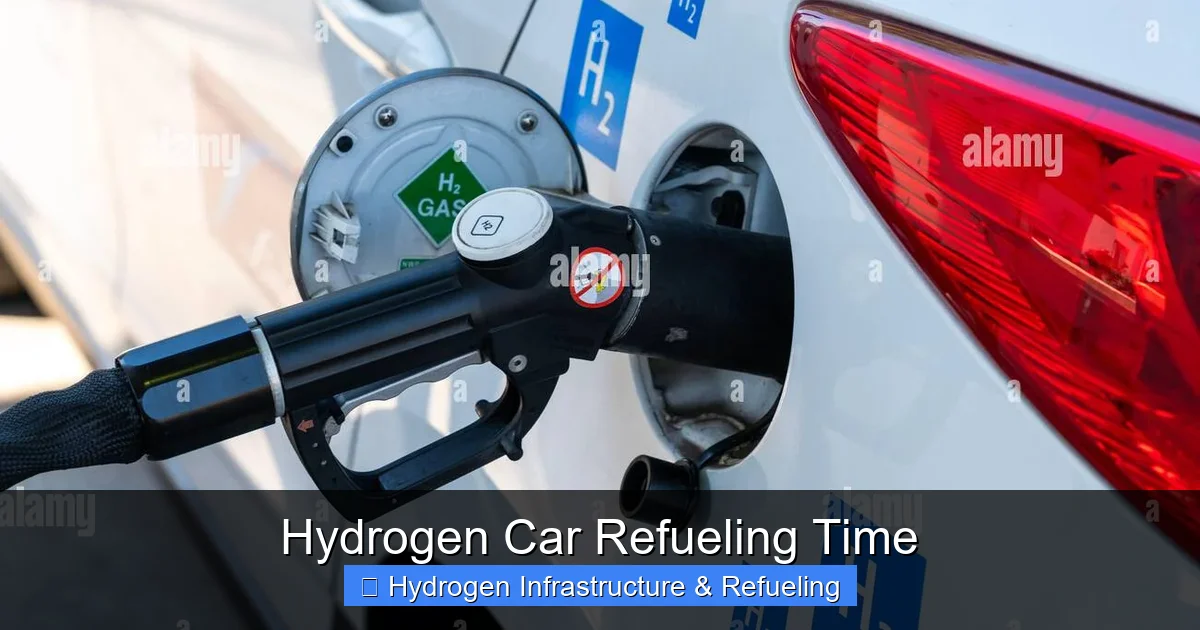
Visual guide about Hydrogen Car Refueling Time
Image source: c8.alamy.com
To understand why hydrogen car refueling time is so fast, it helps to know what happens behind the scenes at a hydrogen fueling station. The process is surprisingly similar to pumping gasoline—just with a cleaner, quieter twist.
When you arrive at a hydrogen station, you’ll typically see a dispenser that looks a lot like a gas pump. You open the fuel door, connect the nozzle to your car’s receptacle, and the system automatically begins transferring hydrogen gas into your vehicle’s high-pressure tank. The gas is stored at either 350 bar (5,000 psi) or 700 bar (10,000 psi), depending on the vehicle and station. Most modern hydrogen cars, like the Toyota Mirai or Hyundai NEXO, use 700-bar systems because they allow for greater range and faster refueling.
The Role of Compression and Storage
Hydrogen is the lightest element, which makes it tricky to store in large quantities. To fit enough hydrogen into a car for a useful driving range, it must be compressed to extremely high pressures. At 700 bar, hydrogen gas is squeezed into a volume about 700 times smaller than it would be at normal atmospheric pressure. This compression allows a typical hydrogen car to carry 5 to 6 kilograms of hydrogen—enough for a range of 300 to 400 miles.
The refueling process relies on pressure differentials. The station’s storage tanks are kept at even higher pressures than the car’s tank, so when the connection is made, hydrogen naturally flows from high to low pressure. This flow is carefully controlled by sensors and valves to ensure a smooth, safe fill. The entire process is automated, so drivers don’t need to monitor it closely.
Safety Systems in Action
Safety is a top priority in hydrogen refueling. Because hydrogen is flammable and invisible, stations are equipped with multiple layers of protection. Leak detectors, emergency shut-off valves, and thermal sensors monitor the system in real time. If a problem is detected—like a sudden pressure drop or temperature spike—the refueling stops immediately.
The nozzles and hoses are also designed with safety in mind. They’re built to withstand high pressures and are equipped with breakaway couplings that disconnect safely if the car drives away while still connected. Plus, hydrogen disperses quickly into the air, reducing the risk of fire compared to liquid fuels.
What Happens During a Typical Refuel
Let’s walk through a real-world example. Say you’re driving a Toyota Mirai and your hydrogen level is down to 20%. You pull into a station in California—one of the few states with a growing hydrogen network. You park, open the fuel door, and connect the nozzle. The system checks for compatibility and seals the connection. Within seconds, hydrogen begins flowing into your tank.
The dispenser shows real-time data: pressure, temperature, and the amount of hydrogen delivered. Most drivers report that the process feels smooth and quiet—no loud pumps or vibrations. After about four minutes, the tank is full, and the system automatically stops. You disconnect, close the fuel door, and you’re back on the road with a full tank and zero emissions.
Factors That Influence Hydrogen Car Refueling Time
While hydrogen car refueling time is generally fast, it’s not always the same every time you fill up. Several factors can influence how quickly your tank fills, from the station’s equipment to the weather outside.
Station Pressure and Capacity
The most important factor is the pressure rating of the hydrogen station. Stations that operate at 700 bar can refuel vehicles much faster than those at 350 bar. For example, a 700-bar station might fill a 5-kg tank in 3 to 4 minutes, while a 350-bar station could take 8 to 10 minutes for the same amount. This is because higher pressure allows more hydrogen to flow into the tank per second.
Not all stations are created equal. Some are designed for light-duty vehicles like sedans, while others serve heavy-duty trucks and buses. Heavy-duty stations often have larger compressors and storage tanks, enabling faster refueling for larger vehicles. As the hydrogen infrastructure grows, we’re likely to see more high-capacity stations that can serve multiple vehicles quickly.
Vehicle Tank Size and State of Charge
The size of your car’s hydrogen tank also plays a role. A smaller tank will fill faster than a larger one, assuming the same flow rate. For instance, a compact hydrogen car with a 4-kg tank might refuel in 2.5 minutes, while a larger SUV with a 6-kg tank could take closer to 5 minutes.
Your car’s current state of charge matters too. If your tank is nearly empty, it will accept hydrogen more quickly at first, then slow down as it approaches full capacity. This is similar to how a gas tank fills faster when it’s empty and slows near the top to prevent overflow. Most hydrogen systems use a “filling curve” that adjusts the flow rate based on tank pressure and temperature.
Ambient Temperature and Weather Conditions
Cold weather can slightly increase hydrogen car refueling time. When temperatures drop, hydrogen gas becomes denser, and the tank’s internal pressure rises more slowly. This means the station may need to reduce the flow rate to avoid over-pressurizing the tank. In extreme cold, refueling could take 10–15% longer than in mild conditions.
On the flip side, hot weather can also pose challenges. High temperatures increase the risk of overheating during compression, so stations may slow the flow to protect equipment. However, modern hydrogen stations are designed with thermal management systems to handle these variations. In most climates, the impact on refueling time is minimal.
Station Utilization and Queue Times
Another often-overlooked factor is how busy the station is. If multiple vehicles are refueling at once, the station’s compressor may not be able to deliver hydrogen at full speed to each one. This can lead to slightly longer refueling times during peak hours.
In regions with limited hydrogen infrastructure, stations may also experience maintenance delays or supply shortages. For example, if a station runs low on hydrogen due to delivery delays, it might not be able to fill tanks to 100%. These logistical issues don’t affect the actual refueling speed, but they can impact the overall experience.
Real-World Examples of Hydrogen Refueling
To get a better sense of what hydrogen car refueling time looks like in practice, let’s look at a few real-world scenarios.
Daily Commuting in California
California is currently the leader in hydrogen infrastructure in the U.S., with over 50 public hydrogen stations. Many drivers use hydrogen cars like the Toyota Mirai for daily commuting between cities like Los Angeles and San Francisco. For these drivers, refueling is a quick and routine part of their week.
One Mirai owner in San Diego reports that he refuels every 7 to 10 days, depending on his driving habits. He usually stops at a station near his office, connects the nozzle, and grabs a coffee while his car fills up. “It takes about four minutes,” he says. “I’m in and out before my coffee cools down.”
Long-Distance Travel on the West Coast
Hydrogen cars are particularly well-suited for long-distance travel, thanks to their quick refueling and long range. Some drivers have completed cross-state trips from Southern California to Northern California using hydrogen stations along Highway 101.
One such trip involved a Hyundai NEXO traveling from San Diego to Eureka—a distance of over 800 miles. The driver made three refueling stops, each taking about 5 minutes. “It was just like driving a gas car,” he said. “No waiting, no stress. I could focus on the road.”
Commercial Fleets and Delivery Vans
Hydrogen refueling time is a major advantage for commercial fleets. Companies like Amazon and UPS are testing hydrogen-powered delivery vans because they can refuel quickly and operate for long shifts without downtime.
In one pilot program, a fleet of hydrogen-powered trucks in Southern California refueled at a dedicated station every morning. Each truck took about 6 minutes to fill, allowing the entire fleet to be ready for dispatch within 30 minutes. This efficiency is hard to match with electric trucks, which often require hours of charging.
Public Transit and Buses
Cities like Oakland and Sacramento are using hydrogen buses for public transit. These buses can travel over 300 miles on a single tank and refuel in under 10 minutes. Transit operators say the quick refueling time allows for more flexible scheduling and reduces downtime between routes.
Comparing Hydrogen Refueling to Electric Charging
One of the most common questions about hydrogen cars is how their refueling time stacks up against electric vehicles. The short answer? Hydrogen wins—by a wide margin.
Speed: Minutes vs. Hours
Most battery electric vehicles (BEVs) take at least 30 minutes to charge from 10% to 80% using a fast charger. Even the fastest chargers, like Tesla’s Superchargers, typically require 20–30 minutes for a significant charge. To reach a full charge, many BEVs need 45 minutes to an hour or more.
In contrast, hydrogen car refueling time is consistently under 5 minutes for a full tank. This means you can stop, refuel, and continue your journey in less time than it takes to charge an EV to 80%. For drivers on tight schedules or long road trips, this difference is huge.
Convenience and Driver Experience
Charging an EV often requires planning. You need to find a compatible charger, wait for it to become available, and stay with your car during the process. Some drivers charge overnight at home, but that’s not an option for everyone—especially renters or those without garages.
Hydrogen refueling, on the other hand, mimics the familiar gas station experience. You pull up, connect the nozzle, and walk away. No cables, no apps, no waiting. It’s simple, fast, and intuitive.
Range and Flexibility
Hydrogen cars typically offer longer ranges than most BEVs. The Toyota Mirai, for example, has an EPA-estimated range of 402 miles—more than most electric sedans. Combined with quick refueling, this makes hydrogen ideal for drivers who need to cover long distances without frequent stops.
Electric vehicles are improving, but they still face challenges with range in cold weather and at high speeds. Hydrogen cars are less affected by these factors, maintaining consistent performance in various conditions.
Infrastructure Challenges
Of course, hydrogen refueling has one major drawback: infrastructure. There are currently fewer than 100 public hydrogen stations in the U.S., mostly in California. This limits where you can drive and refuel.
Electric charging, by contrast, is widely available. There are over 150,000 public charging ports in the U.S., and that number is growing fast. For most drivers, charging at home or work is also an option.
So while hydrogen refueling is faster, it’s not yet as convenient in terms of accessibility. This trade-off is important to consider when choosing between hydrogen and electric vehicles.
The Future of Hydrogen Refueling
As hydrogen technology evolves, we can expect hydrogen car refueling time to get even faster and more reliable. Several innovations are already in development.
Higher-Pressure Systems
Engineers are working on 900-bar and even 1000-bar refueling systems. These ultra-high-pressure stations could reduce refueling time to under 2 minutes for a full tank. While still in the testing phase, these systems promise to make hydrogen refueling nearly instantaneous.
Improved Station Design
New station designs are focusing on efficiency and scalability. Some use on-site hydrogen production from renewable energy, eliminating the need for deliveries. Others are modular, allowing multiple stations to be deployed quickly in high-demand areas.
Smart Refueling and Automation
Future stations may include AI-driven systems that predict demand, optimize flow rates, and even pre-cool hydrogen for faster filling. Some prototypes already use automated nozzles that connect without driver intervention—similar to robotic gas pumps.
Expansion of Infrastructure
Governments and private companies are investing heavily in hydrogen infrastructure. The U.S. Department of Energy has launched initiatives to build hydrogen hubs across the country. In Europe and Asia, countries like Germany, Japan, and South Korea are rapidly expanding their hydrogen networks.
As more stations come online, hydrogen refueling will become more accessible and convenient. Combined with faster refueling times, this could make hydrogen a mainstream option for drivers worldwide.
Conclusion
Hydrogen car refueling time is one of the most exciting advantages of fuel cell vehicles. With fill times of just 3 to 5 minutes, hydrogen cars offer a level of convenience that rivals gasoline vehicles and far surpasses most electric cars. This speed makes hydrogen ideal for long-distance travel, commercial fleets, and drivers who value their time.
While infrastructure is still limited, the technology is advancing quickly. Higher-pressure systems, smarter stations, and growing networks are paving the way for a future where hydrogen refueling is as common as pumping gas.
For now, hydrogen remains a niche option—but one with enormous potential. If you’re looking for a clean, fast, and efficient way to fuel your vehicle, hydrogen might just be the answer.
Frequently Asked Questions
How long does it take to refuel a hydrogen car?
Most hydrogen cars can be refueled in 3 to 5 minutes, similar to filling up a gasoline car. This makes it much faster than charging an electric vehicle.
Is hydrogen refueling safe?
Yes, hydrogen refueling is very safe. Stations use multiple safety systems, including leak detectors, emergency shut-offs, and thermal sensors to prevent accidents.
Can cold weather slow down hydrogen refueling?
Cold weather can slightly increase refueling time, but modern systems are designed to handle temperature variations. The impact is usually minimal.
Are there enough hydrogen stations to make refueling convenient?
Currently, hydrogen stations are limited, mostly in California and parts of Europe and Asia. Infrastructure is growing, but it’s not yet as widespread as gas or electric charging stations.
Do all hydrogen cars use the same refueling standard?
Most modern hydrogen cars use the SAE J2601 standard, which ensures compatibility between vehicles and stations. This allows for safe and efficient refueling across brands.
Will hydrogen refueling get faster in the future?
Yes, advancements in high-pressure systems and station technology are expected to reduce refueling time to under 2 minutes in the coming years.