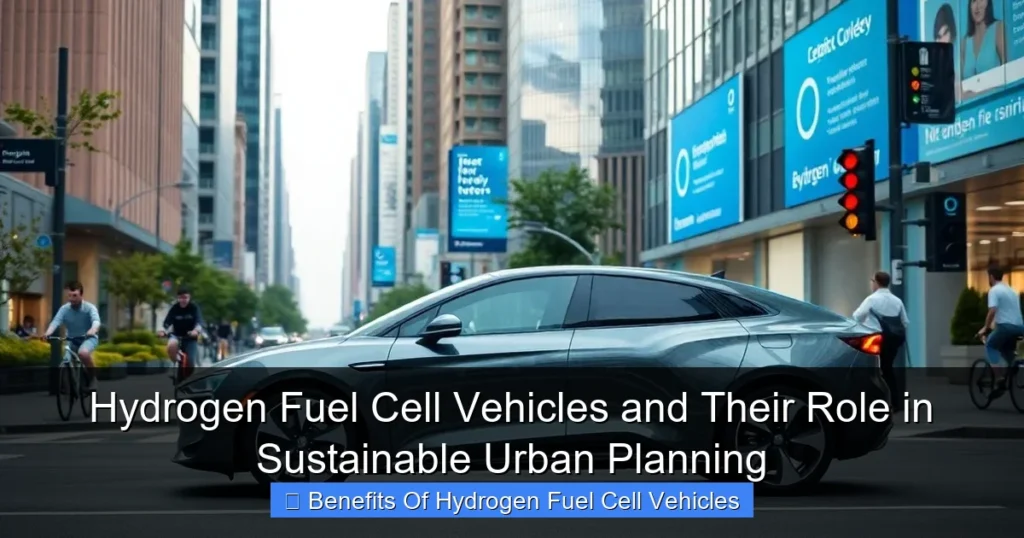
Hydrogen fuel cell vehicles (FCVs) are a game-changer for sustainable urban planning, offering zero-emission mobility, reduced reliance on fossil fuels, and integration with renewable energy grids. By leveraging hydrogen’s clean energy potential, cities can cut pollution, enhance energy resilience, and create smarter, greener transportation systems.
Key Takeaways
- Zero Emissions: FCVs produce only water vapor, eliminating tailpipe pollutants that worsen air quality.
- Energy Efficiency: Hydrogen’s energy density enables longer ranges compared to batteries, ideal for heavy-duty transport.
- Renewable Integration: Hydrogen can be produced from solar/wind energy, making it a truly clean solution when sourced sustainably.
- Urban Infrastructure: Hydrogen refueling stations reduce range anxiety, encouraging FCV adoption in dense cities.
- Waste-to-Hydrogen: Cities can repurpose industrial waste gases into hydrogen, turning byproducts into fuel.
- Circular Economy: FCVs support closed-loop systems where hydrogen is produced, used, and recycled efficiently.
[FEATURED_IMAGE_PLACEHOLDER]
—
###
Introduction: Why FCVs Matter for Urban Sustainability
Imagine a city where buses, taxis, and delivery trucks run silently without spewing smog—where traffic congestion doesn’t mean choking air pollution. That’s the promise of hydrogen fuel cell vehicles (FCVs). Unlike electric cars relying solely on battery power, FCVs use hydrogen stored in tanks to generate electricity via fuel cells, emitting only water vapor as a byproduct. This technology isn’t just about cleaner cars; it’s a blueprint for sustainable urban planning, addressing climate change, energy security, and livability.
Cities like Tokyo, Hamburg, and Los Angeles are already piloting FCV fleets, proving their viability. But why now? With rising CO₂ levels, aging infrastructure, and growing populations, traditional solutions often fall short. FCVs offer a scalable alternative that aligns with global net-zero goals while meeting daily mobility needs. In this article, we’ll explore how FCVs fit into sustainable cities, their benefits, challenges, and real-world success stories.
—
###
Section 1: Environmental Benefits of FCVs
####
Zero Tailpipe Emissions
The most obvious advantage? FCVs don’t burn fossil fuels at all. Instead, they combine hydrogen (H₂) with oxygen (O₂) in fuel cells to produce electricity, with water (H₂O) as the only output. This contrasts sharply with gasoline or diesel engines, which release nitrogen oxides (NOₓ), particulate matter (PM), and carbon dioxide (CO₂). For example, a single FCV bus in Seoul reduces annual CO₂ emissions by ~40 tons compared to a diesel counterpart.
####
Reduced Air Pollution in Dense Cities
In megacities like Delhi or Mexico City, poor air quality claims thousands of lives yearly. FCVs target this crisis directly:
– Particulate Matter (PM): No combustion = no PM2.5/PM10 emissions.
– Nitrogen Oxides (NOₓ): Fuel cells avoid high-temperature combustion that generates NOₓ.
– Noise Pollution: FCVs operate quieter than internal combustion engines, easing urban noise stress.
Pro Tip: Cities pairing FCVs with renewable hydrogen production (e.g., solar-powered electrolysis) achieve near-net-zero lifecycle emissions.
—
###
Section 2: Energy Efficiency & Grid Resilience
####
High Energy Density for Heavy Transport
While EVs excel in passenger cars, hydrogen’s energy density (≈3x higher than lithium-ion batteries) makes FCVs better suited for:
– Trucks & Buses: Longer routes without frequent stops.
– Emergency Vehicles: Rapid refueling vs. hours-long EV charging.
– Shipping: Port cities like Rotterdam use hydrogen ferries to decarbonize inland transport.
####
Grid Flexibility & Storage
Excess renewable energy (from wind/solar) can be converted into hydrogen via electrolysis during off-peak hours. This “green hydrogen” acts as:
– Energy Buffer: Storing surplus renewables for times of low generation.
– Backup Power: FCVs can power emergency shelters or microgrids during outages.
Example: Germany’s H2Global initiative aims to store 5 terawatt-hours of renewable energy annually using hydrogen.
—
###
Section 3: Urban Planning Synergies
####
Smart Infrastructure Development
FCV adoption hinges on hydrogen stations. Cities can integrate them into:
– Transit Hubs: Bus terminals with dual-fuel refueling points.
– Industrial Zones: Factories producing hydrogen (e.g., steel plants) can supply local fleets.
– Green Corridors: Dedicated lanes for FCVs, incentivizing drivers to choose clean transport.
Case Study: London’s Ultra Low Emission Zone (ULEZ) prioritizes FCVs, offering toll exemptions to boost adoption.
####
Land Use Optimization
Unlike EVs needing sprawling charging networks, FCVs require compact refueling stations. This frees up space for:
– Parks & Green Spaces
– Mixed-Use Developments (residential + retail)
—
###
Section 4: Economic & Social Advantages
####
Job Creation & Local Economies
Hydrogen ecosystems create jobs in:
– Station Construction & Maintenance
– Hydrogen Production & Logistics
– Vehicle Manufacturing (e.g., Hyundai’s Tucson FCV plant in Ulsan, Korea).
####
Equity & Accessibility
Public FCV fleets (buses, taxis) ensure low-income residents benefit from clean transit, reducing health disparities linked to pollution.
—
###
Section 5: Challenges & Solutions
####
High Initial Costs
– Solution: Government subsidies (e.g., California’s $9M FCV grant program) and economies of scale will lower prices over time.
####
Hydrogen Supply Chain
– Solution: On-site production (e.g., using municipal waste gas) cuts transportation emissions.
####
Public Awareness
– Solution: Campaigns showcasing FCVs’ safety (no explosions risk) and performance (Toyota Mirai’s 400-mile range) build trust.
—
###
Conclusion: The Future of FCVs in Cities
Hydrogen fuel cell vehicles aren’t just a niche option—they’re a cornerstone of sustainable urban planning. By combining zero emissions, energy resilience, and smart infrastructure, FCVs help cities transition to circular economies while improving quality of life. As technology matures and policies evolve, expect to see FCVs powering everything from delivery drones to neighborhood buses. The question isn’t whether they’ll succeed—it’s how fast we can accelerate the shift. Start small, think big, and embrace the hydrogen revolution!
—
###
Quick Q&A
Question 1?
How do FCVs compare to electric cars (EVs)? FCVs suit heavy transport due to higher energy density and faster refueling, while EVs dominate light-duty vehicles with cheaper battery tech.
Question 2?
Is hydrogen dangerous? Properly stored hydrogen is safer than gasoline (lighter than air, dissipates quickly). Modern tanks meet stringent safety standards.
Question 3?
Where is hydrogen made today? Most comes from natural gas (steam methane reforming), but green hydrogen (via renewables) is scaling up in Europe, Australia, and the U.S.
Question 4?
Can FCVs work with existing gas stations? Yes! Some stations retrofit hydrogen dispensers (e.g., Shell’s H2 stations in California).
Question 5?
What’s the cost per mile for an FCV? Around $0.04–$0.06/mile, comparable to EVs when accounting for infrastructure costs.
—
###
FAQs
Are FCVs more expensive than EVs?
Currently, yes, due to fuel cell costs, but subsidies and scaling (like Tesla’s battery price drops) are narrowing the gap within a decade.
How long does a hydrogen tank last?
Modern tanks hold enough hydrogen for 300–500 miles on a full charge, with refueling taking under 5 minutes.
Can hydrogen be stored indefinitely?
No—it leaks slowly, but advanced materials (e.g., metal hydrides) improve storage stability for months.
Do FCVs need special roads?
No, but dedicated lanes (like London’s ULEZ) encourage adoption without requiring new infrastructure.
What happens to unused hydrogen?
It can be vented safely (water vapor) or blended back into natural gas pipelines (up to 20% blend limits).
Will FCVs replace all EVs?
Unlikely; they’ll coexist, each serving different niches based on energy density, infrastructure, and regional policies.
This is a comprehensive guide about Hydrogen fuel cell vehicles and their role in sustainable urban planning.
Key Takeaways
- Understanding Hydrogen fuel cell vehicles and their role in sustainable urban planning: Provides essential knowledge
Quick Answers to Common Questions
What is Hydrogen fuel cell vehicles and their role in sustainable urban planning?
Hydrogen fuel cell vehicles and their role in sustainable urban planning refers to essential knowledge and techniques.
Frequently Asked Questions
What is Hydrogen fuel cell vehicles and their role in sustainable urban planning?
Hydrogen fuel cell vehicles and their role in sustainable urban planning is an important topic with many practical applications.