Hydrogen fuel cells offer a cleaner, quieter, and more efficient alternative to traditional gasoline engines. While gasoline powers most vehicles today, hydrogen technology promises zero emissions and faster refueling—making it a strong contender for the future of sustainable transportation.
Key Takeaways
- Zero Emissions: Hydrogen fuel cells produce only water and heat as byproducts, making them a truly clean energy source compared to gasoline engines that emit CO2 and pollutants.
- Higher Efficiency: Fuel cells convert energy more efficiently than internal combustion engines, with up to 60% efficiency versus 20–30% for gasoline engines.
- Refueling Speed: Hydrogen vehicles refuel in 3–5 minutes, similar to gasoline, unlike battery-electric vehicles that can take hours to charge.
- Infrastructure Challenges: Gasoline has a vast refueling network, while hydrogen stations are still limited, especially outside major cities.
- Cost and Production: Hydrogen production is currently expensive and often relies on fossil fuels, though green hydrogen from renewable sources is growing.
- Vehicle Performance: Hydrogen-powered vehicles offer smooth, quiet operation and strong acceleration, rivaling or exceeding gasoline counterparts.
- Future Potential: With advancing technology and government support, hydrogen could play a major role in decarbonizing transport, especially for trucks, buses, and aviation.
📑 Table of Contents
- Hydrogen Fuel Cells vs Gasoline Engines: The Future of Transportation
- How Hydrogen Fuel Cells Work
- How Gasoline Engines Work
- Efficiency Comparison: Fuel Cells vs Gasoline
- Environmental Impact: Emissions and Sustainability
- Cost and Economics: Upfront and Long-Term
- Infrastructure and Refueling: Where We Stand
- Performance and Driving Experience
- The Future of Hydrogen and Gasoline
- Conclusion: Which Is Better?
Hydrogen Fuel Cells vs Gasoline Engines: The Future of Transportation
Imagine driving a car that emits nothing but water vapor—no smog, no carbon dioxide, no harmful pollutants. That’s the promise of hydrogen fuel cells. On the other hand, gasoline engines have powered our cars, trucks, and buses for over a century. They’re familiar, widely available, and deeply embedded in our infrastructure. But as the world grapples with climate change and air pollution, the question isn’t just about convenience—it’s about sustainability.
So, which is better: hydrogen fuel cells or gasoline engines? The answer isn’t black and white. Both technologies have strengths and weaknesses, and the “best” choice depends on your priorities—whether that’s environmental impact, performance, cost, or convenience. In this article, we’ll break down how hydrogen fuel cells and gasoline engines compare across key areas like efficiency, emissions, cost, infrastructure, and real-world usability. By the end, you’ll have a clear picture of where each technology stands today—and where it might be headed.
How Hydrogen Fuel Cells Work
Visual guide about Hydrogen Fuel Cells Vs Gasoline Engines
Image source: visualcapitalist.com
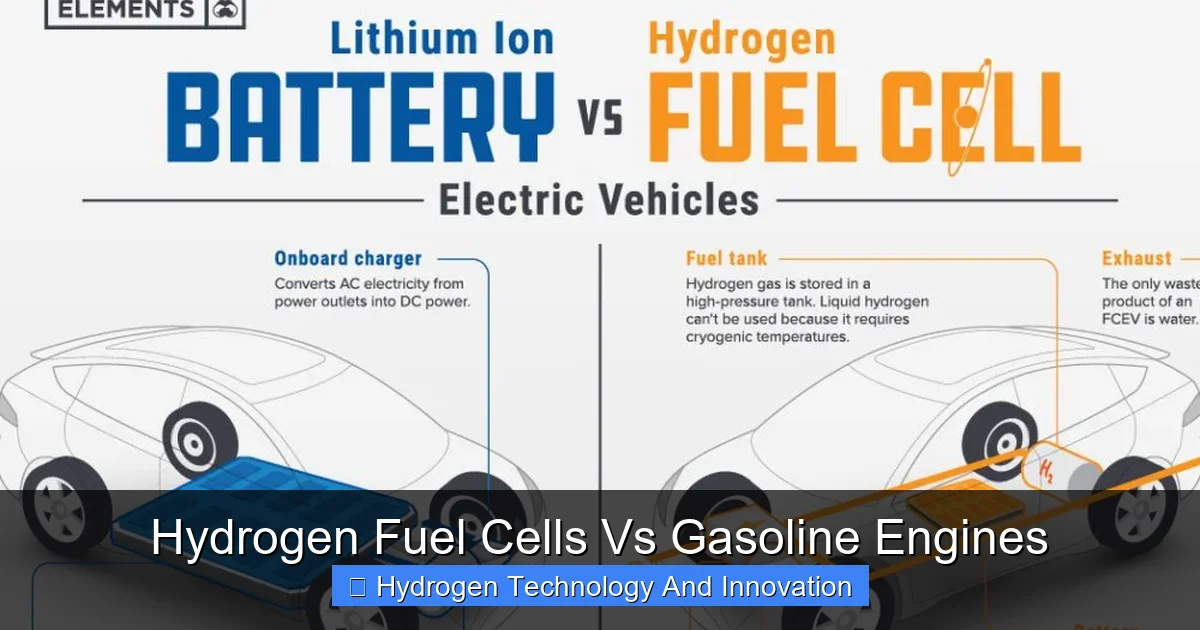
Before we dive into the comparison, let’s understand how hydrogen fuel cells actually work. At their core, fuel cells are electrochemical devices that convert hydrogen and oxygen into electricity, water, and heat. Think of them like batteries, but instead of storing energy, they generate it on demand as long as fuel is supplied.
The Science Behind the Reaction
A hydrogen fuel cell consists of two electrodes—an anode and a cathode—sandwiched around an electrolyte. Hydrogen gas is fed into the anode, where a catalyst (usually platinum) splits the hydrogen molecules into protons and electrons. The protons pass through the electrolyte to the cathode, while the electrons are forced to travel through an external circuit, creating an electric current. At the cathode, oxygen from the air combines with the protons and electrons to form water—the only emission.
This process is silent, efficient, and produces no greenhouse gases during operation. Unlike gasoline engines, which rely on combustion and moving parts, fuel cells operate smoothly and with minimal vibration.
Types of Fuel Cells
There are several types of fuel cells, but the most common for vehicles is the Proton Exchange Membrane (PEM) fuel cell. PEM fuel cells operate at relatively low temperatures (around 80°C), start quickly, and are well-suited for cars and buses. Other types, like Solid Oxide Fuel Cells (SOFC), are better for stationary power generation due to their high operating temperatures.
One key advantage of PEM fuel cells is their scalability. They can be stacked to increase power output, making them suitable for everything from small sedans to heavy-duty trucks.
Real-World Examples
Several automakers have embraced hydrogen technology. Toyota’s Mirai, Honda’s Clarity Fuel Cell, and Hyundai’s NEXO are all production vehicles powered by hydrogen fuel cells. These cars can travel 300–400 miles on a single tank and refuel in under five minutes—offering a driving experience similar to gasoline vehicles, but with zero tailpipe emissions.
How Gasoline Engines Work
Now, let’s look at the other side of the coin: gasoline engines. These internal combustion engines (ICEs) have been the backbone of personal and commercial transportation since the early 20th century. They’re reliable, powerful, and supported by a global network of gas stations.
The Combustion Process
Gasoline engines work by burning fuel in a controlled explosion inside cylinders. Air and fuel are mixed, compressed, and ignited by a spark plug. The resulting explosion pushes a piston, which turns the crankshaft and ultimately powers the wheels. This process repeats thousands of times per minute, generating the torque needed to move the vehicle.
While effective, this method is inherently inefficient. Much of the energy from gasoline is lost as heat, and the mechanical complexity leads to friction and wear over time.
Emissions and Environmental Impact
One of the biggest drawbacks of gasoline engines is their emissions. Burning gasoline releases carbon dioxide (CO2), a major greenhouse gas, along with nitrogen oxides (NOx), particulate matter, and carbon monoxide. These pollutants contribute to smog, respiratory illnesses, and climate change.
Even with modern catalytic converters and emissions controls, gasoline vehicles remain a significant source of air pollution. In cities, they’re often the primary contributor to poor air quality.
Performance and Driving Experience
Despite their environmental downsides, gasoline engines offer strong performance. They deliver high torque at low speeds, making them ideal for acceleration and towing. Many drivers also appreciate the sound and feel of a traditional engine—something electric and hydrogen vehicles often lack.
However, gasoline engines are noisy, vibrate more, and require regular maintenance like oil changes, spark plug replacements, and exhaust system repairs.
Efficiency Comparison: Fuel Cells vs Gasoline
When it comes to energy efficiency, hydrogen fuel cells have a clear advantage over gasoline engines. But what does that mean in real terms?
Measuring Efficiency
Efficiency in vehicles is typically measured as the percentage of energy from the fuel that actually moves the car. For gasoline engines, this number is surprisingly low—only about 20% to 30%. The rest is lost as heat through the exhaust and cooling system, or wasted in friction and mechanical losses.
In contrast, hydrogen fuel cells can achieve efficiencies of 40% to 60%, depending on the design and operating conditions. That means nearly twice as much of the fuel’s energy is used to power the vehicle.
Well-to-Wheel Analysis
But efficiency isn’t just about the vehicle—it’s about the entire energy chain, from production to propulsion. This is known as a “well-to-wheel” analysis.
For gasoline, the process starts with extracting crude oil, refining it into gasoline, transporting it to gas stations, and finally burning it in the engine. Each step loses energy. Overall, the well-to-wheel efficiency of gasoline is around 15% to 20%.
Hydrogen’s well-to-wheel efficiency depends heavily on how it’s produced. If hydrogen is made from natural gas (a process called steam methane reforming), the efficiency drops to around 25% to 35%. But if it’s produced using renewable electricity (via electrolysis), the efficiency can reach 30% to 40%—still better than gasoline.
Real-World Implications
Higher efficiency means less fuel is needed to travel the same distance. For hydrogen vehicles, this translates to longer range and lower operating costs over time. It also reduces the environmental footprint, especially when green hydrogen is used.
Gasoline engines, while improving with turbocharging and direct injection, are nearing their efficiency limits. Further gains will require significant redesigns or hybrid systems.
Environmental Impact: Emissions and Sustainability
The environmental impact of any vehicle technology boils down to one question: what comes out of the tailpipe—and what goes into making the fuel?
Tailpipe Emissions
Hydrogen fuel cells produce zero tailpipe emissions. The only byproducts are water vapor and a small amount of heat. This makes them ideal for urban areas where air quality is a major concern.
Gasoline engines, on the other hand, emit a cocktail of pollutants. Even with modern emissions controls, they release CO2, NOx, and particulates. In the U.S. alone, transportation accounts for nearly 30% of greenhouse gas emissions, with light-duty vehicles being the largest contributor.
Fuel Production and Carbon Footprint
Here’s where things get complicated. While hydrogen vehicles are clean on the road, the environmental benefit depends on how the hydrogen is made.
Currently, about 95% of hydrogen is produced from fossil fuels—mostly natural gas. This “gray hydrogen” generates significant CO2 emissions. “Blue hydrogen” captures and stores some of these emissions, but it’s still not carbon-free.
“Green hydrogen,” produced by splitting water using renewable electricity, is the holy grail. It’s truly sustainable, but it’s currently expensive and accounts for less than 1% of global hydrogen production.
Gasoline, by contrast, has a well-established but dirty production chain. Oil drilling, refining, and transportation all contribute to its carbon footprint. Plus, oil spills and methane leaks add to the environmental damage.
Lifecycle Analysis
When you consider the full lifecycle—from raw materials to end-of-life recycling—hydrogen fuel cells generally have a lower environmental impact than gasoline engines, especially as green hydrogen becomes more common.
However, manufacturing fuel cells requires rare materials like platinum, which can be environmentally damaging to mine. Battery-electric vehicles face similar challenges with lithium and cobalt.
Still, over the lifetime of the vehicle, hydrogen and electric options tend to come out ahead in terms of total emissions.
Cost and Economics: Upfront and Long-Term
Cost is a major factor for most consumers. Let’s break down the economics of hydrogen fuel cells versus gasoline engines.
Vehicle Purchase Price
Right now, hydrogen vehicles are expensive. The Toyota Mirai starts around $50,000, and the Hyundai NEXO is similarly priced. These costs are driven by the complexity of fuel cell systems, limited production scale, and expensive materials like platinum.
Gasoline cars, especially compact and midsize models, are much more affordable. A new Honda Civic or Toyota Corolla can be had for under $25,000. Even performance models are often cheaper than their hydrogen counterparts.
Fuel Costs
Hydrogen fuel is currently expensive—around $16 per kilogram in the U.S. A kilogram of hydrogen contains roughly the same energy as a gallon of gasoline, so filling up a hydrogen car can cost $50–$70 for a full tank.
Gasoline prices vary by region, but the national average is around $3.50 per gallon. A typical car might get 25–30 miles per gallon, so a 400-mile trip could cost $50–$60.
So, while fuel costs are somewhat comparable, hydrogen is still more expensive on a per-mile basis—especially when you factor in the limited availability of stations.
Maintenance and Longevity
Hydrogen fuel cells have fewer moving parts than gasoline engines, which means less wear and tear. There’s no oil to change, no spark plugs to replace, and no exhaust system to maintain. Over time, this can lead to lower maintenance costs.
Gasoline engines require regular servicing: oil changes every 5,000–10,000 miles, air filter replacements, timing belt changes, and more. Over a 10-year lifespan, maintenance can add thousands to the total cost of ownership.
However, fuel cells aren’t maintenance-free. The stack can degrade over time, and replacing it is costly. But with proper care, fuel cells can last 100,000–150,000 miles or more.
Government Incentives
To encourage adoption, many governments offer incentives for clean vehicles. In the U.S., hydrogen fuel cell vehicles may qualify for federal tax credits of up to $8,000, plus state-level rebates. California, for example, offers a $4,500 rebate for hydrogen vehicles.
Gasoline cars don’t qualify for these incentives, though hybrid and electric models do. As hydrogen infrastructure grows, more incentives are likely to follow.
Infrastructure and Refueling: Where We Stand
One of the biggest hurdles for hydrogen vehicles is infrastructure. Without a reliable network of refueling stations, even the best technology can’t succeed.
Gasoline Infrastructure: The Gold Standard
Gasoline has a massive advantage here. There are over 150,000 gas stations in the U.S. alone, and they’re located in nearly every town and city. Refueling takes just a few minutes, and most drivers can go weeks without thinking about where to fill up.
This convenience is hard to beat. It’s one of the main reasons gasoline remains dominant, even as cleaner alternatives emerge.
Hydrogen Refueling: Limited but Growing
Hydrogen refueling stations are scarce. As of 2023, there are fewer than 100 public hydrogen stations in the U.S., with most concentrated in California. This makes long-distance travel difficult and limits adoption outside urban areas.
Building a hydrogen station is expensive—costing $1–$3 million each—due to the need for high-pressure storage, safety systems, and specialized equipment. Plus, hydrogen is harder to transport and store than gasoline.
However, progress is being made. Countries like Japan, South Korea, and Germany are investing heavily in hydrogen infrastructure. In the U.S., the Department of Energy is funding new stations, and companies like Shell and Toyota are partnering to expand the network.
Refueling Experience
When you do find a hydrogen station, the experience is similar to pumping gas. You connect a nozzle to the vehicle, and the tank fills in 3–5 minutes. No waiting for a charge, no range anxiety—just quick, clean refueling.
But the lack of stations means planning is essential. Apps like H2.Live and PlugShare can help locate nearby hydrogen stations, but coverage is still spotty.
Performance and Driving Experience
How do these technologies feel behind the wheel?
Acceleration and Power
Hydrogen fuel cell vehicles deliver instant torque, just like electric cars. This means strong acceleration from a stop—often faster than comparable gasoline models. The Toyota Mirai, for example, goes from 0 to 60 mph in about 9 seconds, which is respectable for a midsize sedan.
Gasoline engines can be tuned for high performance, especially in sports cars and trucks. But they require revving the engine to reach peak power, which can feel less responsive.
Noise and Vibration
One of the biggest differences is noise. Hydrogen fuel cells are nearly silent, offering a smooth, quiet ride. Gasoline engines, even with noise insulation, produce engine noise, especially under acceleration.
For some drivers, the quietness of hydrogen vehicles is a plus. For others, the lack of engine sound feels unnatural.
Range and Refueling
Hydrogen vehicles typically offer ranges of 300–400 miles, similar to many gasoline cars. And because refueling is fast, there’s no need to plan charging stops.
Gasoline cars have a slight edge in range, with some models exceeding 500 miles on a tank. But they still require regular stops, and fuel prices can fluctuate.
The Future of Hydrogen and Gasoline
So, what does the future hold?
Hydrogen’s Niche
Hydrogen is unlikely to replace gasoline for everyday passenger cars—at least not soon. But it could play a major role in sectors where battery-electric vehicles struggle: long-haul trucking, buses, trains, and aviation.
These applications need high energy density and fast refueling—exactly where hydrogen shines. Companies like Nikola and Toyota are already testing hydrogen-powered trucks.
Gasoline’s Gradual Decline
Gasoline won’t disappear overnight. It will remain dominant for years, especially in developing countries and rural areas. But as emissions regulations tighten and electric and hydrogen options improve, its market share will shrink.
Many automakers are already shifting focus. General Motors plans to go all-electric by 2035, and Volvo will stop selling gasoline-only cars by 2030.
The Role of Policy and Innovation
The future of both technologies depends on policy and innovation. Government incentives, carbon pricing, and infrastructure investment will shape adoption. Meanwhile, advances in green hydrogen production, fuel cell durability, and battery technology will determine which clean option wins out.
One thing is clear: the era of gasoline dominance is ending. The question is not if, but how quickly, we’ll transition to cleaner alternatives.
Conclusion: Which Is Better?
So, hydrogen fuel cells or gasoline engines? The answer depends on your needs.
If you prioritize zero emissions, quiet operation, and fast refueling, hydrogen is a compelling choice—especially if you live near a refueling station. It’s clean, efficient, and ready for the future.
But if you need affordability, widespread infrastructure, and long-range flexibility, gasoline still has the edge—for now.
The real winner might be a mix of technologies. Electric vehicles for city driving, hydrogen for heavy transport, and gasoline as a bridge until cleaner options are more accessible.
As innovation continues, the gap between these technologies will narrow. And one day, we may look back at gasoline engines the way we now view steam locomotives—reliable in their time, but relics of a less sustainable past.
Frequently Asked Questions
Are hydrogen fuel cells really emissions-free?
Hydrogen fuel cells produce zero tailpipe emissions—only water and heat. However, the overall environmental impact depends on how the hydrogen is produced. If it’s made from fossil fuels, there are upstream emissions.
How long does it take to refuel a hydrogen car?
Refueling a hydrogen vehicle takes about 3 to 5 minutes, similar to filling up a gasoline car. This is much faster than charging an electric vehicle.
Why aren’t hydrogen cars more common?
The main barriers are high vehicle costs, limited refueling infrastructure, and expensive hydrogen production. Most hydrogen is still made from natural gas, not renewables.
Can hydrogen fuel cells be used in trucks and buses?
Yes, hydrogen is especially promising for heavy-duty vehicles like trucks and buses, where long range and fast refueling are critical. Several companies are already testing hydrogen-powered commercial vehicles.
Is hydrogen safe to use in vehicles?
Hydrogen is flammable, but modern hydrogen vehicles are designed with multiple safety features, including leak detectors, pressure relief devices, and reinforced tanks. They are considered as safe as gasoline vehicles.
Will hydrogen replace gasoline in the future?
Hydrogen is unlikely to fully replace gasoline for passenger cars, but it could become a major player in specific sectors like freight, aviation, and public transit. Gasoline will likely decline as cleaner alternatives grow.