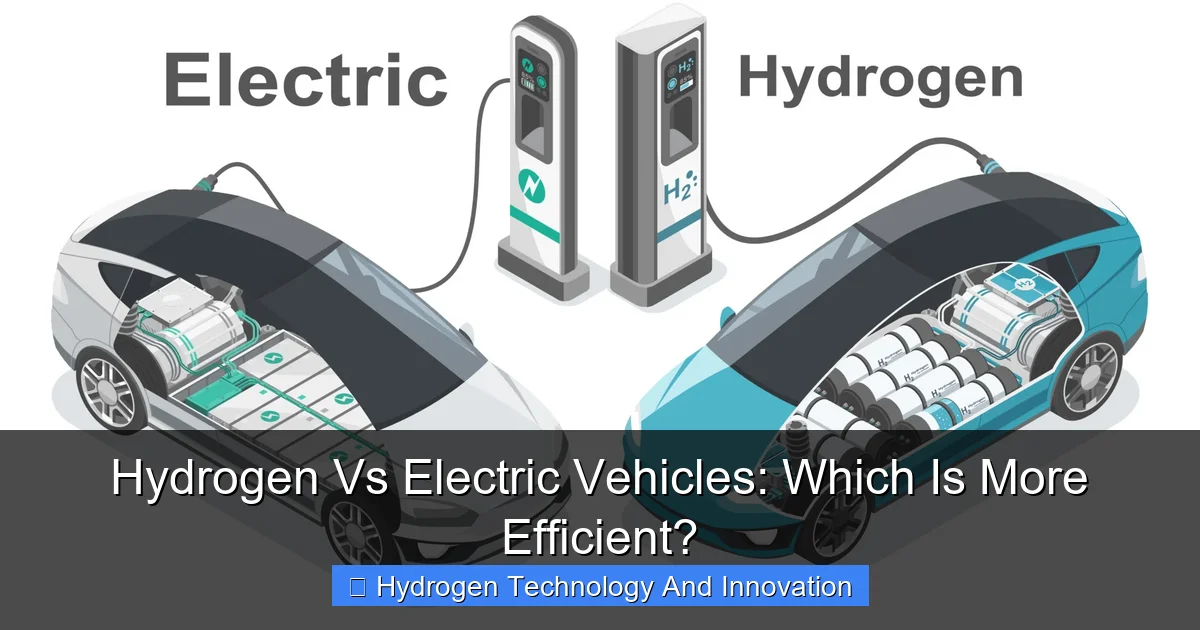
Hydrogen and electric vehicles both aim to reduce emissions, but they differ in efficiency, infrastructure, and use cases. While battery electric vehicles (BEVs) win in energy efficiency, hydrogen fuel cell vehicles (FCEVs) offer faster refueling and longer range—making each better suited for different needs.
Key Takeaways
- Electric vehicles are more energy-efficient: BEVs convert about 77% of grid energy to power at the wheels, far outperforming hydrogen’s 25–35% efficiency.
- Hydrogen refuels faster: FCEVs can be refilled in 3–5 minutes, similar to gasoline cars, while most EVs take 30+ minutes for a fast charge.
- Hydrogen production is energy-intensive: Most hydrogen today comes from natural gas, which emits CO₂, though green hydrogen from renewables is growing.
- EVs have better infrastructure: Charging stations are widespread and expanding rapidly, while hydrogen refueling networks remain limited.
- FCEVs excel in heavy-duty transport: Hydrogen’s high energy density makes it ideal for trucks, buses, and ships where battery weight is a problem.
- Total cost of ownership favors EVs: Lower fuel and maintenance costs make electric cars cheaper to run over time, despite higher upfront prices for some models.
- The future may include both technologies: Rather than one replacing the other, hydrogen and electric vehicles will likely serve complementary roles in a clean transport future.
📑 Table of Contents
- Introduction: The Race Toward Clean Transportation
- How Efficiency Is Measured in Green Vehicles
- Hydrogen Production: The Hidden Energy Cost
- Refueling Speed and Convenience
- Environmental Impact: Beyond Tailpipe Emissions
- Cost Comparison: Upfront and Long-Term
- Conclusion: Efficiency Depends on the Use Case
Introduction: The Race Toward Clean Transportation
The world is shifting gears—literally. As climate change accelerates and air pollution becomes a growing concern, governments, automakers, and consumers are searching for cleaner alternatives to gasoline and diesel vehicles. Two leading contenders have emerged in this green revolution: battery electric vehicles (BEVs) and hydrogen fuel cell vehicles (FCEVs). Both promise zero tailpipe emissions, but they take very different paths to get there.
At first glance, electric cars seem to be winning the popularity contest. Tesla, Rivian, and legacy automakers like Ford and Volkswagen are pouring billions into EV development. Charging stations are popping up in cities, suburbs, and highway rest stops. But hydrogen vehicles aren’t going away. Toyota, Hyundai, and Honda continue to invest in fuel cell technology, especially for commercial and long-haul applications. So which is truly more efficient—hydrogen or electric?
Efficiency isn’t just about how far a car can go on a single charge or tank. It’s about the entire energy chain: from how the fuel is made, to how it’s delivered, to how it powers the wheels. When we dig into the numbers, a clear picture emerges—but it’s not as simple as declaring one technology the outright winner. The answer depends on how you define “efficient” and what kind of driving you do.
How Efficiency Is Measured in Green Vehicles
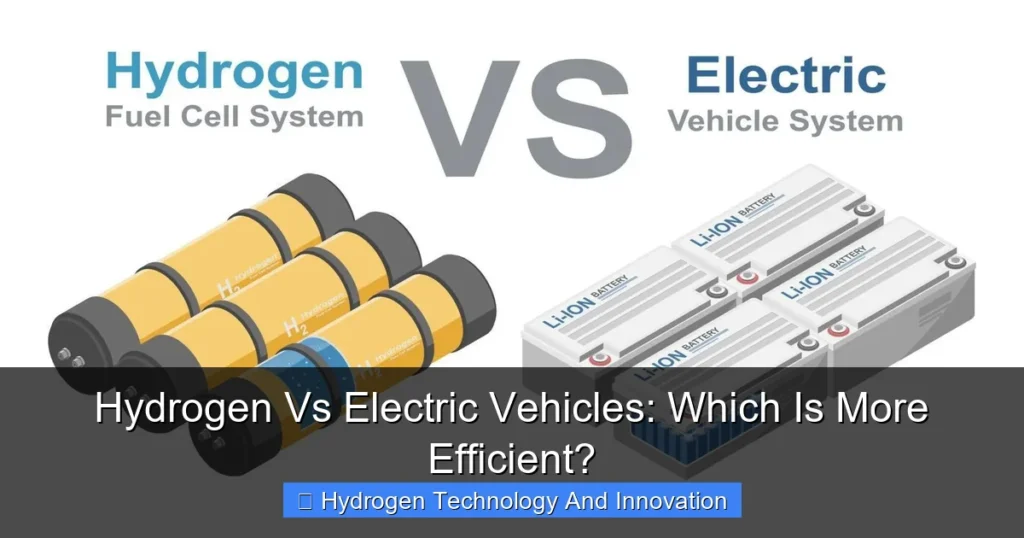
Visual guide about Hydrogen Vs Electric Vehicles: Which Is More Efficient?
Image source: static.vecteezy.com
Before we compare hydrogen and electric vehicles, it’s important to understand what “efficiency” really means in this context. In transportation, efficiency usually refers to how much of the original energy source actually makes it to the wheels to move the car. This is often called “well-to-wheel” efficiency.
Imagine you’re filling up a glass of water from a bucket. If half the water spills on the way, your efficiency is only 50%. The same logic applies to vehicles. Whether you’re using electricity or hydrogen, energy is lost at every step—generation, transmission, storage, and conversion.
For electric vehicles, the path is relatively straightforward. Electricity is generated at a power plant (solar, wind, nuclear, or fossil fuels), sent through the grid, stored in a battery, and then used to power an electric motor. Each step has some loss, but overall, the system is quite efficient.
Hydrogen, on the other hand, takes a more complex route. First, hydrogen must be produced—usually by splitting water (electrolysis) or extracting it from natural gas (steam methane reforming). Then it must be compressed, transported, stored at a refueling station, and finally converted back into electricity in a fuel cell to power the motor. Each of these steps eats up energy.
So when we talk about efficiency, we’re really asking: which system wastes less energy from start to finish?
Energy Conversion: From Source to Motion
Let’s break it down step by step.
For a typical battery electric vehicle:
– Electricity is generated (efficiency varies by source, but let’s assume 50% for fossil fuels or 90%+ for renewables).
– It’s transmitted over power lines (about 5% loss).
– It’s stored in the battery (10–15% loss during charging).
– The electric motor converts stored energy to motion (about 90% efficient).
When you multiply these factors, the total well-to-wheel efficiency for an EV is around **77%** if the electricity comes from a mix of sources. If the grid is powered by renewables, that number climbs even higher.
Now consider a hydrogen fuel cell vehicle:
– Hydrogen is produced via electrolysis (60–70% efficient) or steam methane reforming (65–75% efficient, but emits CO₂).
– It’s compressed and transported (another 10–15% loss).
– It’s stored at the station and dispensed into the car (5–10% loss).
– The fuel cell converts hydrogen to electricity (50–60% efficient).
– The electric motor powers the wheels (90% efficient).
Multiply all these steps, and the total well-to-wheel efficiency for an FCEV drops to just **25–35%**.
That means for every 100 units of energy used to make hydrogen, only 25 to 35 units actually move the car. In contrast, EVs use 77 units out of 100. That’s a massive difference.
Real-World Examples: Tesla vs. Toyota Mirai
Let’s look at two real-world examples: the Tesla Model 3 and the Toyota Mirai.
The Tesla Model 3 Long Range has a battery capacity of about 75 kWh and can travel around 358 miles on a full charge. That’s roughly 4.8 miles per kWh. If electricity costs $0.15 per kWh, a full charge costs about $11.25.
The Toyota Mirai has a hydrogen tank that holds about 5.6 kg of hydrogen and can travel around 400 miles. Hydrogen currently costs around $16 per kg in California (where most FCEVs are sold), so a full tank costs about $89.60.
Even if we assume the Mirai gets slightly better range, it costs nearly eight times more to fuel than the Tesla. And that’s before considering the massive energy loss in producing and delivering hydrogen.
Now, some might argue that hydrogen prices will drop as production scales up. That’s possible—but so will electricity prices, especially as solar and wind become cheaper. And even if hydrogen becomes half as expensive, EVs still win on efficiency and cost per mile.
Hydrogen Production: The Hidden Energy Cost
One of the biggest challenges with hydrogen vehicles isn’t the car itself—it’s how the hydrogen is made. Right now, about 95% of the world’s hydrogen is produced from fossil fuels, primarily natural gas, through a process called steam methane reforming (SMR). This method emits carbon dioxide, which undermines the environmental benefits of driving a zero-emission vehicle.
Even when hydrogen is made using renewable electricity (via electrolysis), the process is inherently inefficient. Electrolysis splits water into hydrogen and oxygen using electricity. But as we saw earlier, only 60–70% of the input energy ends up in the hydrogen. Then you lose more energy compressing, transporting, and converting it back to electricity in the fuel cell.
In contrast, charging an EV directly uses electricity with far fewer conversion steps. There’s no need to split water, compress gas, or run a fuel cell. The energy goes straight from the grid to the battery to the motor.
Green Hydrogen: A Bright Spot?
There is hope on the horizon: green hydrogen. This is hydrogen produced using renewable energy—solar, wind, or hydro—to power electrolysis. When done right, green hydrogen can be truly carbon-free.
Countries like Germany, Australia, and Japan are investing heavily in green hydrogen projects. For example, the HyDeal Ambition project in Spain aims to produce green hydrogen at $1.50 per kg by 2030—competitive with fossil fuel-based hydrogen.
But even green hydrogen faces efficiency challenges. If you use solar power to make hydrogen, you lose about 50% of the energy in conversion and transport. Meanwhile, using that same solar power to charge an EV would be far more efficient.
So while green hydrogen is a promising solution for hard-to-decarbonize sectors—like steel production or aviation—it may not be the best choice for passenger vehicles.
Grey, Blue, and Green: Understanding Hydrogen Colors
You may have heard terms like “grey,” “blue,” and “green” hydrogen. These refer to how the hydrogen is produced:
– Grey hydrogen is made from natural gas using SMR and emits CO₂. It’s the most common and cheapest form today.
– Blue hydrogen is also made from natural gas, but the CO₂ is captured and stored (carbon capture and storage, or CCS). It’s cleaner than grey but still relies on fossil fuels.
– Green hydrogen is made using renewable electricity and emits no CO₂. It’s the cleanest option but currently the most expensive.
For hydrogen vehicles to be truly sustainable, they need to run on green hydrogen. But right now, green hydrogen makes up less than 1% of global production. Scaling it up will require massive investments in renewable energy and electrolyzer technology.
Refueling Speed and Convenience
While EVs win on efficiency, hydrogen has one major advantage: refueling speed.
Charging an electric car takes time. Even with a fast DC charger, most EVs need 20–40 minutes to go from 10% to 80% charge. Home charging is even slower—often 6–12 hours for a full charge on a Level 2 charger.
Hydrogen, on the other hand, refuels in just 3–5 minutes—about the same as filling up a gasoline car. This makes FCEVs much more convenient for long trips or for drivers who don’t have time to wait.
For example, a truck driver on a cross-country route can’t afford to stop for an hour to recharge. A hydrogen truck could refuel in minutes and keep going. The same applies to buses, taxis, and delivery vehicles that operate on tight schedules.
Charging Infrastructure vs. Hydrogen Stations
But convenience isn’t just about speed—it’s also about availability.
As of 2024, there are over 1.5 million public charging stations worldwide, with the U.S. alone adding thousands each month. In contrast, there are fewer than 1,000 hydrogen refueling stations globally, with most concentrated in California, Japan, and parts of Europe.
This lack of infrastructure is a major barrier to hydrogen vehicle adoption. Why buy a car you can’t refuel? Even if hydrogen were cheaper and more efficient, drivers need confidence that they can find a station when they need one.
EVs, meanwhile, benefit from a rapidly expanding network. Plus, most charging happens at home or work, reducing reliance on public stations. With a home charger, you wake up every morning with a “full tank.”
Range Anxiety: Does It Still Matter?
Range anxiety—the fear of running out of charge—was a big concern for early EV adopters. But today’s EVs offer 250–400 miles of range, which is more than enough for most daily driving.
Hydrogen vehicles often have even better range—up to 400–500 miles—but that advantage is offset by the lack of refueling stations. You can’t use that range if you can’t refill.
Still, for specific use cases—like long-haul trucking or remote areas with limited charging—hydrogen’s fast refueling and long range could be a game-changer.
Environmental Impact: Beyond Tailpipe Emissions
Both hydrogen and electric vehicles produce zero emissions while driving. But the full environmental picture depends on how the energy is generated.
If an EV is charged using coal-powered electricity, its carbon footprint is higher than if it’s charged with solar or wind. The same goes for hydrogen: if it’s made from natural gas, it’s not truly clean.
However, as the grid gets greener, EVs automatically become cleaner. A Tesla charged today in California (where over 50% of electricity comes from renewables) has a much lower carbon footprint than one charged in a coal-heavy state like West Virginia.
Hydrogen doesn’t have this advantage. Even if the grid gets cleaner, grey and blue hydrogen still rely on fossil fuels. Only green hydrogen offers a truly sustainable path—and it’s not yet widely available.
Lifecycle Emissions: Manufacturing Matters Too
Another factor is the environmental cost of manufacturing. Both EVs and FCEVs require rare materials and energy-intensive production.
EV batteries use lithium, cobalt, and nickel, which have environmental and ethical concerns related to mining. Fuel cells use platinum, a rare and expensive metal.
However, studies show that over their lifetime, EVs still produce fewer greenhouse gases than FCEVs—even when accounting for battery production. This is mainly due to the higher efficiency of electric drivetrains.
Cost Comparison: Upfront and Long-Term
Let’s talk money.
Electric vehicles have come down in price significantly. The average new EV in the U.S. costs around $55,000, though many models—like the Tesla Model 3, Chevrolet Bolt, and Hyundai Kona Electric—are available under $40,000.
Hydrogen vehicles are still niche and expensive. The Toyota Mirai starts at around $50,000, and the Hyundai NEXO is even pricier. Plus, hydrogen fuel costs $13–$16 per kg, which translates to about $0.15–$0.20 per mile. In contrast, electricity costs about $0.04–$0.08 per mile for most EVs.
Maintenance is another factor. EVs have fewer moving parts—no engine, transmission, or exhaust system—so they require less servicing. Hydrogen vehicles are more complex, with fuel cells, compressors, and storage tanks that may need specialized maintenance.
Over time, the total cost of ownership strongly favors EVs. Even with higher upfront prices for some models, lower fuel and maintenance costs make electric cars cheaper in the long run.
Government Incentives and Future Trends
Governments are stepping in to help. In the U.S., the Inflation Reduction Act offers up to $7,500 in tax credits for new EVs and up to $40,000 for commercial FCEVs. California offers additional rebates for both technologies.
But the trend is clear: most automakers are betting on batteries. General Motors plans to go all-electric by 2035. Ford is investing $50 billion in EVs. Even Toyota, a longtime hydrogen advocate, is now expanding its EV lineup.
Hydrogen is finding its niche in heavy transport. Companies like Nikola, Hyzon, and Toyota are developing hydrogen-powered trucks and buses. These vehicles need the range and refueling speed that batteries can’t yet provide.
Conclusion: Efficiency Depends on the Use Case
So, which is more efficient: hydrogen or electric vehicles?
The short answer: battery electric vehicles are far more energy-efficient, converting 77% of grid energy to motion compared to hydrogen’s 25–35%. They’re also cheaper to fuel, easier to maintain, and supported by a growing charging network.
But hydrogen isn’t obsolete. Its fast refueling and high energy density make it ideal for heavy-duty applications like trucks, buses, and ships—where batteries are too heavy and charging too slow.
The future of clean transportation isn’t a battle between hydrogen and electric. It’s a partnership. EVs will dominate passenger cars and urban transport, while hydrogen powers the vehicles that need to go far and fast without stopping.
As renewable energy grows and technology improves, both paths will get cleaner and more efficient. The key is choosing the right tool for the job—and recognizing that efficiency isn’t just about the car, but the entire energy ecosystem behind it.
Frequently Asked Questions
Are hydrogen vehicles really zero emission?
Hydrogen vehicles emit only water vapor from the tailpipe, so they are zero emission while driving. However, if the hydrogen is produced from fossil fuels, the overall process still generates CO₂ emissions.
Can I charge an EV at home?
Yes, most EV owners charge at home using a Level 2 charger, which plugs into a 240V outlet. This allows you to wake up each morning with a full battery, just like filling up a gas tank.
How long does it take to refuel a hydrogen car?
Hydrogen refueling takes about 3–5 minutes, similar to gasoline. This is much faster than even the quickest EV fast charging, which takes 20–40 minutes for an 80% charge.
Is hydrogen safer than gasoline?
Hydrogen is flammable, but it’s lighter than air and disperses quickly if leaked. Modern hydrogen tanks are rigorously tested and designed to withstand crashes, making them as safe as gasoline vehicles.
Why aren’t there more hydrogen cars on the road?
Hydrogen vehicles are limited by high costs, lack of refueling stations, and lower efficiency compared to EVs. Most consumers and automakers see batteries as a more practical solution for passenger cars.
Will hydrogen ever be cheaper than electricity?
It’s unlikely for passenger vehicles. Even if green hydrogen production scales up, the multiple energy conversion steps make it inherently less efficient than direct electric charging. However, hydrogen may become cost-competitive in heavy transport.