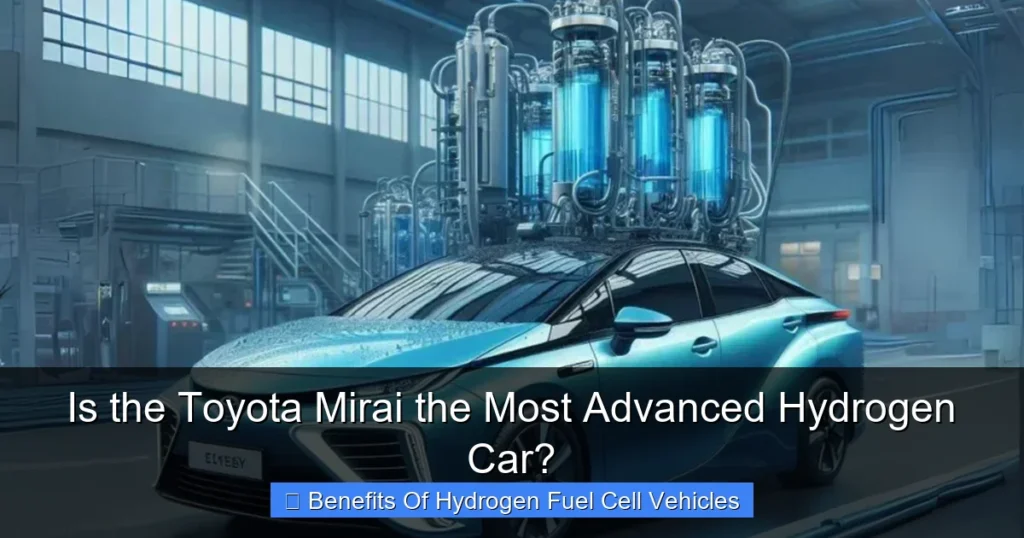
The Toyota Mirai is one of the most advanced hydrogen fuel cell vehicles (HFCVs) on the market, but whether it’s *the* most advanced depends on criteria like technology, range, and infrastructure. With a sleek design, industry-leading efficiency, and Toyota’s reliability, it sets a high bar—but competitors like Hyundai Nexo and upcoming models push boundaries further.
This is a comprehensive guide about Is the Toyota Mirai the most advanced hydrogen car?.
Key Takeaways
- Leading Technology: The Mirai’s hydrogen fuel cell system offers near-zero emissions and faster refueling than EVs.
- Range & Efficiency: 402-mile EPA-rated range and 65 MPGe make it competitive with top hybrids.
- Challenges Remain: Limited hydrogen stations (especially outside California) hinder widespread adoption.
- Competitors Close the Gap: Hyundai Nexo (370 miles) and upcoming Honda Clarity FCEV rival the Mirai’s specs.
- Future Potential: Toyota’s solid-state battery R&D could redefine HFCV tech within years.
- Practicality Wins: Spacious interiors, premium materials, and safety ratings (IIHS Top Safety Pick+) appeal to buyers.
—
[FEATURED_IMAGE_PLACEHOLDER]
# Is the Toyota Mirai the Most Advanced Hydrogen Car?
## Introduction
Hydrogen fuel cell vehicles (HFCVs) are often hailed as the future of sustainable transportation, promising zero-emission driving without range anxiety. At the forefront of this revolution stands the Toyota Mirai, a car that’s been synonymous with hydrogen since its 2014 debut. But as more automakers enter the space—Hyundai, Honda, BMW, and even startups like Nikola—it begs the question: is the Mirai still the most advanced hydrogen car?
In this article, we’ll dissect the Mirai’s innovations, compare it to competitors, and explore where the technology stands today. We’ll also address practical hurdles like infrastructure and cost to give you a clear picture of whether the Mirai deserves its “advanced” label.
## 1. What Makes the Toyota Mirai Stand Out?
###
Cutting-Edge Fuel Cell Technology
The Mirai’s heart is its hydrogen fuel cell stack, which converts hydrogen into electricity with only water vapor as a byproduct. Unlike traditional combustion engines, there’s no tailpipe pollution or particulate matter. Toyota’s proprietary system achieves:
- High Efficiency: ~60% energy conversion rate (compared to ~30% for gasoline).
- Fast Refueling: Takes just 3–5 minutes to fill up, rivaling gas cars.
- Longevity: The fuel cells last over 80,000 hours (over 9 years of daily use).
###
Range & Performance
The 2024 Mirai boasts an EPA-rated 402-mile range—among the highest for any production HFCV. Combined with a 65 MPGe (miles per gallon equivalent), it outperforms many plug-in hybrids. For example:
– Compared to the Hyundai Nexo (370 miles), the Mirai edges out slightly.
– Against the Tesla Model S Plaid (405 miles), the Mirai matches range but lacks supercar acceleration (0–60 mph in 5.2 seconds vs. 1.99).
## 2. How Does It Compare to Competitors?
###
Hyundai Nexo: A Strong Contender
The Nexo offers:
- Larger Tank Capacity: 5.6 kg H₂ vs. Mirai’s 5.6 kg (same volume, but different tank shapes affect efficiency).
- Advanced Driver Assistance: Highway Driving Assist II (semi-autonomous driving).
- Lower Cost:$60k MSRP vs. Mirai’s $58k base model.
However, the Mirai’s interior quality and Toyota’s brand loyalty keep it ahead.
###
Upcoming Honda Clarity FCEV & Others
Honda’s upcoming Clarity FCEV promises:
– 500+ mile range (via larger hydrogen storage).
– Lower production costs (targeting $40k by 2025).
BMW’s iX5 Hydrogen (limited production) emphasizes luxury and off-road capability.
## 3. Infrastructure: The Biggest Challenge
###
Limited Hydrogen Stations
As of 2024, the U.S. has about 70 hydrogen refueling stations, mostly concentrated in California (e.g., LA, San Francisco). Outside the West Coast, options are scarce. This makes the Mirai impractical for most buyers unless they live in areas like:
– California
– Hawaii
– Japan
– South Korea
###
Cost & Scalability
Hydrogen production remains expensive ($16–$20/kg vs. $1.50/gasoline). While green hydrogen (from renewables) aims to cut costs, scaling up infrastructure will take years. Toyota estimates $2 billion+ investment needed nationwide.
## 4. Practical Advantages Over Electric Vehicles (EVs)
###
Refueling Time vs. Charging
– Mirai: 3–5 minutes to full charge.
– Tesla Model 3: ~30 minutes at 250 kW Supercharger (or overnight AC charging).
For long trips, the Mirai wins if stations are available.
###
Weight & Payload
Hydrogen tanks add weight (~1,000 lbs), but the Mirai’s lightweight chassis keeps it agile. EVs with large batteries (e.g., Lucid Air) face similar trade-offs.
## 5. Future of Hydrogen Tech: Toyota’s Roadmap
Toyota isn’t resting on its laurels. Key initiatives include:
- Solid-State Batteries: Could combine hydrogen storage with higher energy density, extending range to 600+ miles.
- Partnerships: Collaborating with Shell and Chevron to expand hydrogen networks.
- Affordable Models: Plans for a sub-$30k FCEV by 2030.
## Conclusion: Is the Mirai the *Most* Advanced?
The Toyota Mirai is undeniably advanced, setting benchmarks for efficiency, reliability, and design. However, advancements from Hyundai, Honda, and startups mean “most advanced” is subjective today. If you prioritize proven technology, range, and brand trust, the Mirai is a top choice. But if you want cutting-edge autonomy or lower cost, alternatives like the Nexo or future models may suit better.
Hydrogen’s true potential hinges on infrastructure—until then, the Mirai remains a symbol of progress, not just a car.
—
### Quick Q&A
Question 1?
The Mirai’s fuel cell system uses platinum catalysts, which are costly but highly efficient. Toyota is researching non-platinum alternatives to reduce expenses.
Question 2?
No. While the Mirai has excellent range, the Hyundai Nexo offers more advanced driver-assistance systems (like highway self-driving), making it a close second.
Question 3?
Hydrogen production emits CO₂ unless powered by renewables. Green hydrogen (from wind/solar + electrolysis) is cleaner but currently rare.
Question 4?
Yes! The Mirai’s fuel cells have fewer moving parts than internal combustion engines, reducing maintenance needs. No oil changes required!
Question 5?
By 2025, expect more stations in major cities (Chicago, Denver) and lower prices as economies of scale kick in.
### FAQs
What’s the biggest drawback of hydrogen cars?
Limited refueling infrastructure is the main hurdle. Few stations exist outside California, making long-distance travel risky without planning.
How does hydrogen fuel cell tech differ from EV batteries?
HFCVs refuel instantly and emit only water, while EVs rely on slower charging and produce emissions during grid electricity generation.
Can I convert a gasoline car to run on hydrogen?
Technically possible, but prohibitively expensive and unsafe. OEMs like Toyota build these systems from the ground up.
Are hydrogen cars cheaper to own than EVs?
Currently, no. Higher upfront costs, sparse infrastructure, and expensive hydrogen keep ownership costs higher than comparable EVs.
Will hydrogen cars replace EVs entirely?
Unlikely. They’re niche now—ideal for heavy transport (trucks, buses) and regions with abundant renewable energy for hydrogen production.
Does the Mirai qualify for tax credits in the U.S.?
Yes. The 2024 Mirai qualifies for a $7,500 federal tax credit under the Inflation Reduction Act, provided it meets labor and sourcing requirements.
Quick Answers to Common Questions
What is Is the Toyota Mirai the most advanced hydrogen car??
Is the Toyota Mirai the most advanced hydrogen car? refers to essential knowledge and techniques.
Frequently Asked Questions
What is Is the Toyota Mirai the most advanced hydrogen car??
Is the Toyota Mirai the most advanced hydrogen car? is an important topic with many practical applications.