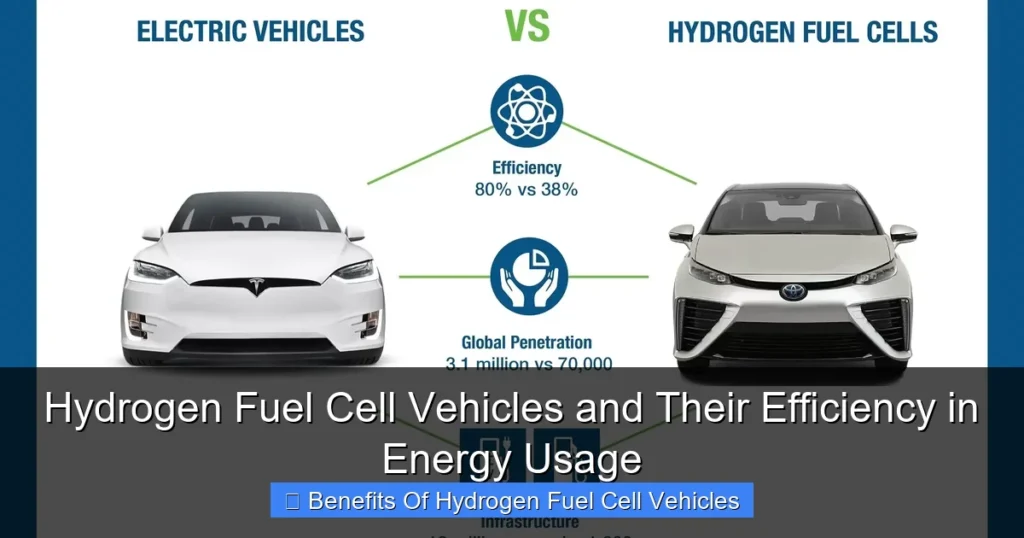
Hydrogen fuel cell vehicles (FCVs) are a cutting-edge solution for sustainable transportation, converting hydrogen into electricity with near 100% energy efficiency and emitting only water vapor. Their efficiency surpasses conventional EVs in refueling time and range, making them ideal for long-distance travel and heavy-duty applications.
This is a comprehensive guide about Hydrogen fuel cell vehicles and their efficiency in energy usage.
Key Takeaways
- Efficiency: FCVs achieve ~60-70% overall system efficiency, outperforming gasoline cars (~20-30%) and even some EVs.
- Zero Emissions: Only water vapor is emitted, reducing air pollution and carbon footprint.
- Fast Refueling: Replenishes in minutes vs. hours for battery-powered EVs, enhancing convenience.
- Long Range: FCVs often exceed 400 miles on a single tank, ideal for cross-country trips.
- Scalability: Hydrogen production can be renewable (green H₂), aligning with global decarbonization goals.
- Challenges: High infrastructure costs and energy-intensive hydrogen production remain hurdles.
—
[FEATURED_IMAGE_PLACEHOLDER]
# Hydrogen Fuel Cell Vehicles and Their Efficiency in Energy Usage
## Introduction: Why Hydrogen FCVs Are the Future
Imagine a car that never needs hours to recharge, emits nothing but water vapor, and can drive 500+ miles without stopping. That’s the promise of hydrogen fuel cell vehicles (FCVs). As climate concerns grow, governments and automakers are betting big on hydrogen as a clean energy alternative. But how efficient are these vehicles really? And what makes them stand out from electric cars (EVs) and gas guzzlers?
In this guide, we’ll break down how hydrogen FCVs work, their energy efficiency compared to other technologies, real-world examples, and why they might just redefine mobility. Whether you’re curious about sustainability or planning your next car purchase, this post has everything you need.
## How Hydrogen FCVs Work: The Science Behind Efficiency
### The Basic Process
Hydrogen FCVs don’t burn fuel like traditional cars. Instead, they use an electrochemical reaction between hydrogen (H₂) and oxygen (O₂) in a fuel cell stack to generate electricity. This electricity powers an electric motor, while the byproduct is water vapor—no CO₂, no smog.
Key components:
- Fuel cell stack: Converts H₂ + O₂ → electricity + water.
- Tank: Stores compressed hydrogen (700 bar pressure).
- Battery: Stores excess energy for acceleration and regenerative braking.
### Energy Conversion Breakdown
Here’s where FCVs shine:
- Hydrogen production: Green H₂ (from renewables) uses electrolysis (~70% efficient).
- Fuel cell conversion: ~60% of stored energy becomes usable electricity.
- Motor output: ~90% of electricity turns into motion.
Total system efficiency: ~54-63% (vs. ~20-30% for gasoline cars).
#### Example: Toyota Mirai
The Toyota Mirai achieves 68% well-to-wheel efficiency (from H₂ production to wheels), beating most EVs when accounting for grid electricity sources (which may rely on coal).
## Efficiency Comparison: FCVs vs. EVs vs. Gasoline Cars
### 1. Refueling Time & Range
| Vehicle Type | Refuel/Charge Time | Avg. Range |
|---|---|---|
| Gasoline Car | 5 mins | 300-400 miles |
| Electric Car | 4-12 hrs (fast charging) | 250-350 miles |
| Hydrogen FCV | 3-5 mins | 350-500 miles |
Tip: For road-trippers, FCVs eliminate “range anxiety” without waiting overnight at a charger.
### 2. Energy Loss Over Time
- Gasoline: Loses ~40% energy through engine heat, friction, and exhaust.
- EVs: Lose ~20-30% during battery charging/discharging.
- FCVs: Minimal energy loss; fuel cells operate quietly at high temps.
### 3. Infrastructure Impact
Hydrogen stations require less space per “fill-up” than EV chargers. A single station can service dozens of cars simultaneously, whereas fast-chargers often need dedicated spots.
## Advantages of Hydrogen FCVs for Sustainability
### Zero Tailpipe Emissions
Unlike EVs relying on grid electricity (which may come from fossil fuels), FCVs emit only water vapor. In regions with dirty grids, this advantage is massive.
### Green Hydrogen Potential
If produced via electrolysis using renewable energy, hydrogen becomes a carbon-neutral fuel. Projects like Australia’s Hornsea Project aim to scale green H₂ production.
### Heavy-Duty Applications
FCVs excel in trucks, buses, and ships where batteries are impractical. For example:
- Hyundai XCIENT: A hydrogen truck covering 200 miles per fill-up, with a payload capacity rivaling diesel models.
- Mercedes-Benz GenH2: Prototype bus for urban transit with 1,000 km range.
## Challenges and Limitations
### Infrastructure Costs
Building hydrogen stations ($1M–$2M each) is expensive. Currently, there are fewer than 100 globally (mostly in Japan, Germany, and California).
### Hydrogen Production Efficiency
Most H₂ today comes from steam methane reforming (SMR), which emits CO₂. Scaling green H₂ requires massive investment in wind/solar farms and electrolyzers.
### Storage & Safety
Compressed hydrogen tanks are lightweight but require robust materials. Leaks pose explosion risks, though modern designs mitigate this.
## Real-World Examples: Leading FCV Models
### Toyota Mirai (2023)
- Range: 402 miles (EPA rating).
- Refuel Time: 3-5 minutes.
- Cost:$ 57,500 (after incentives).
### Hyundai Nexo
- Unique Feature: Uses hydrogen-assisted combustion for extra power in hybrid mode.
- Range: 365 miles.
### Nikola Tre (Truck)
- Payload: 8 tons over 250 miles per fill-up.
- Goal: Replace diesel fleets in logistics.
## Tips for Choosing a Hydrogen FCV
1. Check Incentives: Tax credits (e.g., U.S. $7,500) reduce upfront costs.
2. Locate Stations: Use apps like Hydrogen Station to find nearby refueling points.
3. Plan for Charging: Some FCVs support bidirectional charging, allowing energy export to homes.
4. Consider Total Cost: While FCVs are pricier now, lower fuel costs (~$15/gallon equivalent) save money long-term.
## Conclusion: The Road Ahead for FCVs
Hydrogen fuel cell vehicles aren’t just a niche technology—they’re a pivotal part of the transition to sustainable energy. With advancements in green H₂ production and infrastructure growth, FCVs could soon rival EVs in mainstream adoption. While challenges exist, their unmatched efficiency, speed, and environmental benefits make them a compelling option for the future.
Whether you’re a fleet operator needing heavy-duty haulers or a commuter prioritizing low emissions, hydrogen FCVs offer a glimpse of cleaner, smarter transportation. Stay tuned—the hydrogen revolution is accelerating!
—
### QUICK Q&A
Question 1?
Do hydrogen FCVs produce any emissions?
Question 2?
How much does hydrogen fuel cost compared to gasoline?
Question 3?
Can I charge my FCV at home?
Question 4?
Which countries lead in FCV adoption?
Question 5?
Are hydrogen cars better for long trips than EVs?
### FAQS
What’s the lifespan of a hydrogen fuel cell?
Modern fuel cells last 15-20 years or 150,000–200,000 miles, similar to gasoline engines. Maintenance is minimal due to fewer moving parts.
Is hydrogen flammable?
Yes, but it’s safer than gasoline in small leaks. FCVs use leak-proof tanks and sensors to prevent accidents.
How common are hydrogen stations?
As of 2024, ~500 stations exist worldwide, concentrated in Japan, South Korea, and California. More are planned in Europe and North America.
Can hydrogen be used in airplanes?
Research is ongoing. Airlines like Airbus are testing hydrogen-powered prototypes, but infrastructure remains unproven.
What’s the difference between gray, blue, and green hydrogen?
Gray: Made from natural gas (high emissions). Blue: Adds carbon capture. Green: Uses renewables (zero emissions).
Will FCVs replace EVs entirely?
Unlikely both ways. FCVs suit heavy transport and remote areas, while EVs dominate personal vehicles due to cheaper infrastructure.
Quick Answers to Common Questions
What is Hydrogen fuel cell vehicles and their efficiency in energy usage?
Hydrogen fuel cell vehicles and their efficiency in energy usage refers to essential knowledge and techniques.
Frequently Asked Questions
What is Hydrogen fuel cell vehicles and their efficiency in energy usage?
Hydrogen fuel cell vehicles and their efficiency in energy usage is an important topic with many practical applications.