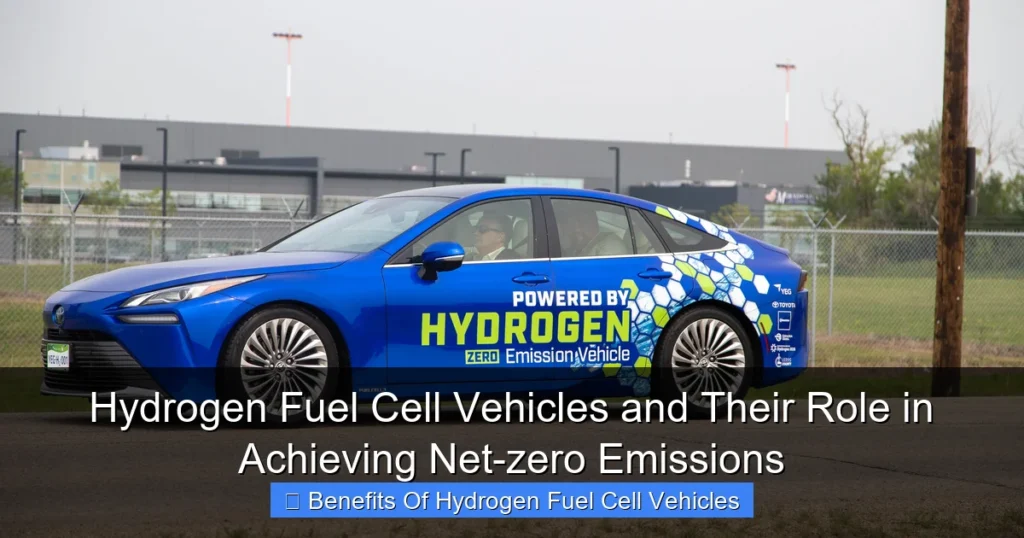
Hydrogen fuel cell vehicles (FCEVs) play a pivotal role in achieving net-zero emissions by producing only water as a byproduct, eliminating greenhouse gases from transportation. Unlike battery electric vehicles, FCEVs excel in long-distance travel, fast refueling, and renewable hydrogen integration, making them a versatile solution for decarbonizing heavy-duty and commercial fleets.
This is a comprehensive guide about Hydrogen fuel cell vehicles and their role in achieving net-zero emissions.
Key Takeaways
- Zero Emissions: FCEVs emit only water vapor, unlike ICEs or even BEVs that rely on grid electricity.
- Fast Refueling: Hydrogen tanks can be filled in minutes, similar to gasoline, while BEVs require hours.
- Renewable Hydrogen: Green hydrogen from electrolysis powered by renewables ensures sustainability.
- Heavy-Duty Focus: Ideal for trucks, buses, and ships where battery weight is impractical.
- Scalability: Hydrogen infrastructure can coexist with existing gas stations, easing adoption.
- Energy Density: Hydrogen stores more energy per unit than batteries, critical for long-haul transport.
- Policy Support: Governments worldwide are investing in hydrogen hubs to accelerate deployment.
—
[FEATURED_IMAGE_PLACEHOLDER]
Hydrogen Fuel Cell Vehicles and Their Role in Achieving Net-zero Emissions
Introduction: Why Hydrogen Matters for Net-Zero Goals
The race to achieve net-zero emissions by 2050 hinges on decarbonizing every sector—and transportation isn’t lagging behind. While electric cars dominate headlines, hydrogen fuel cell vehicles (FCEVs) quietly offer a game-changing alternative for hard-to-electrify applications like trucks, buses, and aviation. By converting hydrogen into electricity via electrochemical reactions, FCEVs produce zero CO2 at the tailpipe, making them a cornerstone of clean mobility strategies.
But why focus on hydrogen? Simple: it’s the only fuel that can match gasoline’s energy density without emitting pollution when burned or used in cells. Plus, green hydrogen—produced using renewable energy—turns FCEVs into a truly circular system. Let’s dive deep into how FCEVs fit the net-zero puzzle.
How Hydrogen Fuel Cells Work: A Simplified Breakdown
The Science Behind It
An FCEV operates like a mini power plant onboard:
- Hydrogen Supply: Stored in high-pressure tanks, hydrogen flows to the fuel cell stack.
- Electrochemical Reaction: In the stack, hydrogen splits into protons and electrons. Electrons create current; protons combine with oxygen to form water.
- Electricity Generation: The current powers an electric motor driving the wheels.
- Byproduct: Only H₂O exits the exhaust—no CO2, no particulates.
This process mirrors how your phone charger works but at a much larger scale.
Advantages Over Battery Electric Vehicles (BEVs)
- Range & Speed: FCEVs typically offer 300–400 miles per tank vs. 250–300 miles for BEVs. Refueling takes 3–5 minutes, not 4+ hours.
- Weight: Hydrogen’s energy density is 3x higher than lithium-ion batteries, crucial for heavy loads.
- Grid Independence: FCEVs don’t depend on charging infrastructure bottlenecks.
Net-Zero Impact: How FCEVs Reduce Emissions
From Production to Wheels
A 2023 study by the International Energy Agency (IEA) found that green hydrogen FCEVs cut lifecycle emissions by up to 90% compared to diesel trucks. Here’s why:
- Green Hydrogen Production: When made via electrolysis using wind/solar power, hydrogen emits near-zero CO2.
- No Battery Degradation: Unlike BEVs, FCEVs avoid battery replacement waste (lithium mining has environmental costs).
- Scalability for Industry: Hydrogen already powers steelmaking and chemicals; adding transport expands its carbon-free footprint.
Practical Examples
Nissan X-Trail FCEV: Japan’s first mass-produced FCEV runs on hydrogen sourced from local solar farms.
Hyzon Motors Trucks: These zero-emission trucks haul freight across California, using hydrogen from renewable sources.
Challenges and Solutions: Is Hydrogen Ready?
Barriers to Adoption
- Cost: Hydrogen production and storage remain expensive (~$16/kg vs. $2/kg for gray hydrogen).
- Infrastructure Gaps: Only ~1,200 public hydrogen stations exist globally (mostly in Europe/Japan/California).
- Energy Losses: Electrolysis and compression lose 30–50% of input energy.
Overcoming Obstacles
- Government Subsidies: The U.S. Inflation Reduction Act offers $3/kg incentives for green hydrogen.
- Industry Collaboration: Toyota and Hyundai are pooling resources to build cheaper fuel cells.
- Smart Grids: Pairing hydrogen production with excess renewable energy slashes costs.
The Future: Hydrogen Hubs and Policy Levers
Growing Investment
The EU’s European Green Deal allocates €8 billion for hydrogen projects, while China aims for 1 million FCEVs by 2035. Private players like Shell and Air Liquide are building “hydrogen valleys” to cluster production, storage, and transport.
Policy Drivers
- Carbon Pricing: Higher taxes on fossil fuels make hydrogen competitive.
- Mandates: Norway requires all new car sales to be zero-emission by 2025 (including FCEVs).
- Public Fleets: Cities like London and Tokyo are piloting hydrogen buses to cut urban emissions.
Conclusion: FCEVs as a Complementary Solution
FCEVs won’t replace BEVs everywhere, but they’re vital for sectors where batteries struggle. From heavy-duty transport to aviation, hydrogen offers a scalable, zero-emission path forward. With falling costs, policy support, and technological advances, the tipping point is closer than you think. The key? Green hydrogen must stay central—otherwise, we trade one carbon problem for another. The net-zero future needs both batteries *and* hydrogen working together.
—
QUICK Q&A
Question 1?
FCEVs emit only water vapor during operation, unlike BEVs which may indirectly pollute depending on grid electricity sources. Green hydrogen production ensures true zero emissions.
Question 2?
Yes! FCEVs excel in long-haul trucking, shipping, and aviation due to their high energy density and quick refueling times.
Question 3?
Costs are dropping: fuel cells now cost ~$100/kW (down 90% since 2010), and green hydrogen could hit $1/kg by 2030.
Question 4?
Hydrogen stations can repurpose natural gas stations with minor modifications, easing rollout.
Question 5?
Yes! Companies like Plug Power and Cummins are developing modular electrolyzers for decentralized hydrogen production.
—
FAQS
What’s the difference between blue and green hydrogen?
Blue hydrogen uses natural gas with carbon capture, while green hydrogen is made entirely from renewables. Green is preferred for net-zero goals.
Are FCEVs safer than BEVs?
Hydrogen is non-flammable below 70 bar pressure, and leaks dissipate quickly. BEVs have risks like thermal runaway in batteries.
Can hydrogen be stored at home?
Yes, but high-pressure tanks require special equipment. Most early adopters use centralized stations.
How does hydrogen compare to biofuels?
Biofuels still emit CO2; hydrogen’s only byproduct is water if produced renewably.
Will FCEVs replace BEVs completely?
No—they’ll coexist, with FCEVs dominating niche applications where batteries aren’t practical.
Quick Answers to Common Questions
What is Hydrogen fuel cell vehicles and their role in achieving net-zero emissions?
Hydrogen fuel cell vehicles and their role in achieving net-zero emissions refers to essential knowledge and techniques.
Frequently Asked Questions
What is Hydrogen fuel cell vehicles and their role in achieving net-zero emissions?
Hydrogen fuel cell vehicles and their role in achieving net-zero emissions is an important topic with many practical applications.