Hydrogen fuel cell vehicles (FCVs) are emerging as a pivotal solution to cut the transportation industry’s carbon footprint, offering zero-emission driving with only water vapor as a byproduct. Unlike electric cars, FCVs refuel quickly, range farther, and can use diverse energy sources—making them ideal for heavy-duty transport and long-haul logistics.
Key Takeaways
- Zero Emissions: FCVs produce only water vapor, eliminating tailpipe CO₂, NOx, and particulate matter.
- Fast Refueling: Replenishes in 3-5 minutes vs. hours for battery EVs, critical for fleets.
- Diverse Hydrogen Sourcing: Can be produced via electrolysis (green H₂), natural gas (blue H₂), or renewables.
- Scalability: Better suited for trucks, buses, and ships where battery weight limits performance.
- Challenges Remain: High costs, infrastructure gaps, and energy-intensive production need addressing.
- Global Adoption: Toyota, Hyundai, and startups like Nikola are pioneering FCV commercialization.
—
[FEATURED_IMAGE_PLACEHOLDER]
Introduction: Why Hydrogen Fuel Cell Vehicles Matter
The transportation sector accounts for ~24% of global CO₂ emissions, with passenger cars and freight trucks being major culprits. While battery-electric vehicles (BEVs) dominate headlines, hydrogen fuel cell vehicles (FCVs) quietly offer a complementary path to decarbonization. Unlike BEVs that rely on grid electricity (often from fossil fuels), FCVs use hydrogen—a clean energy carrier when sourced sustainably—to generate electricity onboard without batteries.
This article breaks down how FCVs could shrink the industry’s carbon footprint, their advantages over other technologies, real-world examples, and hurdles to overcome. Think of this as your guide to understanding why FCVs might just be the unsung heroes of climate action.
How FCVs Work: The Simple Science
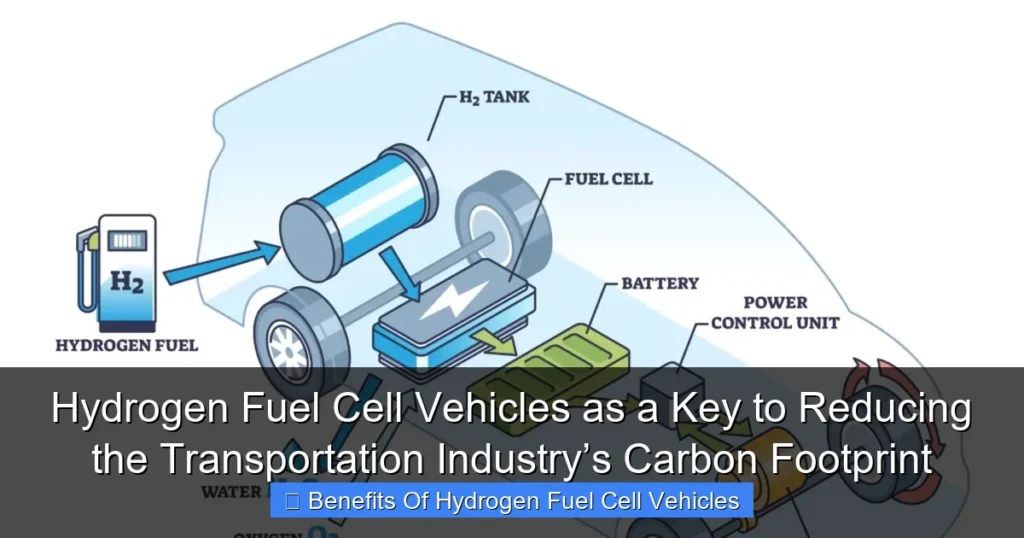
An FCV’s heart is a fuel cell stack: stacks of thin membranes that combine hydrogen (H₂) and oxygen (O₂) from air to produce electricity, heat, and water vapor. No combustion means no pollution. Here’s the step-by-step:
- H₂ Supply: Stored in high-pressure tanks (700 bar).
- Electrolysis: Hydrogen ions pass through a proton-exchange membrane (PEM) to cathode.
- Electricity Generation: Oxygen electrons flow through an external circuit, powering the motor.
- Waste Output: Only H₂O exits the tailpipe.
1. Zero-Emission Driving: The Carbon-Free Promise
Eliminating Tailpipe Pollution
Traditional ICE vehicles emit ~4.6 metric tons of CO₂ per year per car (EPA data). FCVs? None. Even if hydrogen comes from fossil fuels (e.g., steam methane reforming), captured emissions during production can offset lifecycle impacts. For example:
- Green Hydrogen: Produced via renewable-powered electrolysis emits < 1 gCO₂/km.
- Blue Hydrogen: With CCS, cuts emissions by 90% vs. gasoline.
Tip: When paired with solar/wind farms for H₂ production, FCVs achieve true net-zero status.
Health Benefits Beyond Climate
Beyond CO₂, FCVs eliminate harmful pollutants like nitrogen oxides (NOx) and particulate matter (PM). In cities like Tokyo, FC buses reduced PM2.5 levels by 20% in pilot zones. Cleaner air = fewer respiratory diseases and healthcare savings.
2. Range & Refueling: Solving EV’s Biggest Pain Points
Long-Distance Friendliness
Range anxiety is a top EV concern. FCVs outperform BEVs here:
| Vehicle Type | Avg. Range | Refuel Time |
| BEV (Tesla Model 3) | 350 miles | 30–40 mins |
| FCV (Toyota Mirai) | 402 miles | 3–5 mins |
For truckers hauling cargo across continents, FCVs mean less downtime and more revenue-generating miles.
Infrastructure Gaps & Solutions
As of 2023, there are ~1,200 public H₂ stations globally (vs. ~170,000 EV chargers). But governments are scaling up:
- Germany: Aiming for 400+ H₂ stations by 2026.
- California:$2 billion allocated to build 200+ stations.
Companies like Air Liquide and Shell are partnering with automakers to deploy “hub-and-spoke” networks near highways.
3. Versatility: From Cars to Trucks to Ships
Heavy-Duty Transport
Batteries struggle with weight-for-range ratios. FCVs excel:
- Nikola Tre Truck: Targets 800-mile range with 10-minute refueling.
- Hyundai XCIENT: Used in Swiss postal services since 2022.
Shipping companies like Maersk are piloting H₂-fueled container ships to replace diesel.
Public Transit
FC buses dominate in Europe and Japan:
- London: 200+ FC buses on routes since 2018.
- Tokyo: Over 1,000 FC buses in operation.
They’re quieter and require less maintenance than diesels.
4. Hydrogen Production: Green vs. Gray
Breaking Down Methods
Not all hydrogen is equal:
- Green H₂: Electrolysis powered by renewables (ideal but costly).
- Blue H₂: Natural gas + carbon capture (cheaper but not zero-emission).
- Gray H₂: Steam methane reforming (most common but high CO₂ output).
Pro Tip: Pairing wind/solar farms with H₂ plants creates circular systems (e.g., excess power makes H₂; H₂ powers backup turbines).
Cost Trends
Green H₂ prices fell 60% since 2020 ($4.50/kg to $1.80/kg). By 2030, analysts predict <$1/kg—competitive with diesel.
5. Challenges & How They’re Being Addressed
High Upfront Costs
FCVs are 2–3× pricier than comparable BEVs due to fuel cells. Solutions:
- Economies of Scale: Hyundai’s 2025 FCV cost target: $50/kW (down from $150/kW today).
- Incentives: U.S. Inflation Reduction Act offers $3,500 tax credits for H₂ vehicles.
Energy Losses in Production
Hydrogen production loses ~30% energy to compression/transport. Innovations:
- Mobile Compression: On-site compressors at filling stations.
- Pipeline Integration: Using existing gas pipelines for H₂ transport.
Conclusion: The Future Is Hybrid
FCVs aren’t a silver bullet but a vital tool in decarbonizing transport. Their strengths—zero emissions, fast refueling, scalability for heavy goods—complement BEVs. As green hydrogen becomes cheaper and infrastructure grows, expect FCVs to leap from niche to mainstream. The key? Policy support, tech innovation, and public-private collaboration. The road to net-zero isn’t one-way—it’s a highway where every vehicle type has a role to play.
—
Quick Q&A
Question 1?
Are FCVs truly zero-emission? Yes! Only water vapor is emitted, provided hydrogen is green or blue. Gray H₂ still has upstream emissions.
Question 2?
How much faster is FCV refueling than charging an EV? FCVs take 3–5 minutes vs. 30–40 minutes for BEVs—critical for fleets.
Question 3?
Can FCVs work in cold climates? PEM fuel cells perform well below freezing, though some models have pre-heating systems.
Question 4?
Is green hydrogen available now? Limited, but projects like Australia’s Asia-Pacific Hydrogen Hub aim for 1 million tons/year by 2030.
Question 5?
Do FCVs require rare materials? Yes, platinum catalysts are used, but researchers are finding alternatives like iron-nickel alloys.
Frequently Asked Questions
What’s the difference between green and blue hydrogen?
Green H₂ uses renewables for electrolysis (zero emissions); blue H₂ uses natural gas with carbon capture (lower emissions).
How far can FCVs travel on a tank?
Current leaders like the Toyota Mirai hit 400+ miles; heavy-duty FC trucks target 800+ miles.
Are FCVs safer than EVs?
Hydrogen is lighter than air and dissipates quickly, while lithium-ion fires riskier. Both require training for handlers.
When will FCVs become affordable?
By 2030, experts project parity with gasoline cars as costs drop for both H₂ and fuel cells.
Can hydrogen come from waste?
Yes! Biomass gasification and landfill gas can produce H₂, but scalability is limited compared to renewables.
This is a comprehensive guide about Hydrogen fuel cell vehicles as a key to reducing the transportation industry’s carbon footprint.
Key Takeaways
- Understanding Hydrogen fuel cell vehicles as a key to reducing the transportation industry’s carbon footprint: Provides essential knowledge
Quick Answers to Common Questions
What is Hydrogen fuel cell vehicles as a key to reducing the transportation industry’s carbon footprint?
Hydrogen fuel cell vehicles as a key to reducing the transportation industry’s carbon footprint refers to essential knowledge and techniques.
Frequently Asked Questions
What is Hydrogen fuel cell vehicles as a key to reducing the transportation industry’s carbon footprint?
Hydrogen fuel cell vehicles as a key to reducing the transportation industry’s carbon footprint is an important topic with many practical applications.