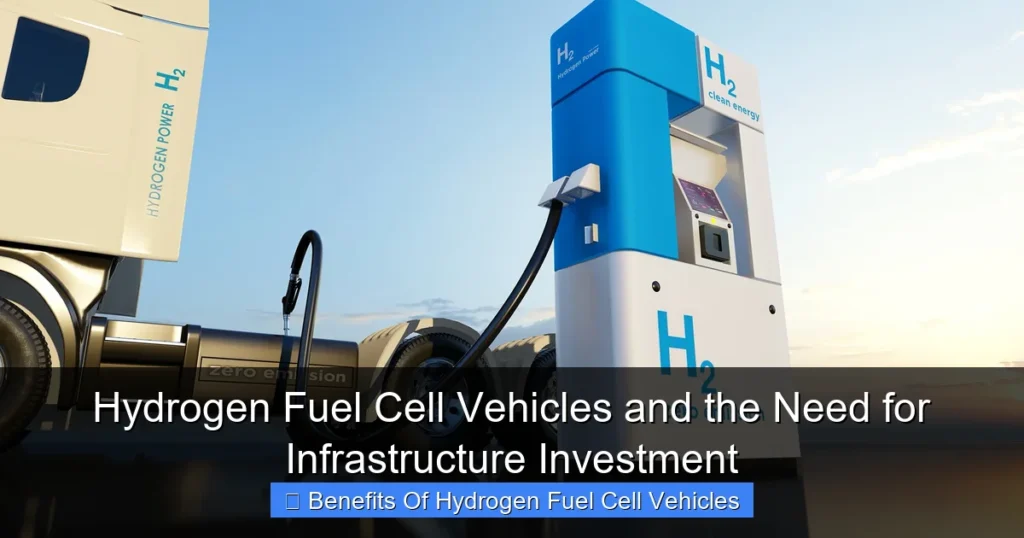
Hydrogen fuel cell vehicles offer zero-emission driving, fast refueling, and long range, making them a promising alternative to electric cars—but widespread adoption hinges on robust infrastructure investment. Without enough hydrogen stations, supply chains, and policy support, FCVs can’t reach their full potential as a climate solution.
This is a comprehensive guide about Hydrogen fuel cell vehicles and the need for infrastructure investment.
Key Takeaways
- Zero emissions: FCVs emit only water vapor, reducing urban air pollution compared to fossil fuel cars.
- Fast refueling: Refill in minutes (vs. hours for EVs), appealing to drivers who prioritize convenience.
- Infrastructure gap: Current global hydrogen stations (~1,000+) are far fewer than EV chargers, limiting FCV adoption.
- Policy matters: Governments must incentivize hydrogen production, storage, and distribution networks.
- Cost barriers: Hydrogen production (especially green H₂) remains expensive; scaling economies are needed.
- Industry collaboration: Automakers, energy firms, and cities must work together to build seamless systems.
—
[FEATURED_IMAGE_PLACEHOLDER]
# Hydrogen Fuel Cell Vehicles and the Need for Infrastructure Investment
## Introduction: The Promise of FCVs
Imagine a car that never runs out of gas in 5 minutes, emits nothing but water, and can go 400 miles on a single tank—that’s the promise of hydrogen fuel cell vehicles (FCVs). Companies like Toyota (Mirai), Hyundai (Nexo), and Honda have already brought these vehicles to market, proving they’re not just futuristic concepts. But here’s the catch: without the right infrastructure, FCVs will stay niche. Just as electric cars struggled without widespread charging stations early on, FCVs need a massive push in hydrogen production, distribution, and refueling networks.
This article breaks down why infrastructure investment isn’t optional—it’s the backbone of FCV success. We’ll explore the technology, current challenges, real-world examples, and actionable steps to accelerate adoption.
## Why Hydrogen? Advantages Over Traditional Cars
###
Zero Emissions
Unlike gasoline or diesel engines, FCVs produce no CO₂, NOx, or particulate matter during operation. Their only byproduct is water vapor from the hydrogen-oxygen reaction in the fuel cell stack. This makes them ideal for cities aiming to cut smog and meet climate goals.
*Example:* In California, FCVs like the Toyota Mirai help reduce tailpipe emissions in heavy-duty fleets (e.g., delivery trucks).
###
Long Range & Fast Refueling
Most FCVs offer ranges of 300–400 miles, rivaling conventional cars. Refueling takes 3–5 minutes (vs. 30+ minutes for most EVs), addressing one of the biggest pain points for drivers.
*Tip:* For long-haul trucking, FCVs excel because they don’t need frequent stops—critical for logistics companies.
## The Infrastructure Gap: Where Do We Stand Today?
As of 2023, there are roughly 1,000 hydrogen stations worldwide, with Japan, Germany, and the U.S. leading the charge. Yet, this pales in comparison to over 2 million public EV charging ports. Here’s what’s missing:
###
Limited Production Capacity
Most hydrogen today comes from steam methane reforming (SMR), which relies on natural gas and emits CO₂. “Green hydrogen” (made via electrolysis using renewables) is rare due to high costs ($3–6/kg vs. $1–2/kg for SMR).
###
Challenges in Distribution
Hydrogen requires high-pressure tanks (700 bar) or cryogenic transport (-253°C), demanding specialized pipelines and trucks. Building these is slow and expensive.
*Fact:* The U.S. has only about 50 hydrogen stations, while Europe aims for 1,000 by 2030.
## Policy Plays a Pivotal Role
Governments must act as catalysts:
###
Subsidies & Tax Credits
Countries like South Korea and Canada offer incentives for FCV purchases and hydrogen station development. The U.S. Inflation Reduction Act allocates $8 billion for clean hydrogen projects.
###
Public-Private Partnerships
Collaboration between automakers, energy giants (e.g., Shell, Linde), and local governments can speed up deployment.
*Example:* Tokyo’s 2020 Olympics spurred FCV adoption with temporary hydrogen stations, now permanent hubs.
## How Cities Can Lead the Charge
Urban areas are perfect testbeds for FCVs due to pollution concerns. Strategies include:
###
Fleets First Approach
Transit buses, garbage trucks, and municipal vehicles are early adopters.
– Case Study: London’s Hydrogen Buses (operated by Arriva) cut emissions by 99%.
###
Zoning & Land Use
Designate zones for hydrogen production hubs near renewable energy sources (e.g., wind farms).
## The Road Ahead: What’s Next?
To hit net-zero targets, experts recommend:
1. Scaling green hydrogen: Invest in cheaper electrolyzers and renewable energy.
2. Standardization: Agree on universal hydrogen storage/refueling tech across brands.
3. Consumer education: Highlight FCVs’ cost savings (fuel is ~$10/day for a 40-mile commute vs. $15 for EVs in some regions).
*Tip:* Follow initiatives like the World Hydrogen Council’s roadmap, which sets 2030 targets for 10 million FCVs globally.
## Conclusion: A Win-Win for Environment and Economy
Hydrogen fuel cell vehicles aren’t just an option—they’re a necessity for decarbonizing transport. But without infrastructure, they’ll remain stuck in limbo. By investing now in production, distribution, and policy, we can unlock a future where FCVs power cleaner cities, create jobs, and reduce reliance on fossil fuels. The time to act is now.
—
### QUICK Q&A
Question 1?
How does hydrogen fuel compare to electricity for cars? Hydrogen offers faster refueling and longer range, while EVs win in upfront cost and grid compatibility.
Question 2?
Why is green hydrogen so expensive? Producing it via electrolysis requires cheap renewable energy (wind/solar) and efficient machines—both still evolving.
Question 3?
Can FCVs work in cold climates? Yes! Modern FCVs handle temperatures as low as -30°F, though battery efficiency drops slightly in extreme cold.
Question 4?
What’s the biggest hurdle for FCV adoption? Infrastructure gaps—stations, supply chains, and consumer awareness.
Question 5?
Are hydrogen stations safer than gas stations? Yes! Hydrogen disperses quickly if leaked, posing lower explosion risks than gasoline vapors.
### FAQs
How much does hydrogen fuel cost per mile?
For FCVs, fuel costs around $0.05–$0.10/mile, depending on location and hydrogen source. EVs typically range from $0.03–$0.12/mile when accounting for home charging.
Do FCVs require special maintenance?
No—FCVs have fewer moving parts than internal combustion engines, reducing maintenance needs. Only occasional checks for fuel cells and hydrogen tanks are required.
Where are the most hydrogen stations located?
Japan (over 160 stations), Germany (100+), and California (50+) lead in density. Europe and Asia are prioritizing FCVs for heavy industry and transport.
Can hydrogen be produced at home?
Not yet. Home-scale hydrogen production lacks safety regulations and cost-effective tech, making centralized plants the norm for now.
Will FCVs replace EVs entirely?
Unlikely. Both will coexist—FCVs excelling in heavy-duty/short-refuel use cases (trucks, buses), while EVs dominate passenger cars due to existing charging infrastructure.
Quick Answers to Common Questions
What is Hydrogen fuel cell vehicles and the need for infrastructure investment?
Hydrogen fuel cell vehicles and the need for infrastructure investment refers to essential knowledge and techniques.
Frequently Asked Questions
What is Hydrogen fuel cell vehicles and the need for infrastructure investment?
Hydrogen fuel cell vehicles and the need for infrastructure investment is an important topic with many practical applications.